Keeping an eye on a neighbor. A German look on Denmark
Bernd Henningsen, Dänemark C H Beck. 2009, 229 pages (From the series: Die Deutschen und ihre Nachbarn)

A scholarly journal from the Centre for Baltic and East European Studies (CBEES) Södertörn University, Stockholm.
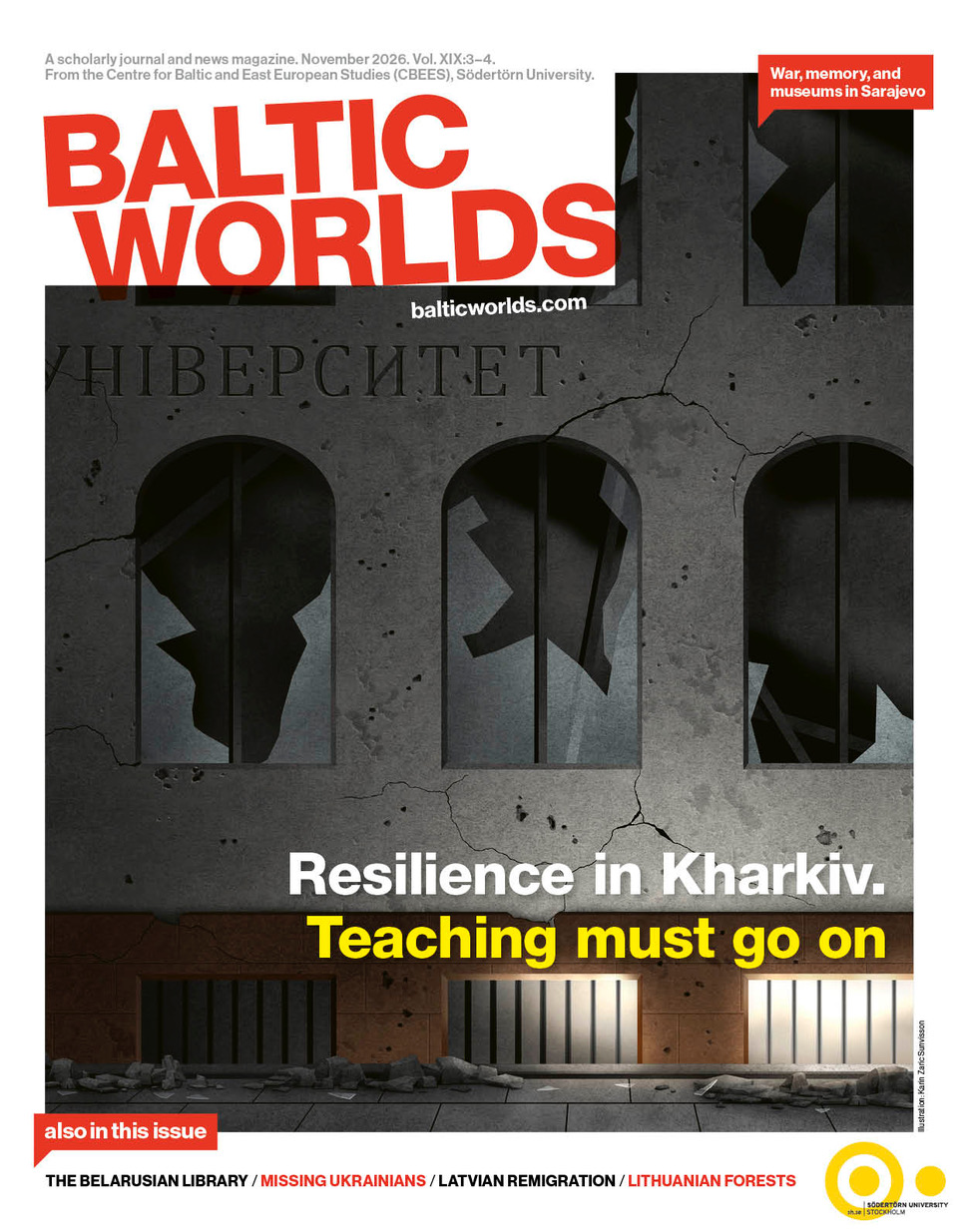 Issue 2026, 3-4: Download.
PhD in international relations; researcher at the Finnish Institute of Foreign Affairs, Helsinki. One of her ongoing research projects is “Russia’s Foreign Policy and the Quest for Leadership in the Eurasian Economic Space (2011–2013)”.
Bernd Henningsen, Dänemark C H Beck. 2009, 229 pages (From the series: Die Deutschen und ihre Nachbarn)
Einar Maseng, Utsikt over de nord-europeiske staters utenrikespolitikk i de siste århundrer [An overview of the Northern European States’ foreign policy during the last centuries]. I–III Oslo: Universitets-forlaget 2005: 323, 291, 353 pages
The Fourth Stakeholders’ meeting gathered more than 400 delegates from government, industry, and labor, as well as consumer, environmental, health, and animal welfare groups and non-governmental organizations. The hottest discussion focused on the issue of information sharing.
Working-class neighborhoods in post-communist countries have often been depicted as unable to adapt to the new economic situation. Stefan Bouzarovski has studied urban development and reached the conclusion that residents in working-class areas may, in fact, display considerable resilience and adaptability to the new housing market. One coping mechanism has been to enlarge apartments by building so-called vertical building extensions.
+ Oddmund Løkensgard Hoel, Målreising og modernisering i Noreg 1885–1940, [The New Language Movement and Modernization in Norway 1885–1940], Trondheim: Noreg’s University of Science and Technology, NTNU, 2009, 589 pages
+ Michail Kasianov, Bez Putina: Politicheskiye dialogi s Yevgenyem Kiselyovym, [Without Putin: Political Dialogues with Yevgeny Kiselyov] Moscow: Novaya gazeta 2009, 320 pages
+ Estonian Life Stories, Edited and translated by Tiina Kirss, Compiled by Rutt Hinrikus Budapest: Central European University Press 2009, 539 pages
+ Julia Obertreis & Anke Stephen (eds.) Erinnerungen nach der Wende: Oral History und (post)sozialistische Gesellschaften, Essen: Klartext Verlag 2009, 401 pages.
In this interview professor Birgitta Almgren discusses her study on Nazi-German infiltration in Sweden and the offshoots, in Cold War Sweden, of the GDR’s policies. She is now requesting that the Swedish law courts make it possible for her to continue her research by granting her access to the so-called Rosenholz files. In a comment professor Åmark argues for a release of the Stasi-material.
On the changes in suicide rates in Eastern Europe after the transformations of 1990. Here, a large number of individual studies are summarized, and the results are compared with previous research on transitional societies undergoing rapid change.