Agnes Käll (143) Inside the compliance puzzle: Dilemmas of supervisory agencies in anti-money laundering
Abstract [en] This thesis unpacks the empirical puzzle that banks suspected of involvement in money laundering may nevertheless be deemed […]

A scholarly journal from the Centre for Baltic and East European Studies (CBEES) Södertörn University, Stockholm.
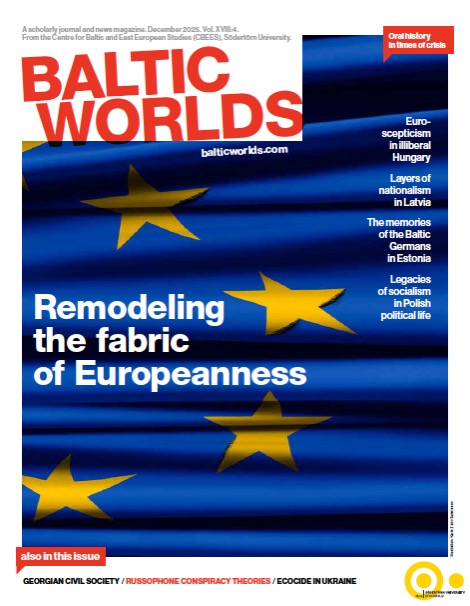 Issue 2025, 4: Download.
PhD in international relations; researcher at the Finnish Institute of Foreign Affairs, Helsinki. One of her ongoing research projects is “Russia’s Foreign Policy and the Quest for Leadership in the Eurasian Economic Space (2011–2013)”.
Abstract [en] This thesis unpacks the empirical puzzle that banks suspected of involvement in money laundering may nevertheless be deemed […]
Abstract [en] This thesis argues that the Baltic Sea region was shaped intellectually, politically and geographically during the period 1914–1945. […]
Abstract [en] We, the Expelled is a study of historical experiences communicated by the Polish Jews who came to Sweden as […]
Abstract [en] Since its inception in the late 1980s, the Turkish black metal scene has gone through significant changes. Whereas […]
Abstract [en] Over the course of the past century, European agriculture has transitioned from small-scale, manual farming to more mechanised, […]
The international conference “Russia Through the Eyes of Its Neighbours: The Ongoing War and Regional Security” which was held in Stockholm on September 18–19, 2025, brought together leading scholars and policy experts from across Europe, providing a platform to assess how Russia’s ongoing war against Ukraine continues to reshape the geopolitical and security landscape of the region.
Yurii Latysh, PhD (Candidate of Historical Sciences), visiting Professor of State University of Londrina (Brazil), deputy editor-in-chief of the journal Historical Expertise (Istoriceskaja Ekspertiza), in a discussion with Denys Kiryukhin on how the Russo-Ukrainian war has affected the politics of memory in Eastern Europe.
That music may connect well with violence contradicts common understandings of music being a force of good which brings people together. While acknowledging that music can harmonize social relations, this special issue highlights the idea that music can equally justify war and ignite conflicts. Exploring music from such a matter-of-fact viewpoint shifts scholarly attention to the relationship between music, politics, and societal dynamics. This special issue does so in the context of Russia’s war on Ukraine.
This essay, based on broader research on independent radio stations from Kyiv, Gasoline Radio and 20ft Radio, and an independent label, Shukai, looks at how these sound media can engage with cultural history and offer different ways to think about archiving. Through applying Diana Taylor’s use of repertoire to three specific sound examples (a radio show, an installation, and a record), I argue that these alternative sound media formats allow an open and dynamic reading of cultural works of the past. The role practitioners seem to take up is to look for and fill gaps they see in mainstream public discourse in relation to Ukrainian music, culture, and sound media history. Listening for the missing knowledge from the past allows the audience to attune it with imaginations of the future.
This research note investigates the revival of Ukrainian folk music in the (re)invented military funeral rituals during the ongoing war on Ukraine. Since the 2022 full-scale invasion, elements of folk music – such as historical Cossack songs, the Carpathian trembita, and lullabies – have re-emerged in urban civic mourning, symbolizing national grief, resistance, and identity. Drawing on concepts of revival, postrevival, and (re)invention (Livingston, Bithell & Hill, Hobsbawm, Prickett), the article examines how these musical forms are recontextualized in response to trauma and loss. Through three specific case studies, the article explores how Ukrainian folk music has been adapted to contemporary urban ritual settings and examines its role in shaping symbolic expressions of memory, resilience, and cultural continuity in wartime Ukraine. The study contributes to the broader discourse on the role of music in ritual transformation in the context of war and conflict.