Lia Dostlieva and Andrii Dostliev
Lia Dostlieva is an Ukrainian artist, essayist, cultural anthropologist and researcher at Adam Mickiewicz University in Poznań, Poland. Focusing on trauma, postmemory, commemorative practices, and agency and visibility of vulnerable groups and how to process “difficult knowledge” and “difficult past”.
Andrii Dostliev is an independent Ukrainian artist, curator, and photography researcher currently based in Poland. His primary areas of interest are memory, trauma, identity – both personal and collective, and various aspects of queerness. Works in various media.
view all contributors
Articles by Lia Dostlieva and Andrii Dostliev
-
Discussions about the assessment of historic events have always had their place in the public discourse in democratic societies, whereas totalitarian regimes such as the Communist one preferred an official version of history that is not up for debate. This is why a conflict-prone memory boom in the CEE was to be expected after the fall of the Iron Curtain. The only recently intensified trend is to fight memory wars with the means of memory laws, i.e. by using laws prescribing and proscribing certain representations of historic events as a weapon to protect one’s national collective memory from divergent interpretation by others. Such approach to governing memory wars are detrimental to the neighborly relations, i.e. turning them into un-neighborly ones.
-
This paper seeks to understand how the Catholic Church manages its involvement in gender politics in Lithuania and exerts power. Lithuania signed the Council of Europe Convention on Preventing and Combating Violence against Women and Domestic Violence (the so-called Istanbul Convention) in 2013 but ratification efforts continue to date. The Convention has become a political “hot potato” and caused ideological confrontations. The Catholic Church is here a political actor, leveraging its influence across multiple levels and cycles of the political decision-making process. NGOs have initiated campaigns in attempt to counter the discourse of oppositional conservative and religious political actors.
-
Wine constitutes a corner-stone in the past and present of Armenian and Georgian societies. During the Soviet era, the production, distribution and consumtion of agro-food products, including wine, became elements in the geopolitical organization of food and agri-cultural relations of the USSR and of the Council for Mutual Economic Assistance Reconstruction (after 1965). The Armenian wine industry was restructured and its main focus became the production of sherry, while the Georgian wine industry focused on wine production, most of which was exported to Russia. The wine sector became re-structured, vineyards were collectivized and their management was centralized and a far reaching division of labour was implemented at industry level. This article offers a glimpse of the economic history of wine in Armenia and Georgia between the 1920’s and 1991.
-
Silvia Kučėnaitė Foti it the author of the book The Nazi’s Granddaughter: How I discovered my Grandfather was a War Criminal. After going through major trauma when discovering her grandfather was not the war hero she heard about but a Nazi collaborator, she started to investigate her grandfather’s past. Considering Jewish sources along with the Lithuanian sources Foti questions the Lithuanian official narrative denying any involvement in the Holocaust.
-
Eastern and Central Europe are seeing emigrants returning. The trend for more people to return to their home countries started as a trickle before Brexit and the pandemic — but has grown over the last couple of years. Over the last 30 years the opposite trend has been the rule: Lithuania and Latvia have lost close to 25% of their citizens since 1990; Bulgaria and Romania approximately 20%. In Poland, over two million people have left, primarily to the UK, Germany, France, and Ireland. Of course, over the years, some people have returned, although those leaving have always outnumbered those returning. Until now.
-
The 2021 Duma Elections have confirmed the Kremlin’s increased reliance on repression and manipulation to obtain the desired results. The 2021 elections show the top-down management of Russia’s electoral authoritarianism to be efficient. With electoral outcomes comprehensively managed, Russia’s political system has never before so closely resembled that of Belarus.
-
The participants in the round-table included artists and researchers performing and/or studying art-activism in Belarus, Russia and Kazakhstan. Some of the participants also position themselves as feminist activists. The participants were invited to reflect in advance on several questions that were aimed to create a common ground and inspiration for the participants.
-
What role does Russia play for the contemporary far-right movement? How is Russia perceived “from the outside” (here meaning Eastern Europe)? These questions were discussed in the online roundtable on June 10, “Invitation: Russia from the Outside: The European Far Right looks East, 1991-2021” with four speakers who shared the views of Russia from their own national contexts in from Ukraine, Slovakia and Poland.
-
The roundtable “Inheriting the Pandora Box: Environmental Impacts of the Soviet Industrial Legacy”, explored the relevance of the Soviet environmental legacy for the way we as a society understand our relationship to the environment today.
-
“Inheriting the Pandora Box: Environmental Impacts of the Soviet Industrial Legacy”, was a Roundtable arranged May 26, 2021, at the Centre for Baltic and East European Studies at Södertörn University. Here follows a brief summary of the event from the social studies' perspectives, while a longer report from the environmental studies' perspectives also can be found at this website.
-

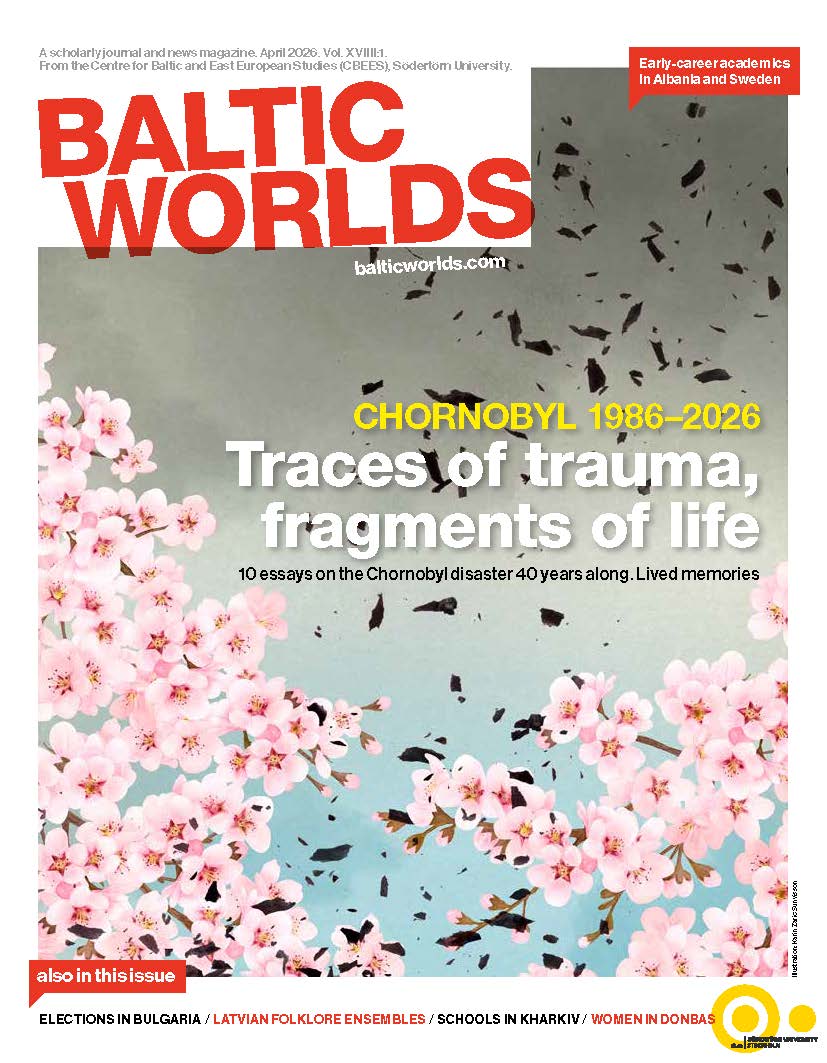 Issue 2026, 1: