Lia Dostlieva and Andrii Dostliev
Lia Dostlieva is an Ukrainian artist, essayist, cultural anthropologist and researcher at Adam Mickiewicz University in Poznań, Poland. Focusing on trauma, postmemory, commemorative practices, and agency and visibility of vulnerable groups and how to process “difficult knowledge” and “difficult past”.
Andrii Dostliev is an independent Ukrainian artist, curator, and photography researcher currently based in Poland. His primary areas of interest are memory, trauma, identity – both personal and collective, and various aspects of queerness. Works in various media.
view all contributors
Articles by Lia Dostlieva and Andrii Dostliev
-
After five months of struggling and political crisis following the general elections in December 2016, Macedonia is finally getting a government. These fourth consecutive early elections were supposed to be a fresh restart and a means to overcome a longer period of deepening political crisis. But the effect was rather the opposite: the governing party lost the elections and have ever since done their utmost to prevent handing over power.
-
On April 2, Armenia held its first parliamentary election with the newly adopted constitution, transforming the country from a presidential to a parliamentary republic. In short the change transfers the substantial executive power from the presidential office to the prime minister and the parliament. The elections have widely been regarded as an important test of the democracy in Armenia.
-
Baltic Worlds invites you to support CEU with its long-held reputation as a center of innovation, academic excellence and scientific inquiry.
-
On 12 February 2017, the president of Turkmenistan, Gurbanguly Berdymukhamedov, won a predictably handsome presidential election victory with a margin of 97.7% and an impressive turnout of 97.28%. At first sight it might seem like just another Soviet-style election, with a solitary contender predestined to win a plebiscitary type contest. During this election, however, the Turkmen political elite constructed a facade of pluralism by running an unprecedented nine candidates representing three political parties.
-
This special theme focuses on the relation between realism and social or socialist realism from different angles and with examples from different countries. It consists of contributions from eight scholars who took part in the workshop: Sven-Olov Wallenstein, Karin Grelz, Aleksei Semenenko, Susanna Witt, Marcia Sá Cavalcante Schuback, Epp Lankots, and Charlotte Bydler and Dan Karlholm.
-
East and Central European History Writing in Exile 1939–1989, Editors: Maria Zadencka, Andrejs Plakans, Andreas Lawaty Brill Rodopi: 2015, 433 pages.
-
The Barents Region: A Transnational History of Subarctic Northern Europe, Chief editor Lars Elenius. PaxForlag, Oslo, 2015, 518 pages.
-
Solidarity in Struggle: Feminist Perspectives on Neo-liberalism in East-Central Europe, EszterKováts (ed.), Friedrich-Ebert-Stiftung, 2016,115 pages
-
The Russian welfare state has undergone deep structural transformations during the last twenty-five years. The aim of the 16th Annual […]
-
How the realist approach during the years around 1970 played out in the force field of society and the psyche, the collective realm and the individual, is exemplified by our two very different Swedish case studies. Svedberg’s political narratives compose montages in which fictional, metaphorical figures are inserted side by side with political leaders drawn from newspaper clips. Kåks’s allegory-like oil painting shows a stone worker working in the face of his imminent disappearance. They both reveal myths as opposed to historically manifested commodity relations.
-

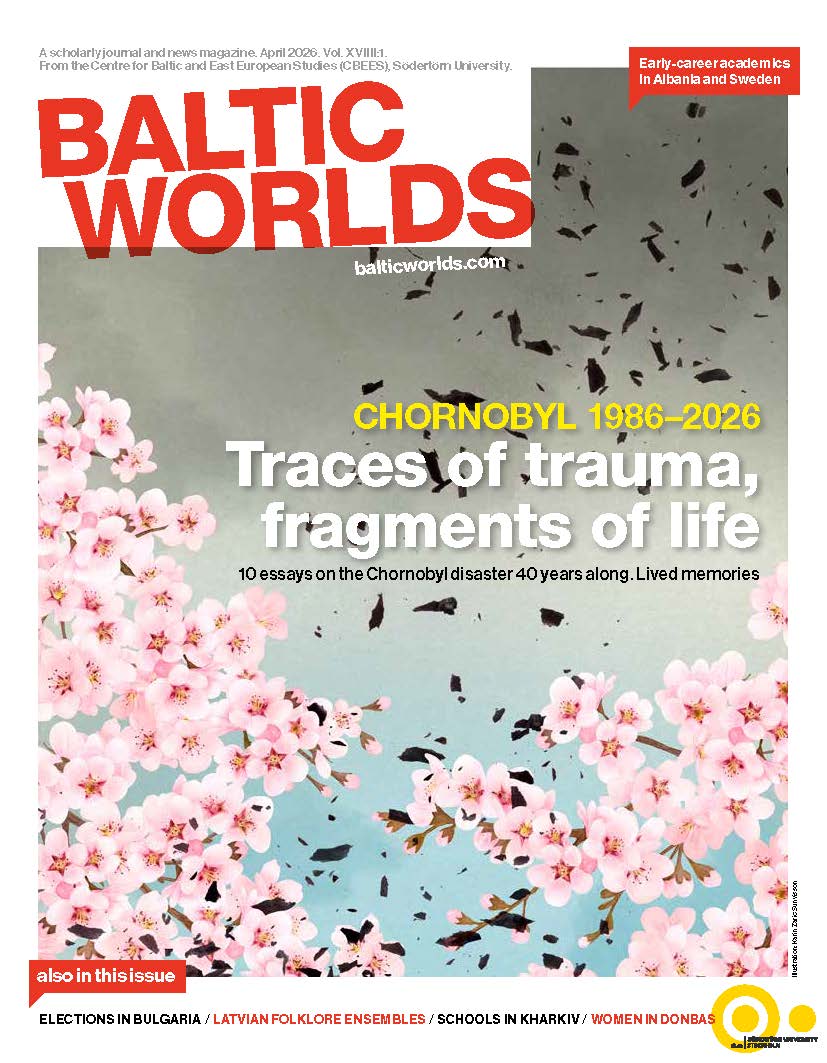 Issue 2026, 1: