Lia Dostlieva and Andrii Dostliev
Lia Dostlieva is an Ukrainian artist, essayist, cultural anthropologist and researcher at Adam Mickiewicz University in Poznań, Poland. Focusing on trauma, postmemory, commemorative practices, and agency and visibility of vulnerable groups and how to process “difficult knowledge” and “difficult past”.
Andrii Dostliev is an independent Ukrainian artist, curator, and photography researcher currently based in Poland. His primary areas of interest are memory, trauma, identity – both personal and collective, and various aspects of queerness. Works in various media.
view all contributors
Articles by Lia Dostlieva and Andrii Dostliev
-
The article addresses the issue of the business climate in Russia from the Swedish investors’ perspective and relates it to a general theoretical debate in the field. Statistical test suggests that the majority of variables relating to the business climate has deteriorated between 2012 and 2014.
-
The study is based on qualitative interviews in small towns and villages in four Russian regions. Actions by local inhabitants, organizations and local administrations are studied. The relation between agency and local development is discussed.
-
"Business is not particulary concerned with democratic values, but rather with the existence of stable rules of the game and secured property rights for investors, says professor Andrei Yakovlev, head of the Institute for Industrial and Market Studies at the higher School of Economics in Moscow.
-
This article discusses the reaction of the EU member-states to Russia’s 2014 military conflict with Ukraine. The European countries’ lack of united response and unwillingness to apply severe sanctions (restrictive measures) on Russia in a timely manner is attributed to a constellation of interests of the European countries and Russia in the European energy market.
-
In assessing intersectional sensitivity of the three NGOs here examined, one can conclude that all three identify the crucial interrelatedness of social marginalization with other marginalizing mechanisms. CfCf elaborates the intersection between ethnicity and social differentiation, where the main focus is on majority society’s institutional discrimination examined in the context of school segregation.
-
Each year Mission Siberia sends 15 young Lithuanians to Siberia and other areas in the former Soviet Union where Lithuanians were deported. They search for traces that Lithuanians left behind and tidy up cemeteries where Lithuanians are buried. But most of all they go to meet Lithuanians — and their children and grandchildren — who decided to stay even after it was possible to return in the 1950s.
-
It’s not always that the departure of someone whom we have a professional relationship with leaves a physical sense […]
-
The escalation around Ukraine calls for a larger historical re-assessment of social change in Eastern Europe – and indeed of the European project at large. The current moment of historical re-assessment requires a full-fledged competitor to liberal theory.
-
Whatever might be said of pop art techniques and art-historical discourses used in Hungary, and later in Estonia, (and less frequently in other countries), one would be hard-pressed to say that the 1960s was an era of pop in the region, especially one with North American influences. Why then?
-
Poet, essayist, film critic, journalist, feminist activist, researcher at Polish Academy of Science, literary researcher at Jewish Historical Institute and lecturer in gender studies at Warsaw University — Bożena Keff’s professional career is as multifaceted as it is interdisciplinary, and her interests impressively manifold.
-

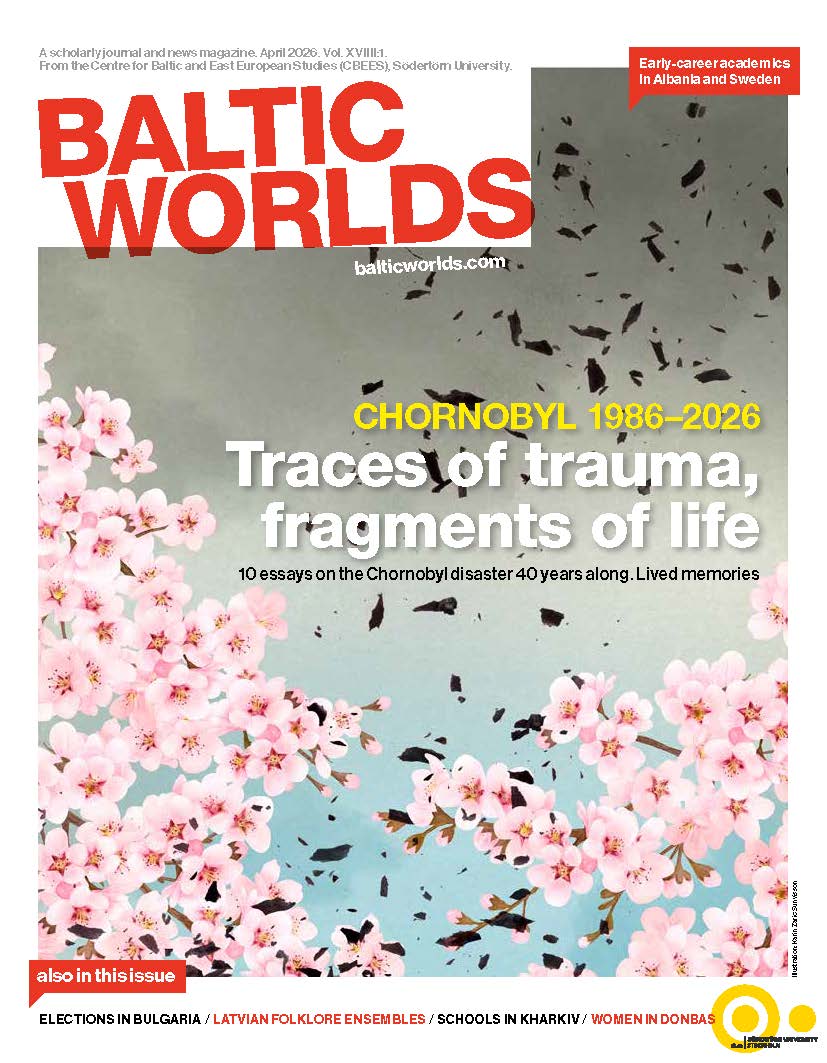 Issue 2026, 1: