Shalamov rediscovered: when a poet writes prose
The shift from a primary focus on Shalamov’s prose to a more comprehensive approach which includes his poetic, biographic, and dramatic works informed the conference throughout its three days.

A scholarly journal from the Centre for Baltic and East European Studies (CBEES) Södertörn University, Stockholm.
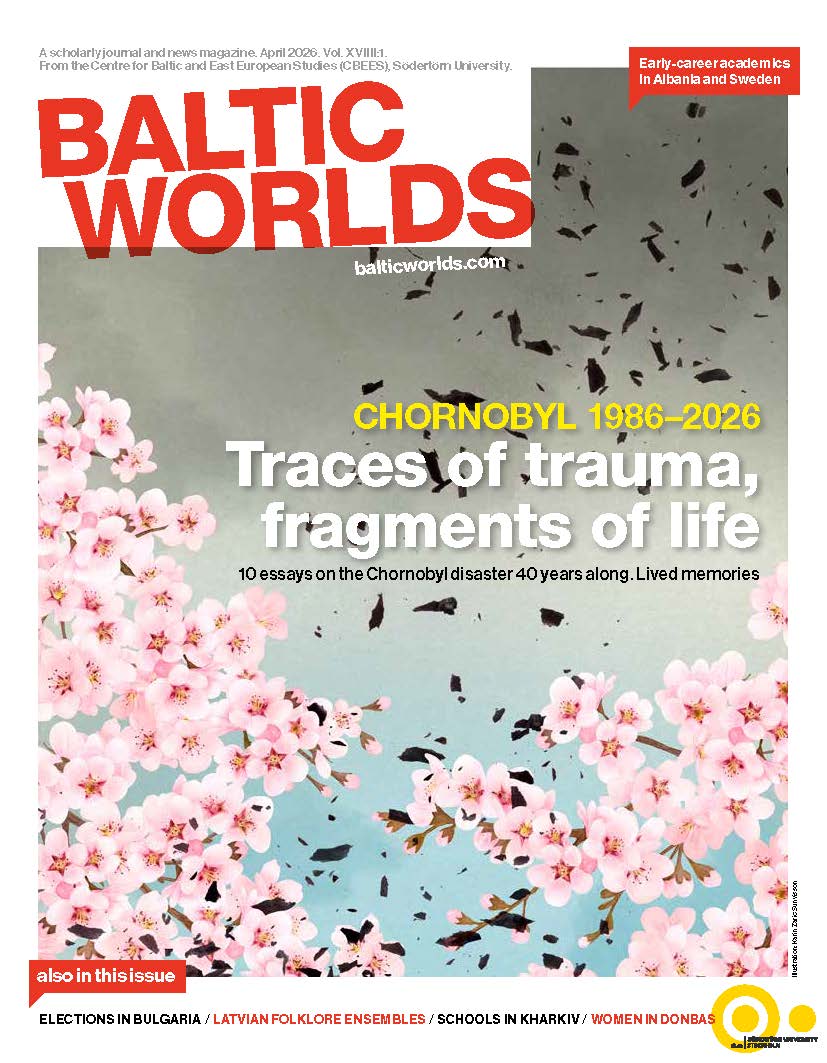 Issue 2026, 1: Download.
Lia Dostlieva is an Ukrainian artist, essayist, cultural anthropologist and researcher at Adam Mickiewicz University in Poznań, Poland. Focusing on trauma, postmemory, commemorative practices, and agency and visibility of vulnerable groups and how to process “difficult knowledge” and “difficult past”.
Andrii Dostliev is an independent Ukrainian artist, curator, and photography researcher currently based in Poland. His primary areas of interest are memory, trauma, identity – both personal and collective, and various aspects of queerness. Works in various media.
The shift from a primary focus on Shalamov’s prose to a more comprehensive approach which includes his poetic, biographic, and dramatic works informed the conference throughout its three days.
In her book on the East German experiment, The People’s State, Fulbrook launched a concept that owes a lot to her life-long preoccupation with Max Weber’s theories of Herrschaft. She calls it “participatory dictatorship”. An unbelievably large proportion of the population — roughly one in six, she calculated — took an active part in activities that had to be carried out to uphold the political system as such.
The only functioning system for transactions in the Soviet Union was in fact blat, the system of corruption and tacit agreement and alliances among all parties involved in a given transaction, is here argued. The “knowing smile” was a shared signal for those in the system.
In Armenia, Azerbaijan, and Georgia an extended transition period is taking place, monitored and orchestrated by the European Council. Here it is investigated how to understand long-term interference of the international community in the affairs of states that strive to be recognized as democratic.
The postcommunist concept of transition, as it was in use during the 1990s and early 2000s, is analyzed from the viewpoint of its intellectual prehistory. The concept is partly contrasted with alternative notions, partly relocated to its antithesis of communist ideology, where “transition” actually was an established concept. The reconstruction of the dialectics between communist and postcommunist transitology indicates and responds to a need for historical reflexivity, argues the author here.
The belief in technology was fundamental in Soviet culture. When the nuclear reactor exploded and harvested souls and spread illness throughout a vast area, over the course of many years, an image of the collapse of the Soviet Union was thereby created. Chernobyl became an image of the apocalypse of communism.
BECAUSE OF THE direct Russian intervention, the territorial integrity and independence of the Ukrainian state is at stake. But as long as business and politics are as intimately intertwined as they are today, any serious reform in Ukraine in line with the ideological foundation of the protest movement will be a an exceptionally challenging task.
It is difficult to identify why Maidan took a violent, military turn. Among the main possible reasons we might first note the inability of three opposition leaders (namely Vitaliy Klychko, Arseniy Yatsenyuk, and Oleh Tyahnybok) to settle on just one Maidan leader, and the absence of any visible, concrete accession to the demands of the protesters by the authorities.
Irina Sandomirskaja, professor of cultural studies at CBEES, Södertörn University, was awarded the most prestigious Russian prize for literary scholarship, […]
Despite the modest albeit important economic recovery in the past 2–3 years Hungary has a number of challenges that can harm its development already in the short and medium term, and these have hardly been addressed in the campaign. The Orbán-regime mostly plans to carry on with its earlier policies.