A polish heart in Lithuania
Poles in Lithuania are a minority who want to strengthen their identity. They are now demanding to have their names spelled correctly in official records.

A scholarly journal from the Centre for Baltic and East European Studies (CBEES) Södertörn University, Stockholm.
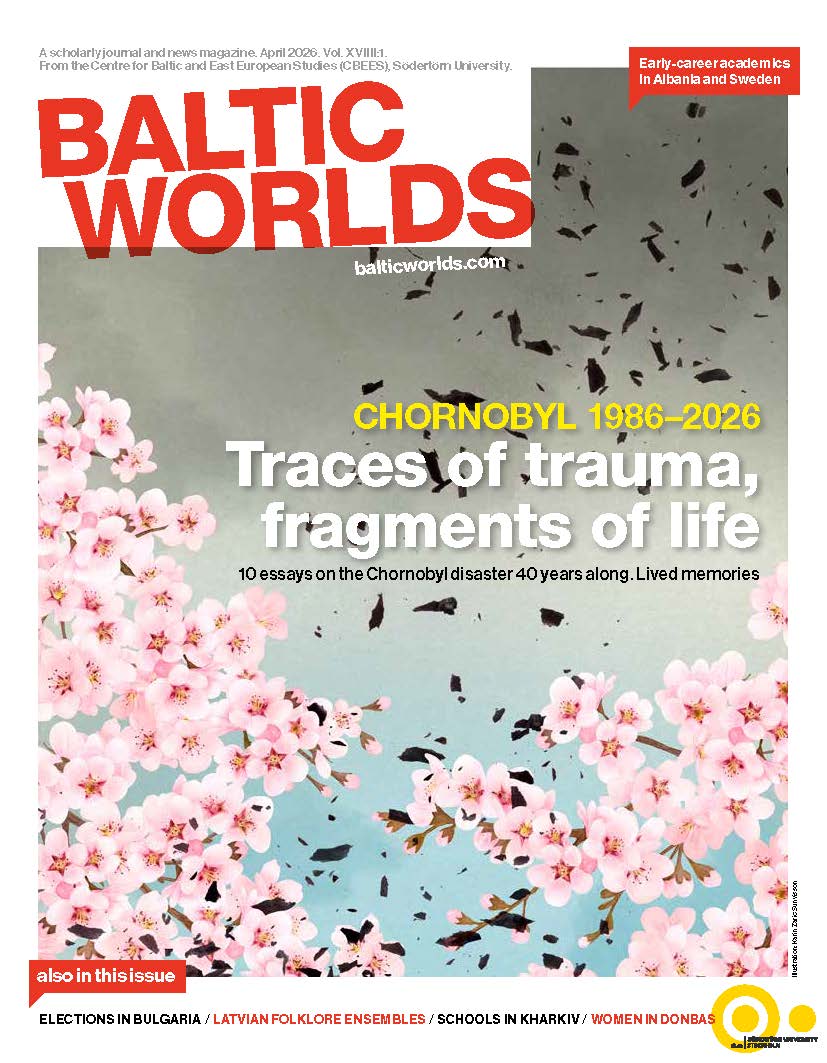 Issue 2026, 1: Download.
Is a Belarusian freelance journalist, photographer and memory researcher temporary based in Berlin as an ICORN Fellow. She is the author of the photobook The Art of (Not) Forgetting (2022) dedicated to the elusive nature of memory and ways to resist it.
Poles in Lithuania are a minority who want to strengthen their identity. They are now demanding to have their names spelled correctly in official records.
Joanna Mizelienska, lecturer in gender and queer studies, argues that it is difficult to apply queer theory in Poland. Can one speak of constructed sexual identities where gay rights are disregarded or violated?
Conor O'Dwyer, professor of political science, talks about a backlash at the political level also. Sexual minorities in Poland and Latvia have had their rights restricted following EU accession.
The passing of a homophobic law 2009 threw the spotlight on the difficult situation faced by the homosexual community in Lithuania.
Cultural historian Karl Schlögel reflects on what sort of components create a geographic space. Interpretations of what took place and what is taking place always occur in a spatial context.
Historian Mats Fridlund says that the technological and scientific development of weapons has influenced the choice of method and the type of people who have become perpetrators. When the revolver became smaller and lighter, female terrorists became more common.
Annual meeting in Narva of translators and writers from countries around the Baltic Sea. Meetings, exchanges of experience – which are the cultural common denominators and where are the barriers?
Latvia’s deep economic down-turn has brought about a historical political change. A left-wing party has won an election and come to power in Riga. The local party is dominated by ethnic Russian politicians.
Many migrate from poor regions of Europe to the richer regions. In the richer regions, there is a need for workers to fill low-paid jobs on the black market.
Narva is the EU’s port to Russia. Here, Swedes, Germans, Russians, and Estonians have had their interests. Today, the official language is Estonian and it is difficult for the Russian minority to obtain citizenship.