Shipwreckin’ in the Baltic
The Baltic Sea is difficult to navigate, through the ages many vessels have been wrecked. Marine archaeologists tell us about discoveries of ships and the difficulties involved in preserving the wrecks on land.

A scholarly journal from the Centre for Baltic and East European Studies (CBEES) Södertörn University, Stockholm.
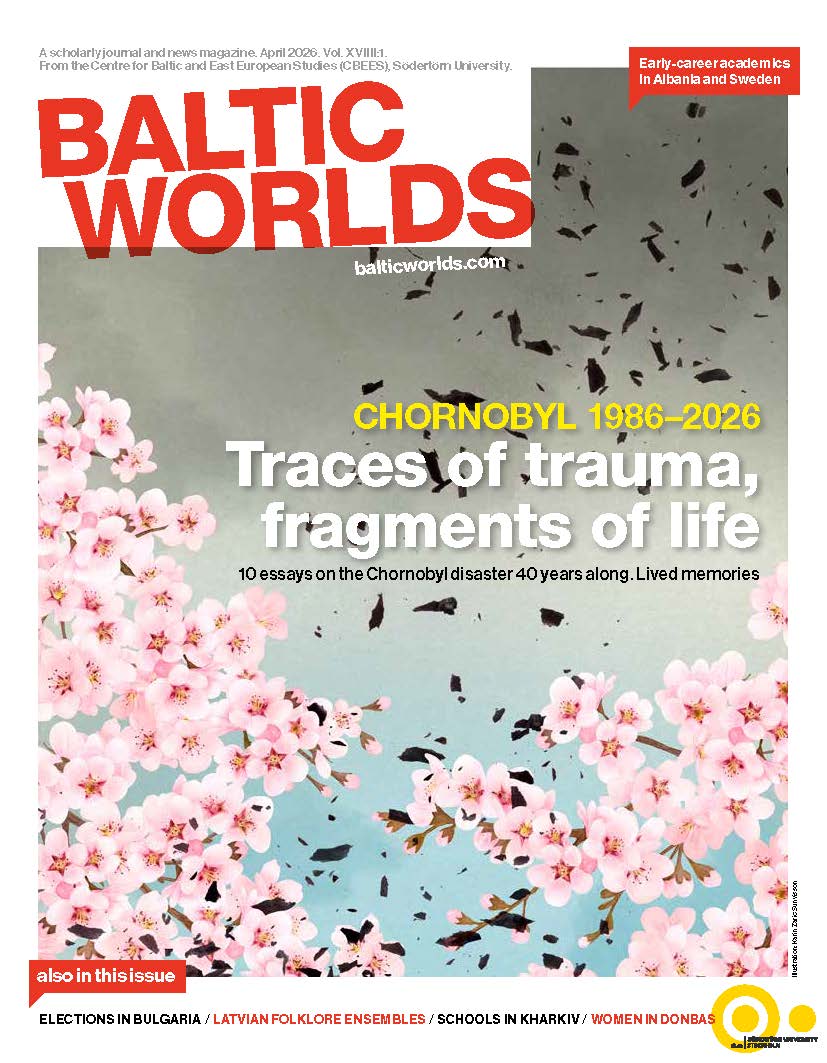 Issue 2026, 1: Download.
Is a Belarusian freelance journalist, photographer and memory researcher temporary based in Berlin as an ICORN Fellow. She is the author of the photobook The Art of (Not) Forgetting (2022) dedicated to the elusive nature of memory and ways to resist it.
The Baltic Sea is difficult to navigate, through the ages many vessels have been wrecked. Marine archaeologists tell us about discoveries of ships and the difficulties involved in preserving the wrecks on land.
The historian Marta Reuter conducts research on how concepts are created and filled with meaning. NGOs are thought to stand for democratic values, but the Hell’s Angels are also elements of civil society.
European Humanities University, EHU, is a Belarusian university in exile that educates Belarusians in an academic environment that encourages the development of independent views. Students run the risk of arrest and interrogation by the Belarusian police. Some can no longer return to Belarus during school breaks.
+ Katarina Wikars Jan Jörnmark. Atomtorg, porrharar och Hitlerslussar: 160 genom Baltikum. [Atomic Square, Porn Bunnies, and Hitler Floodgates] Lund: Historiska Media 2009. 192 pages.
+ Piotr Wawrzeniuk (ed.) Societal Change and Ideological Formation among the Rural Population of the Baltic Area 1880—1939 Studia Baltica II:2, Södertörn University, Stockholm 2008, 206 pages.
+ Lennart Samuelson (ed.) Bönder och bolsjeviker: Den ryska landsbygdens historia 1902—1939 [Peasants and Bolsheviks: The History of the Russian Countryside 1902—1939] The Economic Research Institute, Stockholm School of Economics (EFI) 2007. 271 pages.
In the fall of 2009, Uncivil Society: 1989 and the Implosion of the Communist Establishment by Stephen Kotkin was published. The book offers a new interpretation of the causes behind the Eastern European collapse of 1989, utilizing structural and economic explanations.
+ Egle Rindzeviciute. Constructing Soviet Cultural Policy: Cybernetics and Governance in Lithuania after World War II. Linköping 2008 (Linköping Studies in Arts and Science 437. Theme Q, Culture Studies, Linköping University, Department for Studies of Social Change and Culture) 277 pages.
+ Rune Slagstad. (Sporten): En idéhistorisk studie [(Sport): A Study in the History of Ideas] Oslo: Pax Förlag 2008. 849 pages.
+ Bo Larsson (ed.) Univer-City: The Old Middle-Sized European Academic Town as Framework of the Global Society of Science – Challenges and Possibilities. Lund: Sekel Bokförlag 2008. 472 pages