As Brezhnev saw it. Diaries of a “stable decline” in three volumes
Brezhnev, Leonid, Rabochie i dnevnikovye zapisi, V 3-kh tomakh, Moskva: Istoricheskaya literature, 2016, 3 500 pages.

A scholarly journal from the Centre for Baltic and East European Studies (CBEES) Södertörn University, Stockholm.
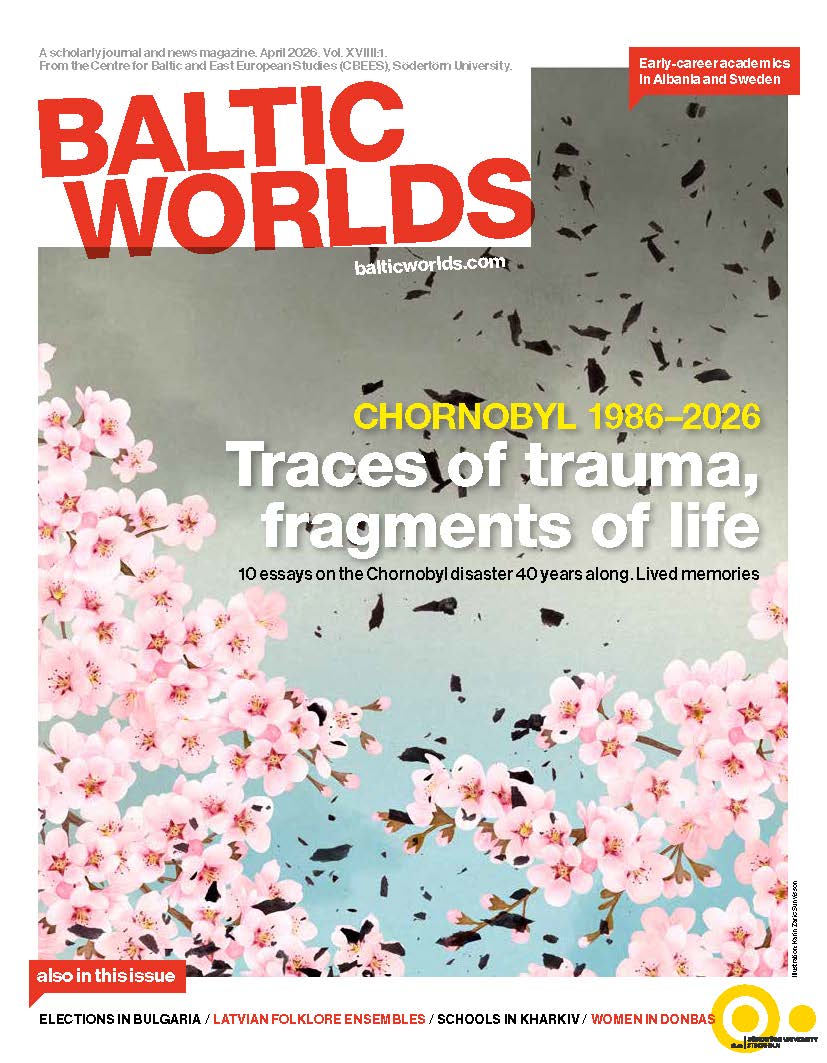 Issue 2026, 1: Download.
Graduated with a BA in Russian and English Literature from Leeds University. His co-translations of Andrey Platonov have won prizes both in the UK and in the US. His translation of Hamid Ismailov’s The Railway won the AATSEEL prize for 2007 and received a special commendation from the judges of the 2007 Rossica Translation Prize. Recently he translated The Armenian Sketchbook by Vasily Grossman, to be published in July 2013.
Brezhnev, Leonid, Rabochie i dnevnikovye zapisi, V 3-kh tomakh, Moskva: Istoricheskaya literature, 2016, 3 500 pages.
Independent media in Belarus is experiencing continued difficulties due to President Alexandr Lukashenko’s repressive policies. To avoid censorship, a number of independent media outlets, such as the most popular news site Charter 97, have chosen to work from abroad. Although this might give them maneuvering space to go on reporting, it also means that many Belarusian citizens do not have access to a sufficient amount of opposition news.
This is a very interesting discussion that Kimmo Granqvist moderates here. It is unusual to have scholars reflecting on the potential of their discipline, so this is a great occasion for Romani studies. If one looks at the contributions closely, one can see the emergence of a struggle by scholars to wriggle their way out of a long-standing and narrow agenda created for the study of “gypsy” issues and to demarcate a wider territory called Romani Studies.
Corina Ceamă, Ion Duminică, Ian Hancock, Tomasz Koper, and Hristo Kyuchukov reflect on their views and aspirations for Romani Studies, as well as their own roles as Roma scholars.
The Roma migrations, which are becoming more topical today, have prompted policies giving attention to issues of Roma inclusion first in the East, but then also in the West. Inclusion policies have, by and large, failed to improve the situation of Roma communities. In order to achieve a better understanding of these issues, we argue that attention should be paid to Roma as distinct ethnic communities, but that are still integral parts of their respective civic nations
This article discusses Yugoslavia’s ethnic and Romani policies and the activities for maintaining common cultural practices among Romani writers and activists after the dissolution of the federation as a political entity, and it examines literary activities and narratives related to Yugoslav topics and the way in which they sustain and demonstrate Romani (post-)Yugoslav belonging. The article argues that a sense of Yugoslav belonging and cooperation has been maintained among Romani writers and activists with explicitly positive references to the legacies of Yugoslavia. These tendencies contrast with the official post-Yugoslav political discourse among the rest of the ethnic and national communities’ leaderships, which have been to a great extent built on criticizing Yugoslav policies and ideologies.
This paper presents a handful of ethnographic observations concerning the Romanian Romani people migrating to Poland in the 1990s. This migration wave, although not very well known in the world, became a very important factor influencing, among others, the perception of the Romanian Roms, the Romani people in general, and even citizens of Romania as such by Poles. For Romani immigrants, this was most often the first opportunity to stay abroad
The focus of this work is on the position of Roma girls/women who have a different set of privileges as well as rights and often experience multiple forms of discrimination in relation to a number of categories of difference. Specifically, the life trajectories of three Roma women living in poverty and experiencing different levels of discrimination are presented and examined. Highlighting the multiple positioning that constitutes their everyday life, these life trajectories show that gender, ethnicity, socio-economic status and other categories of difference are not distinct and isolated realms of experience and that the impact of their intersections needs to be foregrounded. In sum, these brief excerpts undeniably show how discrimination has consistently denied these Roma women personal development, self-esteem, decent living conditions, livelihood opportunities and institutional services.
This paper deals with the moment in 1948–1949, when the representative organization of the Romanian Roma unsuccessfully tried to obtain for them from the communist authorities the status of a national minority. For the Romanian Communist Party, the Roma represented a population that had to be brought into its sphere of influence. Discussions on the establishment of the People’s Union of the Roma lasted for several months but eventually led to the rejection of the request of the Roma leaders. The institutions involved in these discussions created documents, some of which are kept in the archives and allow us to study this moment in time.
Lukashenka is not going to undermine or change electoral strategies that have worked well for sustaining the regime. But the regime will be employing other non-electoral strategies to hold on to its power. The established political system maintains a number of preemptive mechanisms that prevent public mobilization and collective action. The detention of independent journalists on the bogus charges of non-authorized access and the case against the chairman of the independent labor union, who is currently on trial, just confirm that the regime does not shy away from using selective prosecution when it is needed. Now, with the tightening control over the online space, Lukashenka wants to prevent any surprises such as the public mobilization against the infamous unemployment tax.