BOTH VICTIM AND PERPETRATOR Ukraine’s problematic relationship to the Holocaust
For various reasons, Ukraine’s relationship to the Holocaust and the Jews has been overshadowed by the similar, but more striking […]

A scholarly journal from the Centre for Baltic and East European Studies (CBEES) Södertörn University, Stockholm.
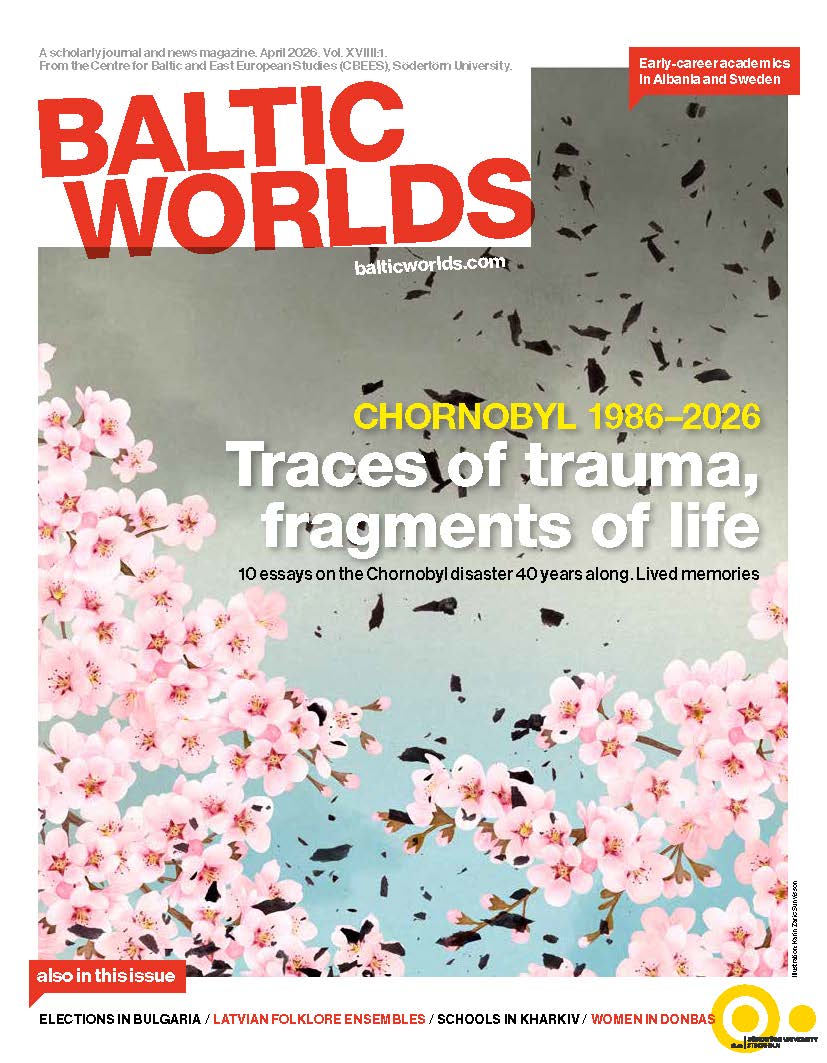 Issue 2026, 1: Download.
Graduated with a BA in Russian and English Literature from Leeds University. His co-translations of Andrey Platonov have won prizes both in the UK and in the US. His translation of Hamid Ismailov’s The Railway won the AATSEEL prize for 2007 and received a special commendation from the judges of the 2007 Rossica Translation Prize. Recently he translated The Armenian Sketchbook by Vasily Grossman, to be published in July 2013.
For various reasons, Ukraine’s relationship to the Holocaust and the Jews has been overshadowed by the similar, but more striking […]
In literature, the opposition between Russian Christians and Muslims was established early on in the folk epics, in the “historical songs” told by the bards in the oral tradition. Several of them deal with the capturing of the khanate of Kazan, the northernmost Tatar realm. From the “Tatars” conquered by Ivan the Terrible in Kazan and depicted in Russian folk songs to Tolstoy’s thistle called “the Tatar” (tatarin) there is a winding line of literary works.
On March 11, 1990, Lithuania declared its independence. The Soviet Union reacted by threatening economic sanctions. Lithuania needed support. Its hopes were directed at the West, and particularly at France. How did France react? What was its foreign policy regarding the “Baltic question”, that is, the demands of the Baltic States for the restoration of their sovereignty, which they had lost in their forced annexation by the Soviet Union in 1940?
Immediately after the Finnish parliamentary elections on April 17, which resulted in a smashing victory for the populist True Finns Party, but left the National Coalition Party with the largest number of seats in Parliament, most observers had expected that the three largest parties would form the new government. But after a couple of weeks it became evident that this would not work.
Roosa Vihavainen, Homeowners’ Associations in Russia after the 2005 Housing Reform, Helsinki: Kikimora , Publications Series A 20, 2009, 274 pages
Kean Birch & Vlad Mykhnenko (eds.) The Rise and Fall of Neoliberalism: The Collapse of an Economic Order? London & New York Zed Books 2010, 280 pages
Sven Eliaeson & Nadezhda Georgieva (eds.) New Europe: Growth to Limits? Oxford: The Bardwell Press 2010, 454 pages
The new virtual Gulag museum in Paris appears in many languages and transcends national boundaries.
The books I have been asked to briefly comment on are both learned works of indisputable scholarly quality. At the […]
What began in Poland, with the publication of Jan Tomasz Gross’s provocative essays, the most recent historical studies, and the research project initiated by the Polish Center for Holocaust Research, is a new phase in the public debate about the Polish nation’s relationship to the Holocaust. What is totally new is that historians and researchers in Poland are now leading the way and providing the most difficult answers to the most difficult questions.