Roland Kostić
PhD in Peace and Conflict Studies from Uppsala University, Sweden. He is currently employed as a Research Director for Holocaust and Genocide Studies at the Hugo Valentin Centre, Uppsala University. His research interests include social psychology, transitional justice, knowledge production process in interventions and peace-building processes. His most recent publications include a piece “Transnational think-tanks: foot soldiers in the battlefield of ideas? Examining the role of the ICG in Bosnia and Herzegovina, 2000–01” in Third World Quarterly (2014), and co-edited volume (Li Bennich-Björkman and Branka Likić-Brborić) “Citizens at Heart? Perspectives on integration of refugees in the EU after the Yugoslav war of succession”, Uppsala Multiethnic Papers 56, Uppsala University, 2016.
view all contributors
Articles by Roland Kostić
-
Historian Mats Fridlund says that the technological and scientific development of weapons has influenced the choice of method and the type of people who have become perpetrators. When the revolver became smaller and lighter, female terrorists became more common.
-
Annual meeting in Narva of translators and writers from countries around the Baltic Sea. Meetings, exchanges of experience – which are the cultural common denominators and where are the barriers?
-
Latvia’s deep economic down-turn has brought about a historical political change. A left-wing party has won an election and come to power in Riga. The local party is dominated by ethnic Russian politicians.
-
Many migrate from poor regions of Europe to the richer regions. In the richer regions, there is a need for workers to fill low-paid jobs on the black market.
-
Narva is the EU’s port to Russia. Here, Swedes, Germans, Russians, and Estonians have had their interests. Today, the official language is Estonian and it is difficult for the Russian minority to obtain citizenship.
-
The Baltic Sea is difficult to navigate, through the ages many vessels have been wrecked. Marine archaeologists tell us about discoveries of ships and the difficulties involved in preserving the wrecks on land.
-
The historian Marta Reuter conducts research on how concepts are created and filled with meaning. NGOs are thought to stand for democratic values, but the Hell’s Angels are also elements of civil society.
-
European Humanities University, EHU, is a Belarusian university in exile that educates Belarusians in an academic environment that encourages the development of independent views. Students run the risk of arrest and interrogation by the Belarusian police. Some can no longer return to Belarus during school breaks.
-
+ Katarina Wikars Jan Jörnmark. Atomtorg, porrharar och Hitlerslussar: 160 genom Baltikum. [Atomic Square, Porn Bunnies, and Hitler Floodgates] Lund: Historiska Media 2009. 192 pages.
-
+ Piotr Wawrzeniuk (ed.) Societal Change and Ideological Formation among the Rural Population of the Baltic Area 1880—1939 Studia Baltica II:2, Södertörn University, Stockholm 2008, 206 pages.
-

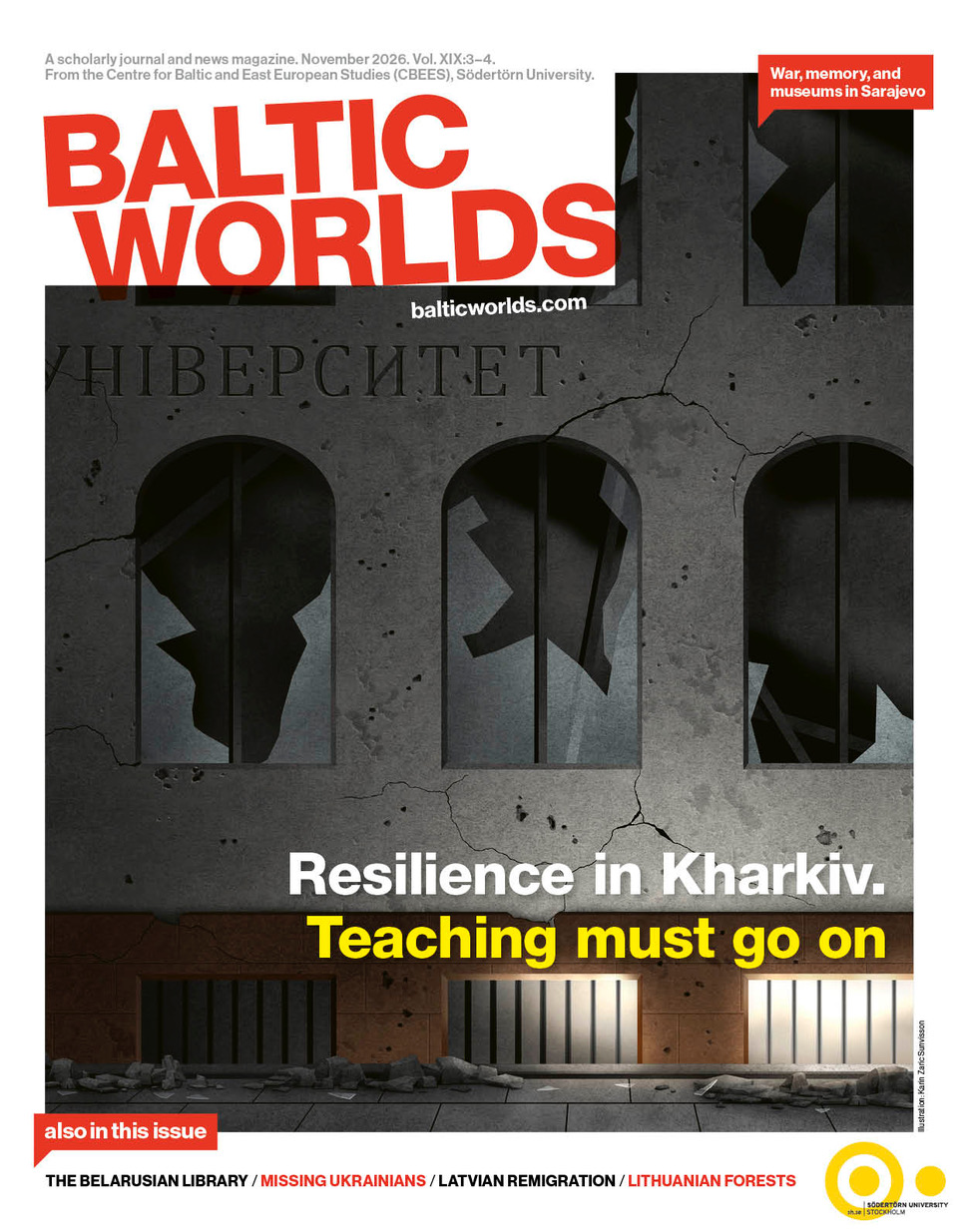 Issue 2026, 3-4: