Roland Kostić
PhD in Peace and Conflict Studies from Uppsala University, Sweden. He is currently employed as a Research Director for Holocaust and Genocide Studies at the Hugo Valentin Centre, Uppsala University. His research interests include social psychology, transitional justice, knowledge production process in interventions and peace-building processes. His most recent publications include a piece “Transnational think-tanks: foot soldiers in the battlefield of ideas? Examining the role of the ICG in Bosnia and Herzegovina, 2000–01” in Third World Quarterly (2014), and co-edited volume (Li Bennich-Björkman and Branka Likić-Brborić) “Citizens at Heart? Perspectives on integration of refugees in the EU after the Yugoslav war of succession”, Uppsala Multiethnic Papers 56, Uppsala University, 2016.
view all contributors
Articles by Roland Kostić
-
In 1996, a Special Economic Zone was created that made it favorable for both Russian and foreign companies to relocate production to Kaliningrad. Once the intentions were to make Kaliningrad known for more than just its military bases. But this is no longer the case. Kaliningrad, once again, is gliding away from being an economic zone to becoming a military zone.
-
The main reason why we have not seen more severe conflicts between majorities and minorities in the new EU member states is, in the authors view, the EU’s success as a normative power. The pressure that the EU put on the candidates for membership to adapt to norms on minority protection and to solve their potential border conflicts had a positive effect.
-
The “feminization of migration” in the EU is spurred by a growing demand for labor in the low-paid sectors of the economy, including domestic work, personal services, care for the elderly and children, and the hotel and restaurant industries. One factor that encourages Central and Eastern European women to migrate to the West is the erosion of their own social and economic situation at home, which cements the asymmetry in economic prosperity between “East” and “West” and perpetuates inequalities between the “old” and “new” EU member states.
-
The post-communist countries did not see the Holocaust narrative and its relation to the history of the EU as part of their own narrative. Since entering the EU, a number of Eastern European countries have challenged the EU’s master narrative and tried to gain acceptance for — and draw attention to — their memory of Soviet Communism.
-
Survivors actually created manifold historical sources on the Holocaust and even completed a broad array of relevant publications before the end of 1940s; these sources were largely neglected afterwards and have remained underexplored to this day.
-
Communism has failed, not only on political and economic, but especially on moral grounds, the author claims; "Every communist state was a far cry from the paradise the doctrine proposed.".
-
Your advertisement in Baltic Worlds reaches a specialised, academic target group. Baltic Worlds contributes to the dissemination of knowledge about […]
-
The electoral campaign was marked by the emergence of several rather peculiar issues in a contemporary electoral context: appeals to religion and ethnic belonging, and to family status.
-
An interview with Russian human rights activist Elena Vasilyeva, founder of the group “Load 200 from Ukraine to Russia.” that gathers information about soldiers killed in military operation zones abroad and then transported home. The article contains statements that reflect the views of the author and the interviewed, not necessary the view of Baltic Worlds'.
-
Today there is a new reign of terror against the Crimean Tatars, as well as against the Ukrainian population in Crimea. Mustafa Jemiloglu has once again been forced out from Crimea. He was after a meeting in Ankara in March refused to enter Crimea and come back to his home in Bakhchisaray.
-

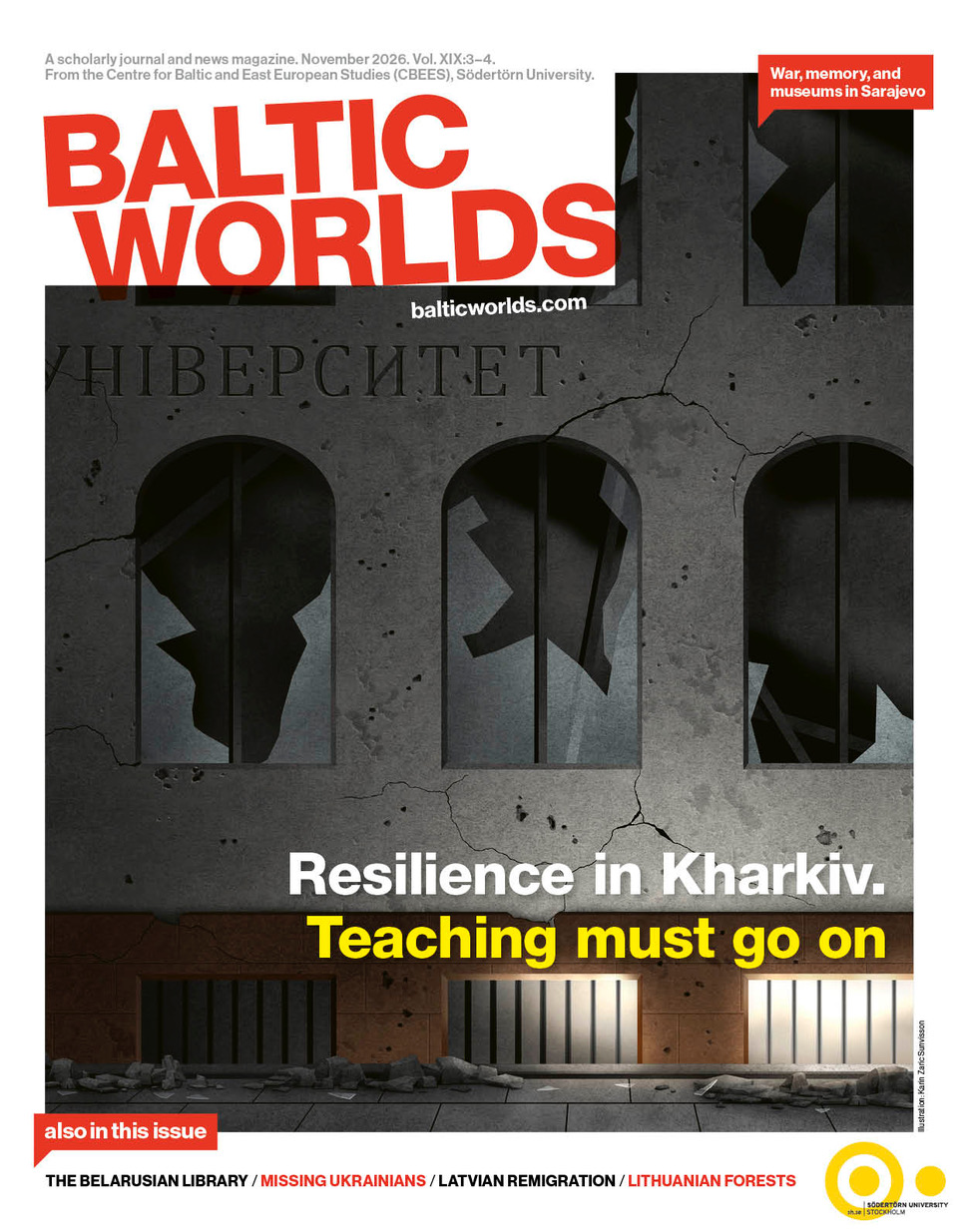 Issue 2026, 3-4: