Fraternity
The term “fraternity” has been clearly linked to a register that could be called romantic. This explains the desire to distinguish the word from others like “solidarity” and “justice” and in particular “equality”.

A scholarly journal from the Centre for Baltic and East European Studies (CBEES) Södertörn University, Stockholm.
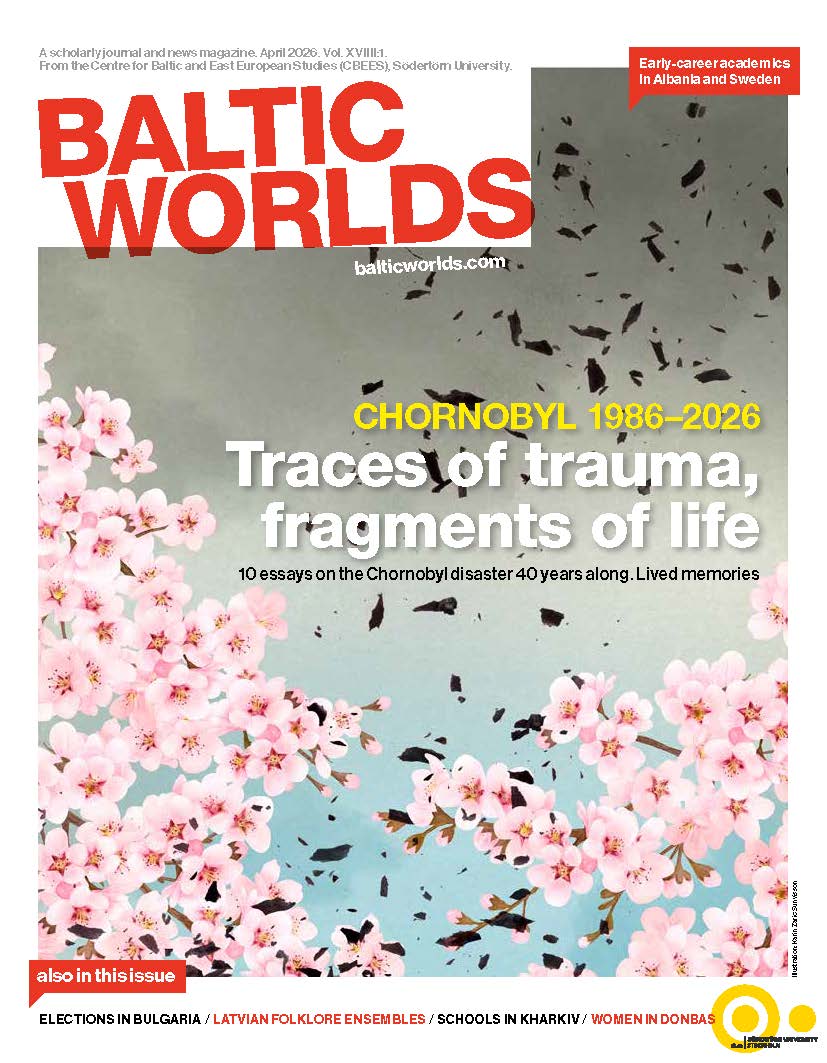 Issue 2026, 1: Download.
Sofie Bedford has a Ph.D. in Political Science from Stockholm University. Currently she is a researcher at Centre for Russian and Eurasian Studies at Uppsala University (UCRS) and affiliated with the Swedish Research Institute in Istanbul. Her main ongoing project focuses on the concept of ‘opposition’ in electoral authoritarian states. Sofie is a part of Baltic Worlds Scientific Advisory Council and she is the contact person for the online election coverage.
Ulyana Kaposhka holds a Master of Science in International and European Relations from Linköping University, Sweden. Her main research interests include societal and political development in the post-Soviet countries, specifically Belarus and Russia, as well as conflict dynamics in the South Caucasus. Ulyana is currently an intern at Uppsala Centre for Russian and European Studies, Uppsala University, where she works with Dr. Sofie Bedford within the project ‘Building Sustainable Opposition in Electoral Authoritarian Regimes’ (2015-2017).
The term “fraternity” has been clearly linked to a register that could be called romantic. This explains the desire to distinguish the word from others like “solidarity” and “justice” and in particular “equality”.
In 1980, women’s participation in the Solidarność movement was far from invisible. Women were present from the start and they “took over” several highly important activities in Solidarność after its de-legalization in December 1981. The invisibility of these tasks was compounded by the fact that all of this work was illegal.
The author analyzes the content of the word “solidarity”, not for the sake of linguistics, but in the belief that words contain memories as well as many other experiences, often conflicting ones. He also talks about Solidarity, the trade union in Poland, which was created in August 1980 and crushed in December 1981.
Ludger Hagedorn has gathered together different voices, all adding insights into the meaning of solidarity. Here he presents the different contributions and place them in a wider context. He concludes, "Perhaps the outcome of solidarity counts less than the atmosphere that it creates and in which it unfolds its explosive message.".
Christer Lokind: DC-3:an. Kalla krigets hemlighet [The DC-3: the secret of the Cold War]. Stockholm: Medströms bokförlag, 2014.
The evolution of political contacts between exile activists in Sweden and the occupied homeland sheds light on the largely underresearched phenomenon of anticommunist cooperation between capitalist and communist societies and challenges the narrative of the impermeability of the “Iron Curtain” between the Soviet Union and the West.
Although there have been some attempts to “add men” into gender analysis, so far these attempts have primarily been made in order to balance the gender perspective and demonstrate that gender is not only about women. Critical analysis and deconstruction of men’s privileges has not yet taken place. Pro-feminist men and masculinities studies in Ukraine is emerging under rather problematic anti-feminist ideological conditions.
The stereotype of the Soviet man was destroyed in the early 1990s. New forms of culture, such as comic books, tried to invent new male models. In 1991, a group of authors started to publish the comic magazine Veles, in which patterns of male identity were constructed. The comics expressed a form of sublimation of post war and post Soviet trauma.
The images of the leaders in the widely distributed press played an important part in shaping the ideological platform in the Soviet Union, including the regulation, control and support of a certain gender order.
The unsuccessful “translation” of “gender equality” into Russian reveals numerous difficulties and indicates that the realization of the transnational feminist agenda could meet with serious obstacles not only in the countries of the “Third World”, but also in some former “Second World” countries.