Valter Bolevics, Jan Sjölin and Tatjana Volkova
Valters Bolevis is PhD Oec. Can. in business administration, Riga International School of Economics and Business Administration. Project manager. MS with distinction cum laude in the field of transport and maritime management from Institute of Transport and Maritime Management (ITMMA), Belgium, 2007.
Jan Sjölin is associate professor at the Baltic International Academy (BIA in Riga) and emeritus at the Technical University of IASI (CETEX). Served within the inner circle of CEEMAN (the Central and Eastern European Management Development Association) dealing with transition and evaluation of academic institutions.
Tatjana Volkova is professor in strategic management and innovation management and former rector of BA School of Business and Finance, Latvia. Her special research interests are design-driven innovations and creative industries. She is among other things a former President of Rector’s Conference of Latvia (2004—2011) and a former member of the European University Association Council.
view all contributors
Articles by Valter Bolevics, Jan Sjölin and Tatjana Volkova
-
Political development in the three Baltic countries has not been equal. The development of democracy and the degree of corruption depends, among other things – it is argued here – on how the resistance against the Soviet Union was organized.
-
World leaders discussed things behind the scenes. Thatcher but also Mitterrand were against German reunification. An analysis of documents shows how Kohl managed to get the EU’s acceptance.
-
The geopolitical situation shaped life on the islands of Gotland, Rügen, and Saaremaa. They became garrison islands and the presence of the military transformed daily life. After the Cold War, the military left the islands.
-
An analysis of the film The Reader, based on the book of the same name. The film’s perspective on individuals’ behavior during the Holocaust makes coming to terms with acts of the past impossible – which itself invalidates the entire film.
-
In the 1960s Hungarian intellectuals listened to jazz as a protest against the system. Symbols united them in the fight. In 1989 they returned to lead the revolution.
-
Cybernetics was created in the Soviet Union in the ’50s; it celebrated technical progress as the future of mankind. Cybernetics proceeded from the encounter between human and machine.
-
Pomerania flew the Swedish flag during the years 1630–1815. The province became a coveted badge in the great political power game of Northern Europe.
-
The altruistic act of donating organs is increasingly a financial transaction with the body as a commodity. Poor people are persuaded, tricked, into selling one of their kidneys without receiving adequate care afterwards.
-
Baltic Sea cooperation is a good example of how nations can find forms of collaboration. There is a solidarity between countries and a desire to work on things such as environmental problems.
-
The struggle for control among the Great Powers in the Nordic region during the 19th century focused on the dissolutions of unions and on nation-building. Russia and Napoleon were strong players. Sweden and Finland had a close relationship.
-

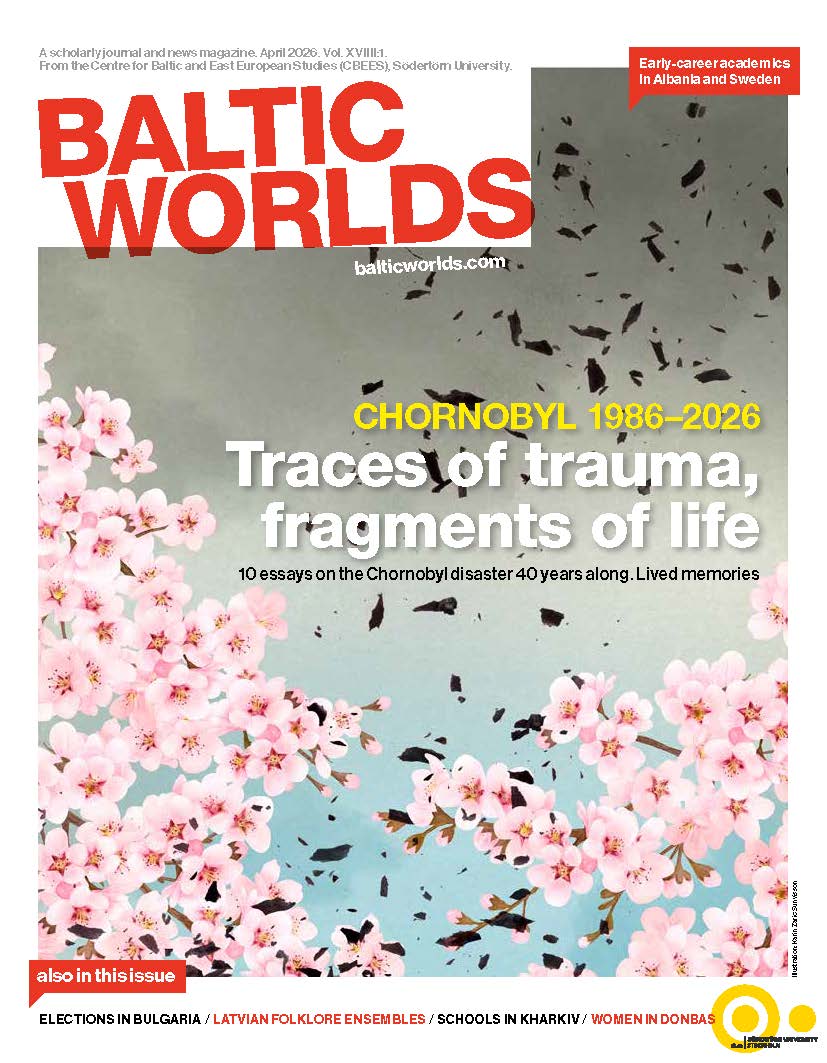 Issue 2026, 1: