Valter Bolevics, Jan Sjölin and Tatjana Volkova
Valters Bolevis is PhD Oec. Can. in business administration, Riga International School of Economics and Business Administration. Project manager. MS with distinction cum laude in the field of transport and maritime management from Institute of Transport and Maritime Management (ITMMA), Belgium, 2007.
Jan Sjölin is associate professor at the Baltic International Academy (BIA in Riga) and emeritus at the Technical University of IASI (CETEX). Served within the inner circle of CEEMAN (the Central and Eastern European Management Development Association) dealing with transition and evaluation of academic institutions.
Tatjana Volkova is professor in strategic management and innovation management and former rector of BA School of Business and Finance, Latvia. Her special research interests are design-driven innovations and creative industries. She is among other things a former President of Rector’s Conference of Latvia (2004—2011) and a former member of the European University Association Council.
view all contributors
Articles by Valter Bolevics, Jan Sjölin and Tatjana Volkova
-
Two months prior to the collapse of the Berlin Wall, on August 23, 1989, far behind the Iron Curtain, two million Latvians, Lithuanians and Estonians joined hands on the highways that linked their countries in a massive demonstration for national independence. They called it the Baltic Way.
-
The concept of nation is not only, as is often assumed, related to states but to the people who feel that they belong to a community based on a common identity, wherein language and culture are often emphasized as something that knit people together. History, as well as contemporary experience, reveal the notion that state nationalism tends to oppress local languages and cultures. However, in a cultural nation interpretation, all national minorities, while being citizens of their state of domicile, are per definition not members of the majority nationality.
-
On February 9 elections to the National Parliament – Milli Məclis – were held in Azerbaijan, nine months early. The […]
-
Baltic Worlds appears four times a year. The journal publishes scholarly articles but also reviews, essays and commentaries. All content is […]
-
Second World, Second Sex: Socialist Women’s Activism and Global Solidarity during the Cold War. Kristen Ghodsee. Duke University Press, 2019, 328 pages.
-
Seasoned Socialism: Gender and Food in Late Soviet Everyday Life , Ed. by Anastasia Lakhtikova, Angela Brintlinger, and Irina Glushchenko. Bloomington, Indiana: Indiana University Press, 2019, 396 pages
-
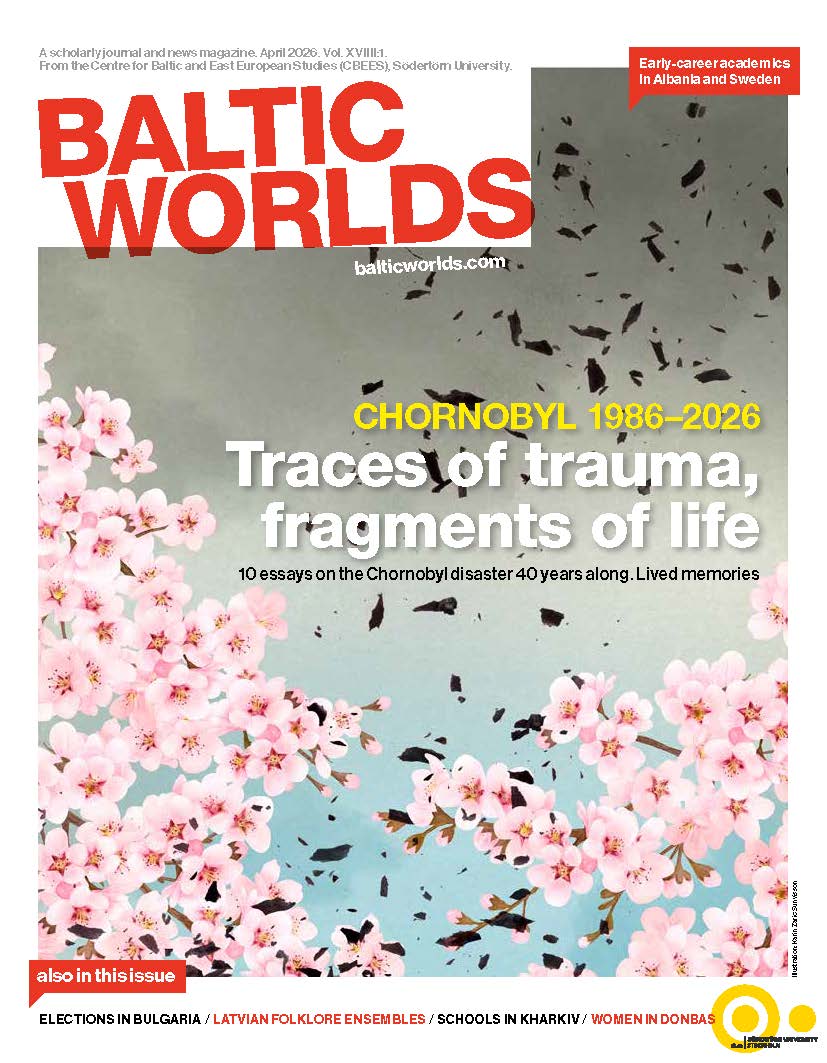
Chernobyl: History of a Tragedy, Serhii Plokhy, Penguin (2019), 432 pages, Winner of the Baillie Gifford Prize 2018
-
We are, as my examples show, tricked into believing that archaeological research, museum practices, and the digitalization of museum objects, archived material, and so on will make a secret world more open and transparent and that this will be positive for the public, democracy, and for the scientific community. The real world is, however, much more dynamic and diverse but always out of reach for the public because of our naïve desire for the Internet. Archive and museum activities are a practice done in reality, not on the Internet, and so is research.
-
More than anything else, the avant-garde is the area of the production of the past: the colossal amounts of memoirs, artefacts, and photographs that are accumulated in archives — in different kinds of archives, including personal ones, but also state archives, and many others of different kinds.
-
Irina Sandomirskaja in a conversation with philosophers Jean-Luc Nancy and Peter Trawny on the subject of nationalism and cultural heritage.
-

 Issue 2026, 1: