
Download back issue of Baltic Worlds
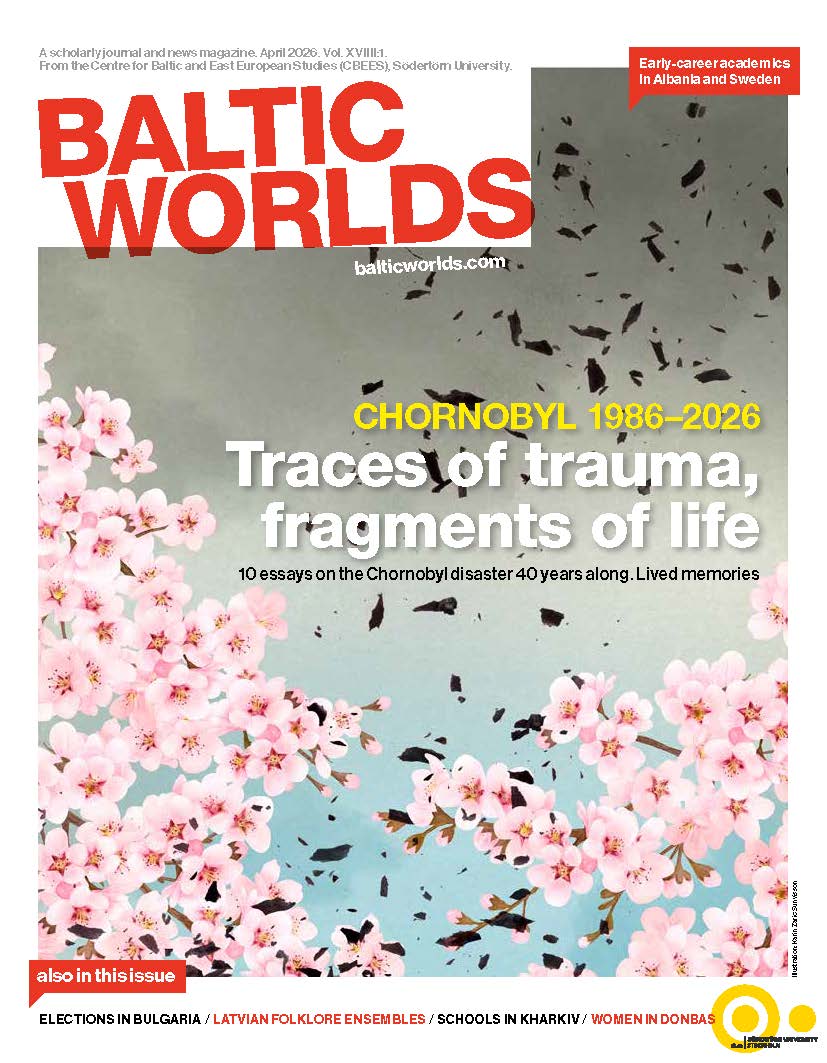 Issue 2026, 1: Download.
Okategoriserade Gustav Sjöberg (146) Den levande materien: Naturfilologiska perspektiv på hylozoiska och panteistiska estetiker
Abstract [en] In the classical Western aesthetic tradition, from Aristotle onwards, ’nature’ and ’art’ are conceptualised in relation to each […]
Published on balticworlds.com on December 16, 2025


Abstract [en]
In the classical Western aesthetic tradition, from Aristotle onwards, ’nature’ and ’art’ are conceptualised in relation to each other, but are ultimately perceived as separate. While nature creates immanently, from within itself, art is characterised by man forming matter external to himself. The ’hylozoic’ (from the Greek hyle, ’matter’, and zoe, ’life’) and ’pantheistic’ texts studied in this thesis have a different approach to this binary opposition. More precisely, the thesis examines the possibility and consequences of an aesthetics in which nature and art are conceived of as one and the same. It makes use of the metaphysics of Italian Renaissance philosopher Giordano Bruno as a theoretical matrix, given that there is no essential difference between what is produced by nature and by man in his thinking. In order to find a methodological correlate to Bruno’s metaphysical concept of nature, the thesis brings forth and elaborates on the notion of “philology of nature”, a concept that has only a few occurrences in previous literature. In the thesis, philology of nature designates both a method and a perspective, and examples of nature philological procedures are ’analogy’ and ’morphology’. These procedures make it possible to study the hylozoic and pantheistic aesthetics on its own premises. The thesis consists of two separate but thematically connected investigations. First, of Bruno’s hylozoic aesthetics, that is, an aesthetics that is based on the idea of all matter as living, and second, of the afterlife of hylozoic aesthetics, primarily from German idealism onwards, with a focus on Friedrich Wilhelm Joseph Schelling, Gustav Theodor Fechner, Jakob Johann von Uexküll and Adolf Portmann. This is followed by a chapter that relates the results of these investigations to the most relevant contemporary theories focusing on nature: anthropology, morphological philosophies of nature and evolutionary aesthetics. Finally, the thesis argues that the excavation of a hylozoic aesthetic vein operative within the Western aesthetic tradition, has the potential to challenge and undo the traditional boundaries between nature and art.
Subject: Aesthetics
Public defence of thesis: 28 November 2025
https://www.diva-portal.org/smash/get/diva2:2010700/FULLTEXT02.pdf
-
by Florence Fröhlig

An Associate Professor in Ethnology at the School of Contemporary and Historical Studies and Director of studies of the Baltic and East European Graduate School (BEEGS) at Södertörn University, Sweden. Besides her research interests concerning memory and mourning processes, counter-memories, resilience and the transmission of memory (PhD "Painful legacy of World War II: Nazi forced enlistment: Alsatian/Mosellan Prisoners of War and the Soviet Prison Camp of Tambov” 2013), she is interested in the memorialization’s and heritagization’s processes of industrial sites. Her research has also expanded to ecological issues in the Baltic and Eastern European regions. Currently, she is involved in a research project on Russian and Belarusian migrants and their identity construction in Lithuania and Poland following Russia’s invasion of Ukraine.
- all contributors