
Download back issue of Baltic Worlds
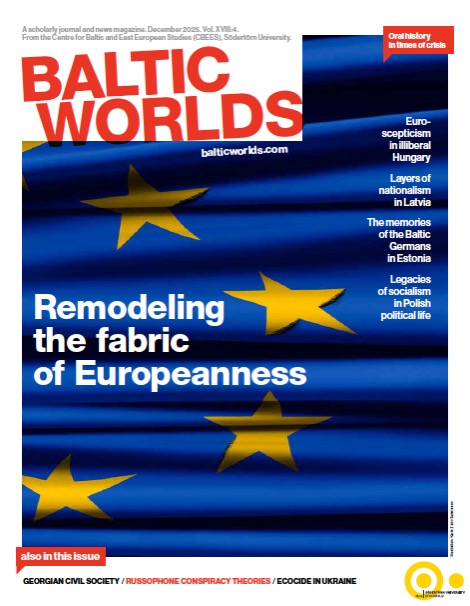 Issue 2025, 4: Download.

Okategoriserade Introducing the Belarus Voices: A New Book Series on Politics, Society, and Culture in Belarus
An important goal for the new series is to create a space where scholars from different disciplines can engage with one another. Research on Belarus is often dispersed across various fields — political science, history, sociology, anthropology, and cultural studies — and the series aims to bring these perspectives into dialogue.
Published on balticworlds.com on March 16, 2026


Dr. Victoria Leukavets serves as an Editor-in-Chief for the new Belarus Voices series. Here she introduces the initiative in the form of Q&As:
Q: What motivated the creation of the Belarus Voices book series?
For a long time, Belarus has occupied a somewhat marginal position within the broader field of East European and post-Soviet studies. Compared with neighbouring countries such as Ukraine, Poland, or Russia, Belarus has received relatively limited attention in international scholarly debates. At the same time, the country’s political trajectory since the collapse of the Soviet Union and its evolving position within the regional political landscape make it an important case for understanding broader processes of political and social transformation in Eastern Europe.
The events following the presidential election of August 2020 brought Belarus to the forefront of international attention. The mass protests and the developments that followed demonstrated that Belarusian society is far more dynamic and complex than it is sometimes portrayed. These developments also highlighted the need for deeper scholarly engagement with Belarusian politics, society, culture, and history.
The Belarus Voices book series emerged from this recognition. The idea was to create a dedicated academic platform that would support interdisciplinary research on Belarus and strengthen the visibility of Belarusian studies within international academic publishing.
Q: When was the series established and how was it launched?
The series was initiated in March 2025. The idea developed through discussions among scholars working on Belarus who recognised the need for a dedicated publication platform focused specifically on Belarusian studies.
The official launch of the series took place at the Congress of Belarusian Studies in Berlin in September 2025, where the project was presented to the international scholarly community. The launch allowed us to introduce the initiative to a broad network of researchers working on Belarus across Europe and North America.
Q: You serve as Editor-in-Chief of the series. What does your role involve?
Yes, I serve as Editor-in-Chief of the Belarus Voices series. I am a postdoctoral researcher at the Centre for Baltic and East European Studies (CBEES) at Södertörn University, and the series is closely connected to this research environment.
As Editor-in-Chief, I coordinate the intellectual development of the series and oversee the editorial process. This includes working with authors and members of the editorial board, identifying promising manuscripts, and ensuring that the publications contribute to ongoing academic debates about Belarus.
An important goal is also to create a space where scholars from different disciplines can engage with one another. Research on Belarus is often dispersed across various fields — political science, history, sociology, anthropology, and cultural studies — and the series aims to bring these perspectives into dialogue.
Q:What is the main intellectual focus of the series?
The central idea behind Belarus Voices is that Belarus cannot be understood solely through the lens of political institutions or political regime analysis. While the durability of authoritarian governance has understandably attracted scholarly attention, Belarusian society is shaped by a much wider set of dynamics.
These include questions of identity formation, cultural production, historical memory, media landscapes, civic mobilization, and transnational networks. The events of 2020 clearly demonstrated that cultural initiatives, independent media platforms, and grassroots civic organizations have played an important role in shaping public life in Belarus.
For this reason, the series adopts an explicitly interdisciplinary approach. We welcome contributions from political science, sociology, history, anthropology, cultural studies, and related fields. Our aim is to encourage research that connects political developments with broader social and cultural processes.
Q: Who is the intended audience of the series?
The series is aimed primarily at an academic audience, including scholars and students working in Belarusian studies, East European studies, and post-Soviet research. At the same time, we also hope to reach readers beyond the academic community.
This includes policymakers, journalists, civil society actors, and members of the Belarusian diaspora who are interested in deeper analytical perspectives on developments in Belarus. Making research on Belarus accessible to a broader audience is particularly important given the growing international interest in the country.
Q: Where is the series published?
The Belarus Voices series is published by Ibidem Press, an academic publisher that has established a strong reputation in East European and Eurasian studies. Ibidem publishes both monographs and edited volumes that contribute to scholarly debates about the region.
One of the advantages of publishing the series with Ibidem is its international distribution network. Through its partnership with Columbia University Press, the books are distributed in both Europe and the United States. This ensures that the publications reach a wide international academic audience.
Q: What publications are currently planned within the series?
The editorial board is currently working on several forthcoming publications. These include both monographs and edited volumes addressing key themes in Belarusian studies.
One of the first major publications currently in preparation is the edited volume Between Continuity and Change: Rethinking Politics, Society and Identity in Belarus. The volume brings together scholars from different disciplines to examine the evolving dynamics of Belarusian society in the aftermath of the 2020 protests.
The chapters explore themes such as historical narratives, language politics, authoritarian governance, civic mobilisation, cultural production, and diaspora networks. By analysing these different dimensions together, the book seeks to illuminate the complex relationship between continuity and transformation in contemporary Belarus.
Q: Has the preparation of this volume involved collaborative academic initiatives?
Yes, very much so. In particular, the Centre for Baltic and East European Studies (CBEES) at Södertörn University has provided financial support for an academic workshop dedicated to the volume.
The workshop which will be held in May 2026 brings together contributors and members of the editorial board to discuss the manuscript and refine its analytical framework. Such collaborative discussions are extremely valuable for edited volumes because they allow authors to engage with one another’s work and strengthen the overall coherence of the publication.
Q: Why do you think a series like Belarus Voices is particularly relevant today?
Belarus today occupies a complex and evolving position within European politics. The political developments of recent years, as well as the emergence of Belarusian diaspora communities across Europe, have created new intellectual and cultural networks that extend beyond the borders of the state.
In this context, it is essential to develop analytical frameworks that capture the complexity of Belarusian society. The Belarus Voices series seeks to contribute to this effort by providing a platform where diverse scholarly perspectives on Belarus can be brought into dialogue and made visible to a wider international audience.
For readers of Baltic Worlds, this initiative is particularly relevant because the journal has long provided a forum for interdisciplinary discussions about the Baltic Sea region and its neighboring societies. The book series hopes to contribute to these conversations by ensuring that Belarus occupies a more visible place within regional and international academic debates.
Q: How can scholars engage with the series?
Information about the series and updates on forthcoming publications are shared through its LinkedIn page:
https://www.linkedin.com/in/belarus-voices-ibidem-verlag-129523381/
Scholars interested in contributing to the series are welcome to submit book proposals, expressions of interest, or inquiries directly to the editorial team. Submissions and expressions of interest can be sent to:
belarus.voices@ibidem.de .