Despite the repressions against civil society in Russia, the independent environmental movement has managed to adapt and survive. The environmental agenda in Russia remains important for the people, for local politicians, and for authorities. These factors lay the groundwork for a potential mobilization, politicization, and demand for system change. To enact this transformation, however, the author argues that professional environmentalists need to combine forces with grassroots protestors and embrace a broader socio-economic and intersectional agenda.
Essay by
Vitaly Servetnik
May 29, 2026
This essay examines the methodological, ethical, and safety challenges of researching civil society and activism in Russia after 2022. Drawing on recent fieldwork experience, we discuss the growing importance of ethnographic engagement, heightened risks for researchers and interlocutors, challenges of trust-building, anonymization, and blurred boundaries between analysis and advocacy. We argue that these conditions reshape both fieldwork practices and knowledge production, raising broader questions about the future of qualitative research in authoritarian contexts.
Essay by
Elisa Marin and Oliver Skye
May 29, 2026
Baltic Worlds’ Special issue “Civic Activism in Russia” offers a unique glimpse into the Russian civil society shortly before and after the full-scale invasion of Ukraine in February 2022. As the authors of the issue observe, the impact of the war has made civil society extremely complex and transnational.
To my knowledge, it is one of the first attempts to examine Russian civil society from within.
Essay by
Nadezda Petrusenko
May 29, 2026

 Issue 2026, 1:
 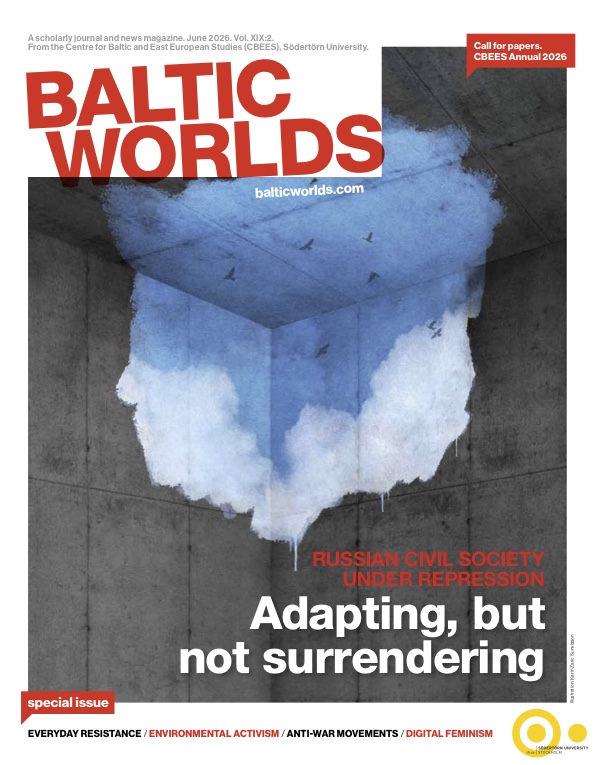 Issue 2026, 2:
  Baltic Worlds covers; the Baltic Sea Region, Eastern Europe, Russia, CentralAsia, Caucasus and the Balkan area.