The history of revolutionary Petrograd covers the period between the two times when the city changed its name, in 1914 and 1924. During this period, it came to witness a world war (not accidentally called the Great War) and two revolutions, as well as cold, famine, and destruction. Even though difficult to assess, the consequences for museums and collections, both private and public, were enormous, as they were for a variety of art institutions and, even more so, for private persons such as collectors, artists, art critics, and so on.
Essay by
Iulia Demidenko
November 21, 2019
It is here claimed that it is practically impossible to determine whether the collector and connoisseur in question (namely Igor Immanuilovich Grabar, 1879—1960) was, indeed, saving his objects from scattering and destruction — or contributing to their further enslavement by exploiting them in a capacity that was radically alien, if not inimical, to their nature.
Essay by
Irina Sandomirskaja
June 18, 2018
Though once very controversial in the context of the Cold War, Fitzpatrick’s view of totalitarianism in the Soviet Union as something complex, full of contradictions and of different kinds of agency, has now become a commonplace in Russian studies.
By
Johan Öberg
April 10, 2012
The author suggests that Platonov’s Chevengur is an attempt to describe the relationships between utopia and ideology, as seen through the eyes of a participant observer.
Essay by
Natalia Poltavtseva
April 8, 2011
+ Lennart Samuelson (ed.) Bönder och bolsjeviker: Den ryska landsbygdens historia 1902—1939 [Peasants and Bolsheviks: The History of the Russian Countryside 1902—1939] The Economic Research Institute, Stockholm School of Economics (EFI) 2007. 271 pages.
By
Johan Eellend
February 19, 2010

 Issue 2026, 1:
 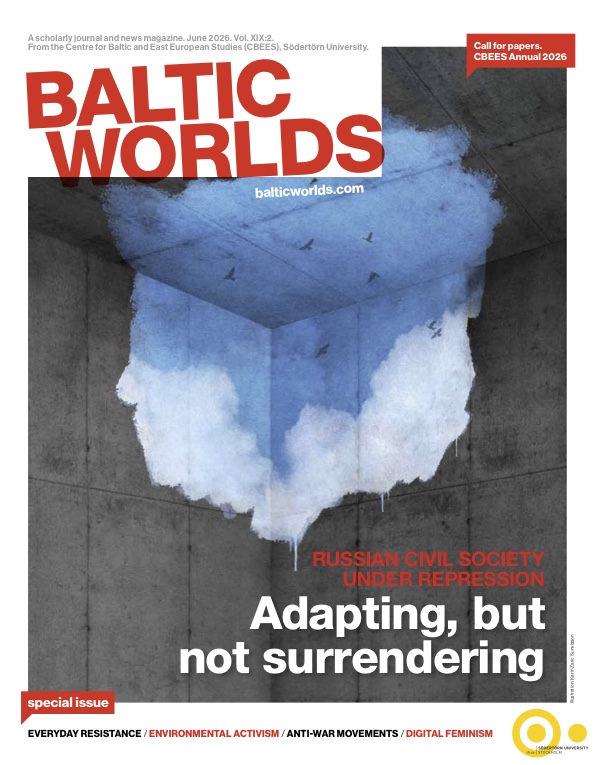 Issue 2026, 2:
  Baltic Worlds covers; the Baltic Sea Region, Eastern Europe, Russia, CentralAsia, Caucasus and the Balkan area.