This article examines how culture functions as a strategic instrument of recolonial power in the post-Soviet space, where imperial legacies, Soviet infrastructures, and contemporary authoritarian practices converge. Integrating postcolonial, decolonial, and recolonial frameworks, the study analyzes three emblematic cases – Gergiev’s 2008 Tskhinvali concert, the 2014 opera Crimea, and Sandro Sulaberidze’s 2023 protest in Tbilisi – to show how artistic production legitimizes territorial conquest, naturalizes hierarchical authority, and disciplines cultural autonomy.1 The article argues that recolonization today operates not only through military force but through performative, affective, and institutional mechanisms that render domination intelligible, emotionally resonant, and politically durable.
By
Nana Sharikadze
December 18, 2025
The section is an invitation to think further on the possibilities of implementing decolonial theory in the memory field of the countries that were dominated by the Soviet Union.
By
Yuliya Yurchuk
December 10, 2024
The essay analyzes the role of Western art institutions in supporting and promoting imperialist views on both the cultural and political history of what once was the Russian Empire, then the Soviet Union, and then the so-called “post-Soviet” space while they universalized and homogenized the multiple, complex, heterogenic, interconnected voices that temporally and spatially fell within the boundaries of the Russian Empire in its various forms. It looks into the case of the market-driven umbrella terms of “Russian art” and “Russian avant-garde,” as presented in several exhibitions in major Western museums between 2016 and 2019, dedicated to the centennial of the October Revolution, often called the Russian Revolution. The research focuses on the artists connected to Ukraine. It attempts to do them epistemic justice by restoring the complexity of the interconnections, contexts, and traditions they grew out of and were inspired by, as well as the ones they reworked, deconstructed, and revolutionized. By referring to decolonial thinkers, it combines and compares how imperial thinking, frames of reference, and coloniality work in symbolic and knowledge production.
Essay by
Kateryna Botanova
December 10, 2024
The article reflects if it is possible to decolonize memory in the former Soviet republics that have been gradually moving centrifugally towards different political allegiances. It is needed to go beyond the postcolonial/post-Soviet national optic and consider inter-imperial (Doyle) and non-nation-state post-imperial (Burbank and Cooper) models and other unrealized alternatives. The article focuses on coloniality of memory critically engaging with various concepts including “dismembering” (Thiong’o), “mankurtism” (Aitmatov), “Myalism” (Brodber), “multidirectional memory” (Rothberg), “double critique” (Khatibi), “species memory” (Kaiser and Thiele), and the “third way” (Wynter). It sets the goal of tracing possible paths for rethinking of what it means to remember in a human way and what it takes to engender a global mnemonic transversal network of solidarity for refuturing.
By
Madina Tlostanova
December 10, 2024

 Issue 2026, 1:
 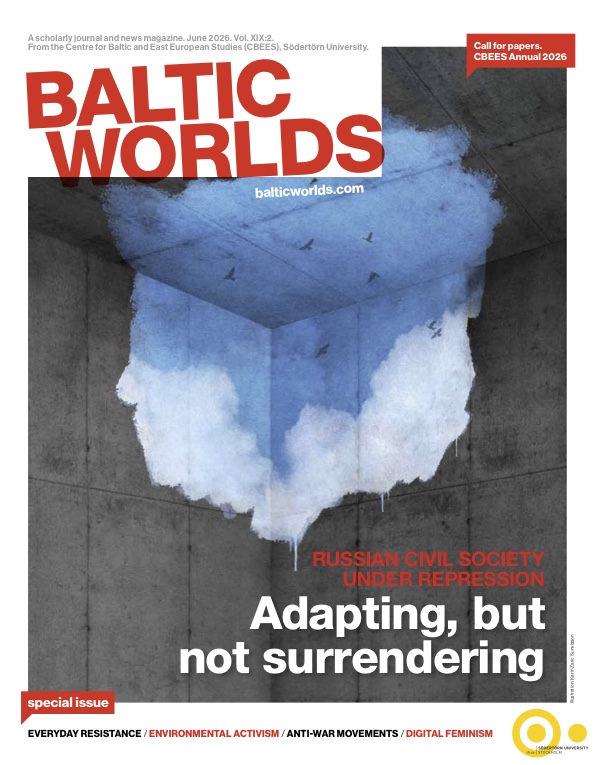 Issue 2026, 2:
  Baltic Worlds covers; the Baltic Sea Region, Eastern Europe, Russia, CentralAsia, Caucasus and the Balkan area.