This article focuses on the texts of songs, poems, prayers, and jokes created by Lithuanians deported to Eastern Siberia in large-scale relocations from the Lithuanian Soviet Republic in 1948 and 1949.
Essay by
Vsevolod Bashkuev
June 27, 2012
The author argues that, despite the disastrous effects of the enormous brain drain for Russia’s development, the emergence of Russian communities abroad can also be seen as an indicator of a normalization resulting from the opening up of the country after a long period of isolation. For Berlin, it is the regeneration of the mixed and more cosmopolitan society of the pre-Nazi and prewar epoch.
By
Karl Schlögel
September 22, 2011
After World War II, researchers in a number of scholarly fields, particularly literary criticism and history, have investigated the various activities of emigrant and exile groups. Leading scholars of East European history have long sought to direct their focus to the decisive importance of exiled intellectuals in 20th century East European history-writing and nation-building. It is gratifying that this research area has become the subject of a conference, “East and Central European History Writing in Exile — International Dissemination of Knowledge”, held December 3–5 at Södertörn University, arranged by CBEES, within the framework of the research theme “cultural theory”.
By
Markus Huss
February 24, 2010
European Humanities University, EHU, is a Belarusian university in exile that educates Belarusians in an academic environment that encourages the development of independent views. Students run the risk of arrest and interrogation by the Belarusian police. Some can no longer return to Belarus during school breaks.
By
Peter Lodenius
February 19, 2010

 Issue 2026, 1:
 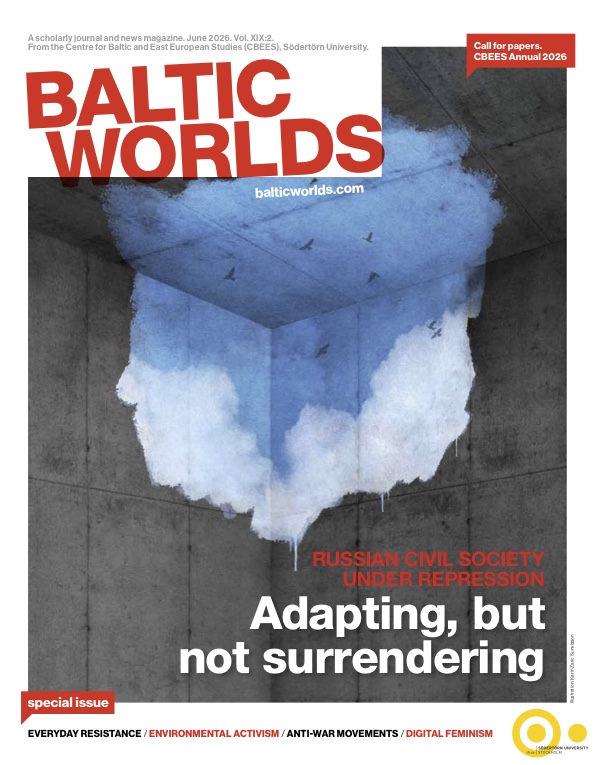 Issue 2026, 2:
  Baltic Worlds covers; the Baltic Sea Region, Eastern Europe, Russia, CentralAsia, Caucasus and the Balkan area.