RUTA is an association formed by epistemic communities and solidarity networks in response to Russia’s full-scale invasion of Ukraine. RUTA promotes and supports Central, South-Eastern, and Eastern European, Baltic, Caucasus, Central and Northern Asia Studies in the global conversation. Tereza Hendl is one of the founding members. In conversation with Elisa Satjukow she discusses the need to reclaim the debate, and emphasizes the decolonial forces set in motion to protect academia in the region from Russia’s violence and epistemological domination.
By
Elisa Satjukow
April 16, 2025
As the economic crisis in socialist Yugoslavia escalated in the late 1970s, the role of education, science, and technology in revitalizing self-management socialism and the economy became a hotly debated issue. Just as the number of universities more than doubled during the 1970s, they started to be criticized for producing unemployable graduates who burdened the economy instead of contributing to it, and for curtailing the upward social mobility of working-class youth. The paper examines the contemporary discussions of the economic purpose of higher education and presents “technocratic” and “anti-technocratic” positions in the debate which occasionally depicted the universities as responsible for the crisis, but also as potentially uniquely suited for resolving it– and thus reversing what many commentators saw as the country’s slide towards scientific, technological, and economic dependency and peripheralization.
By
Vedran Duančić
April 16, 2025
This special theme focuses on a regional context, whose academic history has so far been viewed primarily from a “Western” perspective. We argue, however, that the universities in the area that was supposed to be “integrated” after 1989 under the banner of Europeanisation have a history of their own. This history is shaped not only by different layers of imperial and national history, but above all by the shared experience of decades of socialist rule with its own ideas about the function of the university under socialism.
The authors of this special theme present case studies from different universities in the socialist countries of Central, Eastern, and Southeast Europe and their successor states. It aims to critically assess concepts and practices of “university” within the scientific systems of these (post-)socialist countries on the one hand, and the reciprocal effects that have occurred in the exchange with political or economic discourses on the other.
By
Friedrich Cain and Elisa Satjukow
April 16, 2025
The essay analyzes the role of Western art institutions in supporting and promoting imperialist views on both the cultural and political history of what once was the Russian Empire, then the Soviet Union, and then the so-called “post-Soviet” space while they universalized and homogenized the multiple, complex, heterogenic, interconnected voices that temporally and spatially fell within the boundaries of the Russian Empire in its various forms. It looks into the case of the market-driven umbrella terms of “Russian art” and “Russian avant-garde,” as presented in several exhibitions in major Western museums between 2016 and 2019, dedicated to the centennial of the October Revolution, often called the Russian Revolution. The research focuses on the artists connected to Ukraine. It attempts to do them epistemic justice by restoring the complexity of the interconnections, contexts, and traditions they grew out of and were inspired by, as well as the ones they reworked, deconstructed, and revolutionized. By referring to decolonial thinkers, it combines and compares how imperial thinking, frames of reference, and coloniality work in symbolic and knowledge production.
Essay by
Kateryna Botanova
December 10, 2024

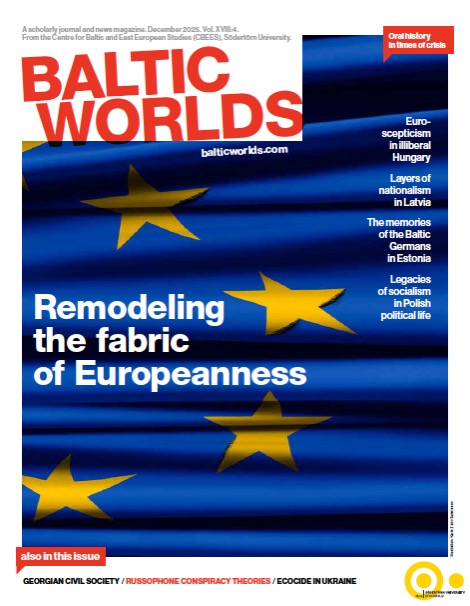 Issue 2025, 4:
  Baltic Worlds covers; the Baltic Sea Region, Eastern Europe, Russia, CentralAsia, Caucasus and the Balkan area.