Barbara Törnquist-Plewa & Magdalena Góra
Barbara Törnquist-Plewa is Professor of Eastern and Central European Studies; director for the Centre for European Studies, Lund University, Sweden. She specializes in cultural studies and contemporary history, focusing on studies of identities, collective memory, and nationalism.
Magdalena Góra is Assistant professor at the Institute of European Studies, Jagiellonian University, Cracow. PhD in political science. Her focus is on the EU role in international relations, Polish foreign policy and processes of collective identity formation in the context of the EU enlargement.
view all contributors
Articles by Barbara Törnquist-Plewa & Magdalena Góra
-
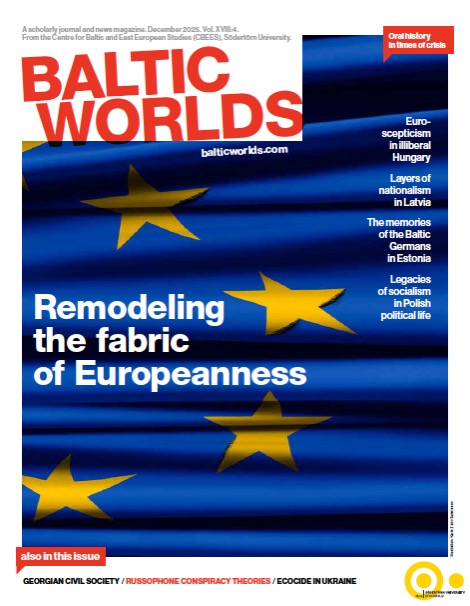
Postcolonial scholarship has made a significant contribution by highlighting and critically assessing the liminal, inbetween positionality of Eastern Europe, which has contributed to the neglect of voices and experiences from the region. Discourses that construct and reproduce the notion of Eastern Europe “catching up” have been examined in historical, anthropological, and sociological contexts, as well as across various fields, including international relations, memory studies, democratization, and European integration. This theme section explores some of these intricacies through the case studies of Poland, Hungary, Latvia and Estonia.
-
Vi, de fördrivna. Historiska erfarenheter hos polska judar som kom till Sverige 1967–1972 [We, the exiled. Historical experiences of Polish Jews who came to Sweden 1967–1972] Martin Englund, Södertörn doctoral dissertations, Stockholm, Södertörns högskola, (2025), 322 pages.
-
Ecocide in Ukraine: The Environmental Cost of Russia’s War Darya Tsymbalyuk, (Cambridge: Polity Press, 2025) 208 pages.
-
This article examines how female politicians in Poland’s contemporary Left navigate the complex legacies of socialism and communism in shaping their political identities and practices. Drawing on ethnographic fieldwork conducted before the 2019 parliamentary elections and during the 2021 party unification convention, as well as 23 in-depth interviews with current and former female left-wing politicians, the article explores how the socialist past continues to structure the discursive field within which the Left defines itself and whether this process is gendered. The analysis reveals how associations with socialism and/or communism are simultaneously disavowed and re-appropriated, as female politicians negotiate their belonging to a “progressive Europe” while distancing themselves from the stigmatized post-socialist East. The article argues that this negotiation unfolds from a distinctly post-socialist “in-between position,” where temporal and spatial hierarchies intersect with gendered experiences of political engagement.
-
Views of the past are constantly being revised, with the impact of different political and social occurrences generating new narratives and ways of interpreting history. This essay focuses on three cases of recent spatial reconfiguration in Estonia, all demonstrating how contrasting memoryscapes are perceived, especially after the full-scale Russian invasion of Ukraine in 2022. Since then, the Soviet memorials, symbols and murals in public space in Estonia have fallen under intense scrutiny as remnants and symbols of the Soviet regime. Russian aggression towards Ukraine seemed to reopen the wound of the most recent trauma. At the same time, the legacies of more remote oppressors, the Baltic Germans, has taken on a new meaning as a more neutral and even positive heritage. With three examples of spatial transformation, the essay examines the choices made on treating the layers of Estonian history and raises questions about how current decisions could shape our perception in the future.
-
This essay traces the development of Latvian nationalism from its emergence in the 19th century to the present, particularly examining how the relationship between the individual and the nation has been interpreted. By relying on the ideas of Johann Gottlieb Fichte and his idealization of authentic cultures, this essay examines his influences on the invention of authentic Latvian culture (and people) in the 19th century, as well as the afterlives of Fichte’s ideas during the Ulmanis regime, the independence struggle in the 1980s, and finally, in the contemporary, liberal era. The essay argues that the unfavorable comparison to their idealized, “authentic” selves has contributed to a discourse in which people are expected to engage in a personal and inherently intimate relationship with their nation. I argue that these principles produce an anti-populist nationalism that distinguishes Latvian nationalism from its European counterparts.
-
The article examines the role of Euroscepticism in the construction of an illiberal hegemonic regime by the Hungarian government, and its operationalization by right wing public intellectuals in their professional and subjective geopolitical analyses. Building on Alexei Yurchak’s concept of hypernormalisation, it argues that Hungarian Eurosceptic narratives have become part of a formalized authoritative discourse that provides a guiding framework for the regime’s intellectuals to voice their opinion about global politics and contemporary history, while leaving space for a set of diverse and often contradictory meanings to emerge in relation to Europe and the European Union.
-
Filming from under a history in erasure: Jessica Gorter’s documentary films about Russia’s memory and counter-memory.
-
Hadley Z. Renkin on Hungarian sexual politics, geotemporal belonging, and the impending reemergence of fascism.
-
Dr. Karlis Leyasmeyer arrived to the United States in 1949 as a displaced person from Latvia. While unknown to most Americans, he quickly embarked on a coast-to-coast speaking tour, organized by newly formed evangelical groups like Youth for Christ and InterVarsity Christian Fellowship. In these talks he glorified Christ and harshly criticized Soviet communism. We explore how Leyasmeyer went from relative unknown, to featured speaker in short order, but also how he situated himself in multiple spaces in his new country: as both a Latvian refugee among other Latvians, and as an evangelical Christian among American evangelicals. At times, Leyasmeyer thrived in these environments, but he would also find himself at the intersection of these groups. This research examines Leyasmeyer’s early career, his many achievements, but also how he developed an intellectual and theological outlook that was distinct from his Latvian contemporaries, as well as from the larger movements of American evangelicals.
-

 Issue 2025, 4: