contributors

Ildikó Asztalos Morell

Associate professor in sociology at Mälardalen University and is currently affiliated with the Uppsala Centre for Russian and Eurasian Studies as senior research fellow. Her current research explores processes of marginalization in rural Hungary from an intersectional perspective.

view all contributors

Articles by Ildikó Asztalos Morell

  1. Oral history of our time Challenges and visualization

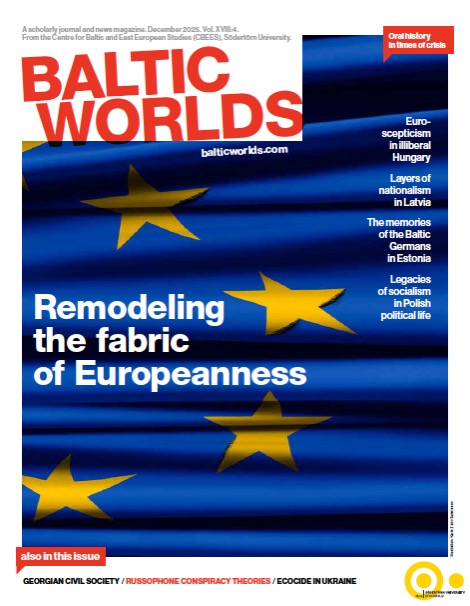
    The article explores how the ongoing Russian–Ukrainian war is transforming the discussion around the oral history method under the conditions of an active war and analyzes the potential of the graphic novel as a new form of publishing oral history sources. The focus is on the theoretical, methodological, and practical dimensions of oral history, as well as on the question of which forms of public representation become relevant in the situation of an ongoing event. Drawing on the project “Graphic Narratives about the War” (archival interviews from the 1990s and new recordings from 2022–2024, created in cooperation with the NeuengammeConcentration Camp Memorial), the article demonstrates how the combination of interviews and original graphic art influences the construction, interpretation, and affective perception of narratives. The theoretical section of the article outlines key conceptualizations of oral history as theory, method, and practice, distinguishes between “documentation” and “oral history” within the context of the “unfinished past,” and argues for the ethical foundations for choosing the graphic format. The empirical section describes the working process — from selecting and transcribing interviews to script adaptation, collaboration with artists, and decisions regarding content, form, format, and dissemination of the publication. The study contributes to current discussions on oral history in times of crisis, and public humanities, proposing the graphic narrative as a safe and meaningful tool for representing oral testimonies in the context of an ongoing war.

  2. Cultural recolonization in the post- Soviet space

    This article examines how culture functions as a strategic instrument of recolonial power in the post-Soviet space, where imperial legacies, Soviet infrastructures, and contemporary authoritarian practices converge. Integrating postcolonial, decolonial, and recolonial frameworks, the study analyzes three emblematic cases – Gergiev’s 2008 Tskhinvali concert, the 2014 opera Crimea, and Sandro Sulaberidze’s 2023 protest in Tbilisi – to show how artistic production legitimizes territorial conquest, naturalizes hierarchical authority, and disciplines cultural autonomy.1 The article argues that recolonization today operates not only through military force but through performative, affective, and institutional mechanisms that render domination intelligible, emotionally resonant, and politically durable.

  3. A longitudinal study of Russophone conspiracy theories about Ukraine. Content and methodological insights

    This article, based on longitudinal ethnography of Russophone groups in Estonia, examines conspiracy theories about the war in Ukraine as they emerged and evolved ever since the full-scale invasion. First, I explore the initial narratives and the underlying vulnerabilities driving conspiratorial thinking. I then discuss why these theories became taboo. Finally, I propose a novel approach to studying self-censored conspiracy theories – the metalevel analysis – and present preliminary findings from research on Russian-speaking adolescents in Estonia.

  4. Retreat but no surrender. Testaments from Georgian civil society under siege

    In the course of just a few months Georgia went from having one of the best working environments for civil society actors to one in which heads of the most prominent organizations are facing charges of treason. The civic space is rapidly shrinking as a result of strong and unprecedented orchestrated attacks on independent organizations and media through the weaponizing of legislation and a fierce propaganda machine set out to silence, stigmatize and practically leave no space for civil society actors. To illuminate how civil society actors are experiencing, interpreting, and adapting to this new climate of repression, we conducted four in-depth interviews with organizations active in different regions of Georgia. To this end, our paper aims to illuminate both the risks and the resourcefulness of Georgian civil society.

  5. Fredrik Bjarkö  (147) The Odyssey of Human Spirit: Historiography of Philosophy in the Post-Kantian Ag

     Abstract [en] In the 1790s, many post-Kantian German philosophers attempted to lay a new foundation for the historiography of philosophy. […]

  6. Gustav Sjöberg (146) Den levande materien: Naturfilologiska perspektiv på hylozoiska och panteistiska estetiker

     Abstract [en] In the classical Western aesthetic tradition, from Aristotle onwards, ’nature’ and ’art’ are conceptualised in relation to each […]

  7. Hamdija Begovic (145) Between Civic and Ethnic: The Party of Democratic Action and the Symbolic Struggle for a Bosnian-Herzegovinian State

     Abstract [en] This thesis examines the persistent political fragmentation of post-war Bosnia and Herzegovina, focusing on the role of the […]

  8. Anna Nyquist (144) Creating, maintaining, and enhancing sustainable marketing credibility

    Abstract [en] This dissertation takes as its focus the question of credibility in sustainable marketing: why it is both necessary […]

  9. Agnes Käll (143) Inside the compliance puzzle: Dilemmas of supervisory agencies in anti-money laundering

    Abstract [en] This thesis unpacks the empirical puzzle that banks suspected of involvement in money laundering may nevertheless be deemed […]

  10. Oscar Nygren (142) Östersjöfrågan – En idégeografisk studie av svenskt utrikespolitiskt tänkande 1914–1945

     Abstract [en] This thesis argues that the Baltic Sea region was shaped intellectually, politically and geographically during the period 1914–1945. […]

Looking for someone? Enter a contributor's name and we will have a look!

Here you can read about the people who have been involved in Baltic Worlds. The texts and images have been provided by the individuals themselves.

If you have contributed to Baltic Worlds and would like to update your presentation, or if you want to send a message to one of our collaborators, send an email to bw.editor@sh.se.