Lia Dostlieva and Andrii Dostliev
Lia Dostlieva is an Ukrainian artist, essayist, cultural anthropologist and researcher at Adam Mickiewicz University in Poznań, Poland. Focusing on trauma, postmemory, commemorative practices, and agency and visibility of vulnerable groups and how to process “difficult knowledge” and “difficult past”.
Andrii Dostliev is an independent Ukrainian artist, curator, and photography researcher currently based in Poland. His primary areas of interest are memory, trauma, identity – both personal and collective, and various aspects of queerness. Works in various media.
view all contributors
Articles by Lia Dostlieva and Andrii Dostliev
-
The International Workshop Far-right Memory Politics in the Internet Era held at the Centre for Baltic and East European Studies from 15–16 January 2020 investigated the nexus between far-right activism, memory politics and the internet.
-
CfP: Please submit before February 20, 2021 on the New Age-related topics suggested here.
-
The Centre for Baltic and East European Studies, CBEES, arranges a series of multidisciplinary roundtables during 2021 with a focus on the 30 years period since the dissolution of the Soviet Union.
-
The outbreak of the Corona virus pandemic has led to a number of legal measures, varying in time and space, over the Baltic Sea area and neighboring states. But the actual distribution of the pandemic does not necessarily follow the administrative territories that form the statistical basis for decisions. While usually defined for specific territories (whole states or administrative areas), the effects on peoples’ daily behavior have been particularly strong in the borderlands. In March 2020, suddenly a sharp line was created along the hitherto almost invisible border between Tornio-Haparanda, Finnish police and border guards checked the line, and only a few people were admitted to cross, based on strict definition of purpose. The reason for the closure was a high incidence of illness and deaths in Sweden.
-
This is an English missionary’s tales of Siberia in the late 19th-century The expedition by Henry Lansdell is documented in the two volumes of Through Siberia from 1882.
-
Miroslava Duma, who presents herself as a Russian digital entrepreneur and investor in international fashion, has described Russia during the communist era as a fashion-free zone. Dresses were supposed to be simple back then. Later, Russian women rather became identified by their big hair, leopard tights and showing off bling and brands. However, this image was to be changed.
-
Awareness of potential political sanctions can stop social media users from expressing critical and open political views for the sake of personal security. This essay focuses on political bloggers in Belarus and Russia as political opinion leaders who have become more frequent targets of these regimes in recent years. The essay presents the results of a survey on perception and practices of self-censorship conducted among 61 well-known political bloggers in Russia and Belarus and discusses them in relation to the theory of the spiral of silence.
-
Ukrainian Greek-Catholic Church (UGCC) is only one of several Eastern-Christian communities which actively take part in the Ukrainian social life. Moreover, statistical data and results of the social surveys show that the members of UGCC are not numerous and that structures of this church are strongly geographically limited. However, during the events related to the Euromaidan, it turned out that UGCC was able to make an important influence on the social developments referred to as the all-Ukrainian social level. This was possible due to the relevant social and symbolic capital which UGCC has on its disposal. This article aims to characterize the elements of the social and symbolic capital that enabled UGCC to become such important agent in the contemporary social transformations in Ukraine.
-
In this article, I focus on the mainstream media coverage of the background of Volodymyr Zelensky, candidate for the position of President of Ukraine and, subsequently, the sixth President of Ukraine. The elections provoked a splash of international interest in Ukraine because of the unexpected candidate, a comedy actor with no prior political experience. This research shows that not only the professional, but also the ethnic background of Volodymyr Zelensky became an important topic in the international media during the presidential campaign and the elections of the President of Ukraine in 2019. Mentions of Zelensky’s Jewish background were supported by references to certain stereotypical views about the history of Ukraine, and his elections were covered as an unexpected breakthrough – either from the Soviet or from the anti-Semitic past.
-
Viktor Yelensky, professor of religion, in a conversation with Yuliya Yurchuk on the position of religions in Ukraine, and different religious actors in the ongoing military conflict in a broader perspective.
-

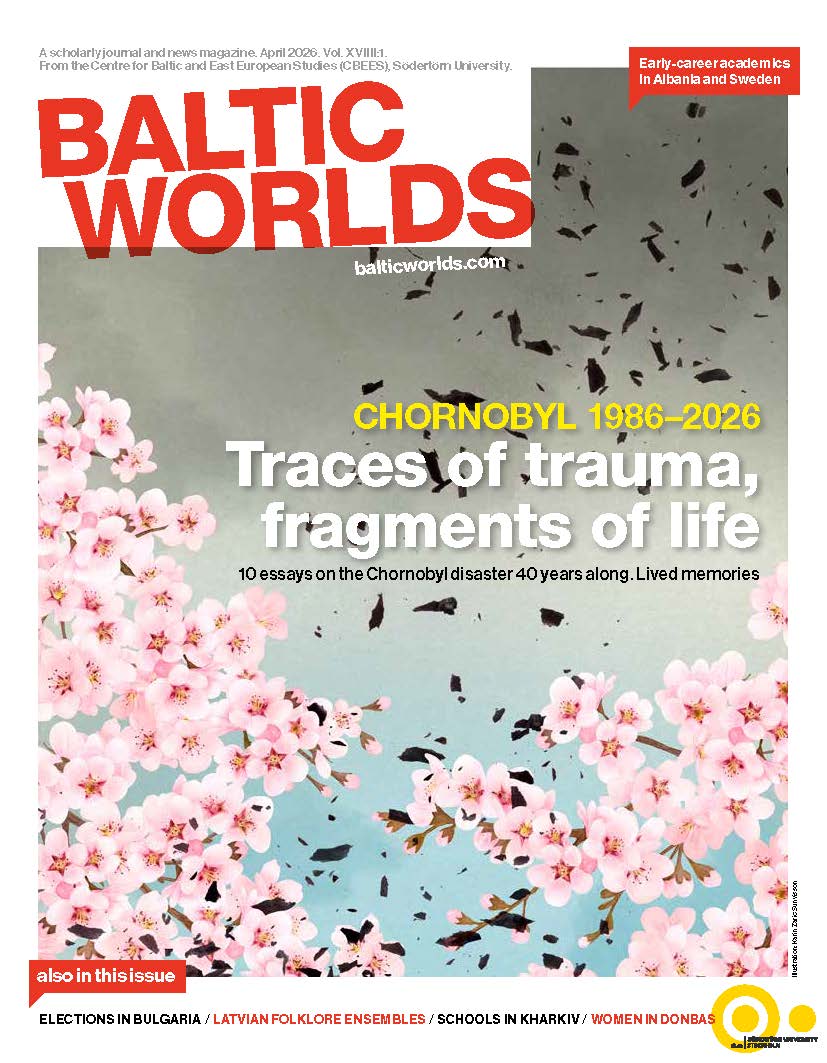 Issue 2026, 1: