Survival Kit festival in Riga art against crisis
When the shops in the center of Riga emptied out in the wake of the economic crisis, the artists were given free reign over the spaces – the result was an art festival.

A scholarly journal from the Centre for Baltic and East European Studies (CBEES) Södertörn University, Stockholm.
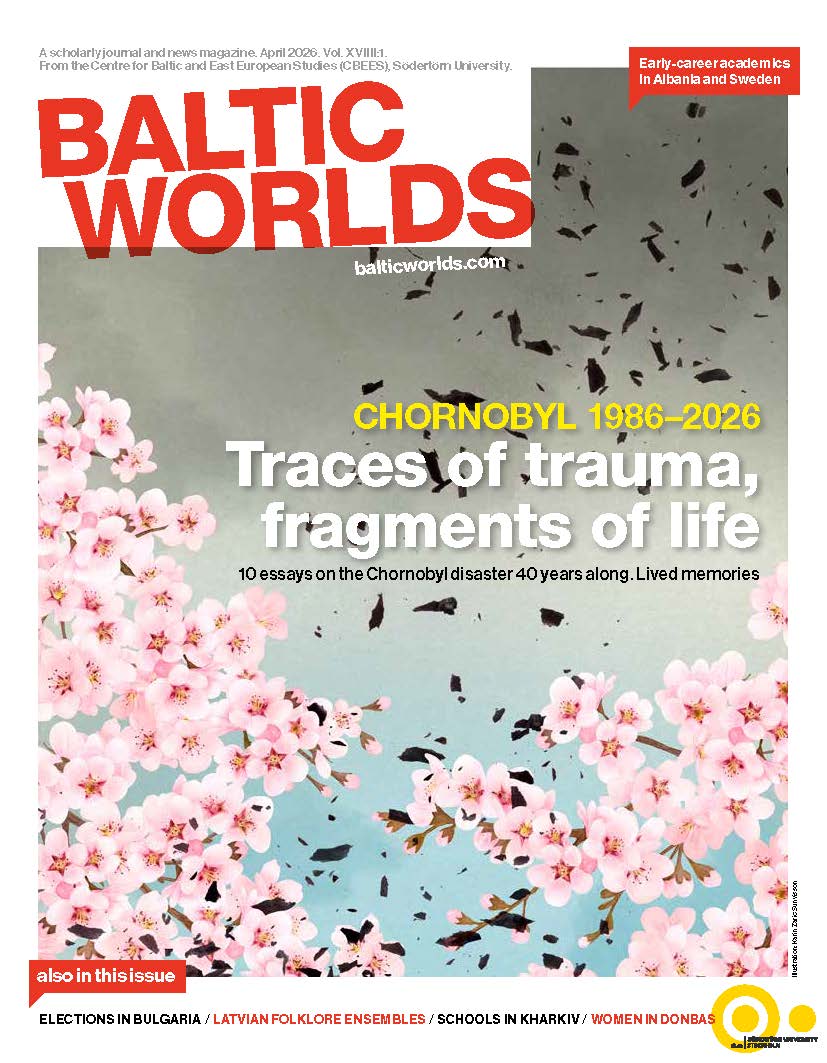 Issue 2026, 1: Download.
Lia Dostlieva is an Ukrainian artist, essayist, cultural anthropologist and researcher at Adam Mickiewicz University in Poznań, Poland. Focusing on trauma, postmemory, commemorative practices, and agency and visibility of vulnerable groups and how to process “difficult knowledge” and “difficult past”.
Andrii Dostliev is an independent Ukrainian artist, curator, and photography researcher currently based in Poland. His primary areas of interest are memory, trauma, identity – both personal and collective, and various aspects of queerness. Works in various media.
When the shops in the center of Riga emptied out in the wake of the economic crisis, the artists were given free reign over the spaces – the result was an art festival.
The fact that Moscow and St. Petersburg house in total five fashion events every season makes one think that the fashion business is considered attractive and economically sound in Russia. However, despite the growth of the Russian fashion market since the 1990s, the fashion industry is losing ground to other promising fashion hubs.
Infrastructure forms a link between the open global economic space and the non-public Russian political space. The question of how to manage the most important trade flows and understand their social importance is not, of course, solely seen as a matter of Russian politics. The research on Russia is also connected to the recent debate on the importance of increasing globalization and the mutual dependence of societies.
“Market Reform and Socio-Economic Change in Russia” was the subject of an ambitious full-day seminar held October 6, focusing on the period since the fall of the Soviet Union.
Maria Janion is Poland’s undisputed intellectual authority – but she is relatively unknown abroad. Maria Janion is a professor emeritus of literature. Her studies of Romanticism led Janion to see the specificity in Poland’s cultural development. As a public intellectual, Janion has always intervened in the political discourse. In recent years, she has put her authority to use to support the feminist movement and the reawakened new Left.
The Polish professor in literature, Maria Janion, writes on Polish identity, and its interpretation and reinterpretation, its crisis and the process of shaping a new Polish imagery. There is a ongoing dialog between the past and the present and a constant struggle between the free Poland and the posthumous life of Romanticisim.
On 4 December, Slovenian citizens went to the polls to elect their representatives in the National Assembly of the Republic of Slovenia, after the President of the Republic, Danilo Türk, had signed an order dissolving the Assembly on 21 October 2011. The Republic’s first snap elections were called after a vote of no confidence on 20 September had brought down the left-wing government led by Borut Pahor (Social Democrats). Here the author notes that several long-term implications may arise from the election results and post-festum reactions.
The city of Kaliningrad itself with its 450,000 inhabitants has acquired a European face. New buildings and shops have appeared all over the center, and the modern shopping malls are packed with both imported and Russian products, marked and sold with electronic bar codes.
The authors here argues that the total picture of the Scandinavian can only be established when the “Rosenholz”-files are generally available. The Rosenholz files consist of three different kinds of records, originally created by the HVA. The major part of the files is 293,000 filing cards of the person index of the HVA. The part of Rosenholz which today is kept in the Stasi files lists 133,000 West Germans, 24,000 West Berliners, 112,000 East Germans, and 121 citizens of other states.
In the short term it seems reasonable to assume that Putin wants to win the presidential elections in early March by an absolute majority in the first round. The election campaign will be a first pointer to where Russia is heading.