Oksana Shmulyar Gréen & Andrea Spehar
Oksana Shmulyar Gréen is PhD in sociology and senior lecturer at the Department of Sociology and Work Science, University of Gothenburg. Her research interests include issues of global migration, gender, and care at a distance, with a special focus on child well-being and migrants’ rights.
Andrea Spehar is PhD in political science and senior lecturer at the University of Gothenburg; researcher at the Centre for European Research (CERGU). Her focus is on political and gender equality developments in Central and Eastern Europe and migration policy development in the EU.
view all contributors
Articles by Oksana Shmulyar Gréen & Andrea Spehar
-
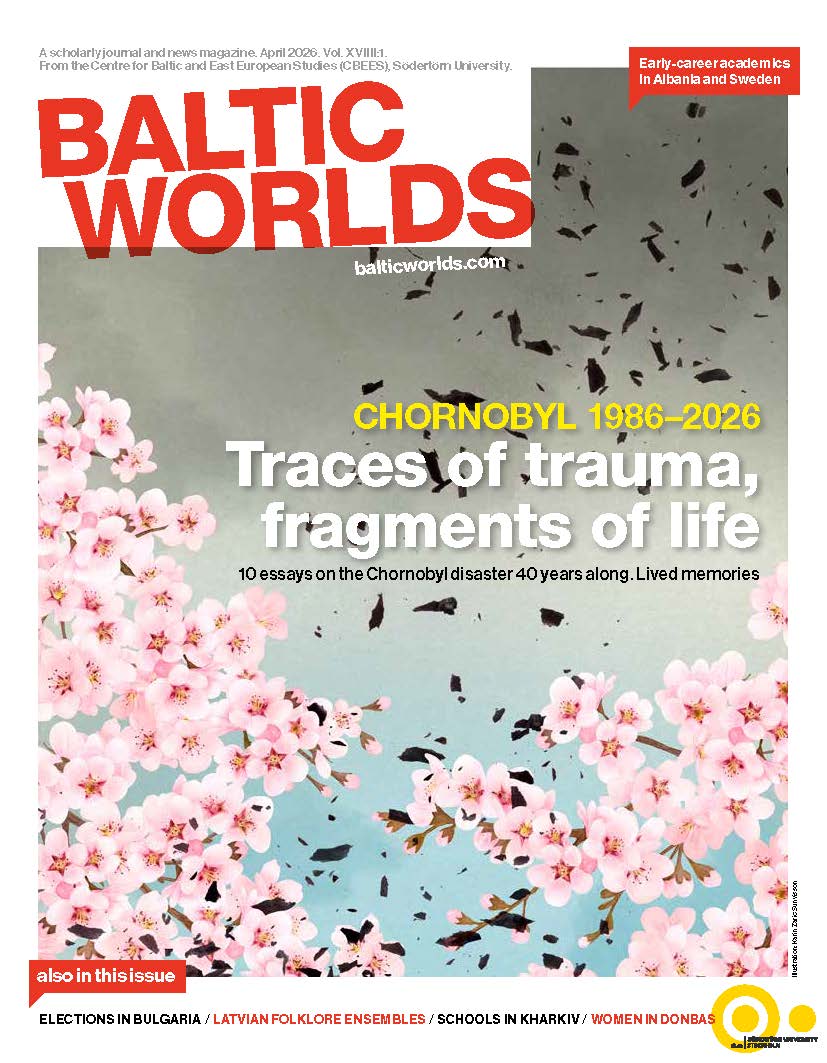
What Chernobyl means to different people has dramatically changed over time. Today, its image mostly invokes fear of radiation, illness, as well as uncertainty. The ruins of the plant are regarded as a somewhat unpredictable source of danger that needs constant attention and monitoring. This is a remarkable historical change from how Chernobyl used to be seen. Before 1986, the construction of Ukraine’s first major nuclear power plant symbolized progress and the hope for a better future. In light of the Russian invasion of Ukraine and recent media coverage of nuclear energy in this context, Chernobyl has truly become a memory space, serving as a place for projections of a multitude of attitudes regarding nuclear safety, catastrophe, war, maintenance and negligence.
-
After the years of Covid closure, when the world was making socializing a possibility once more, Putin attacked Ukraine in February 2022. This meant controversies about how Russians are seen in all industries, including in fashion. So, what has happened to the Russian Fashion Mafia?
-
Even though it is not uncommon for first ladies of various countries to be pictured on the cover of Vogue, this time it stirred some concern. There have been heated discussions on social media. Why does the most prestigious fashion magazine in the world offer their front cover to a first lady defending her country, a country unknown for its design and fashion? And why does she accept? There were considerable discussions on the matter and Zelenska has been both criticized and praised for taking this opportunity.
-
In this essay it is argued that membership of a military alliance with clear security guarantees is a fundamental factor for safeguarding Ukraine’s statehood. The neutrality solution advocated for Ukraine by the so-called “realists” in both academic and political environments does not apply to the Ukrainian-Russian war. Realist readings, as the author demonstrates in the essay, are problematic and cannot explain the fully complex nature of the conflict. On the other hand, an insight into Russia’s imperial identity provides a more convincing outlook of the situation.
-
The impact of negative rhetoric towards Ukraine, the United States and European countries are the constant ingredients in the “menu” of Russian state media resources, not to mention blogs and social networks.
Previous examples such as Rwanda and Srebrenica have shown how words of hatred lead to acts of hatred, with yesterday’s civilians being ready to kill their dehumanized neighbors. Unfortunately, one now can add to this list of examples Ukraine. Hate speech towards Ukraine began to gain momentum since 2014, after the “Revolution of Dignity” took place and the country was taking a political course towards European integration.
-
The concept presented by Bloodlands includes a particular state of being at the mercy of the cultural landscape, which has a complex imprint — of history, politics, socialization. I saw the task of my generation to be the “liberation” of this landscape, a performative healing of my country, where the process of coming to terms with the bloody past would have coexist with the development of solidary and non-violent cohabitation. Today’s war of annihilation has torn not only my generation, but also the older and younger generations from their previous lives and brought them down to the bloody ground.
-
Civil society in Ukraine is, although under severe stress, very active and plays an important role in providing people with their basic needs and safeguarding their human rights. Civil society in Ukraine is still functioning even in a situation of full-scale invasion and warfare, with constant shelling and unpredictable attacks on infrastructure and Ukrainian civilians. How is this possible?
-
Statistics show that around 40 000 Russians escaped through Finland from the day that President Putin declared the mobilization and during the nine days that followed until the border closed. I am on my way to Karelia, a region along the southern part of the Finnish-Russian border where some of the most intense battles between two countries took place during the Second World War. As I write this October 2022, the atmosphere around the border is tense, the relations between the two countries are colder than in a long time, and people on either side of the border have difficulties even seeing each other. That, however, has not always been the case...
-
Many who grew up speaking Russian in independent Latvia do not associate themselves with Russia or what one could call the Russian world, nor the values and aggressions carried out in Ukraine in the Russian language. A recent survey shows that the Russian speaking residents aged 18 to 34 years were more likely to condemn the Russian invasion of Ukraine. Yet, many Russian speakers in Latvia are experiencing an emotional crisis over Russia’s invasion of Ukraine. The war has securitized already divisive issues in the country, such as historical memory and access to media in one’s preferred language.
-
The independent Russian newspaper Novaya Gazeta is known for its critical and investigative coverage of Russian political and social affairs. Their former editor-in-chief, Dmitry Muratov, received the Nobel Peace Prize in 2021. Kirill Martynov is now editor-in-chief for Novaya Gazeta Europe, operating from Riga, Latvia. He is the newspaper’s former political editor, a political scientist, and a former associate professor at Moscow State University. In an open lecture at Södertörn University November 22, Kirill Martynov discussed Russian journalism in exile and the new chapter in Novaya Gazeta’s life.
-

 Issue 2026, 1: