The monolithic other of the Cold War. East versus West
+ Fontana, Josep, Por el bien del imperio: Una historia del mundo desde 1945, [For the good of the empire: a history of the world since 1945] , Barcelona 2011, Pasado y Presente ,1 230 pages

A scholarly journal from the Centre for Baltic and East European Studies (CBEES) Södertörn University, Stockholm.
 Issue 2026, 1: Download.
48 articles tagged with communism were found.
+ Fontana, Josep, Por el bien del imperio: Una historia del mundo desde 1945, [For the good of the empire: a history of the world since 1945] , Barcelona 2011, Pasado y Presente ,1 230 pages
VNIITE, once the world’s largest institute of design research, ceased to exist on June 14, 2013. It was once conceived as a marriage of engineering and aesthetics. Intellectual abilities and sensitivity were to be respected rather than viewed as problems.
+ Vasily Grossman, Everything Flows, Editor and translator: , Robert Chandler, New York, New York Review of Books 2009, 253 pages
+ Vasily Grossman, The Road: Stories, Journalism, and Essays, Editor and translator: , Robert Chandler, New York, New York Review of Books 2010, 373 pages
Den goda tanken och den onda erfarenheten [The good idea and the evil experience] Lund University Department of History Lund 2011, 157 pages
Orphanage No. 7 in Taganrog was one of the former Soviet orphanages that came into contact with the new charity early on, in the form of summer vacation exchanges with Swedish host families. The reality Swedish visitors encountered in Taganrog and elsewhere, however, was not always of the dreaded kind — a destitute shelter for desperate children abandoned by the world — although such a description was at times apt, especially in reference to homes for the mentally disabled. What they found instead were tangible traces and elements of entirely different plans and ambitions.
Wendy Z. Goldman, Inventing the Enemy, Denunciation and Terror in Stalin’s Russia, Cambridge et al.Cambridge University Press 2011, 320 pages
The history and sociology of the telephone in Russian society have only slowly become the object of serious study. The scope of this essay is limited to the following two topics: first, the forms of use, in pre-revolutionary Russia and the Soviet Union, of the telephone as a means of communication, potentially universally available and “horizontal” but actually restricted by “vertical” forces; and second, the symbolism that accumulated around this means of communication in Russian and Soviet culture.
Though once very controversial in the context of the Cold War, Fitzpatrick’s view of totalitarianism in the Soviet Union as something complex, full of contradictions and of different kinds of agency, has now become a commonplace in Russian studies.
Croatia is finally at the doorstep of the EU. Now the door is open and there is no need to knock and wait to get in. Croatia will be part of Eu and be able to participate and be active in social, economic and political projects of common interest.
Maria Janion is Poland’s undisputed intellectual authority – but she is relatively unknown abroad. Maria Janion is a professor emeritus of literature. Her studies of Romanticism led Janion to see the specificity in Poland’s cultural development. As a public intellectual, Janion has always intervened in the political discourse. In recent years, she has put her authority to use to support the feminist movement and the reawakened new Left.
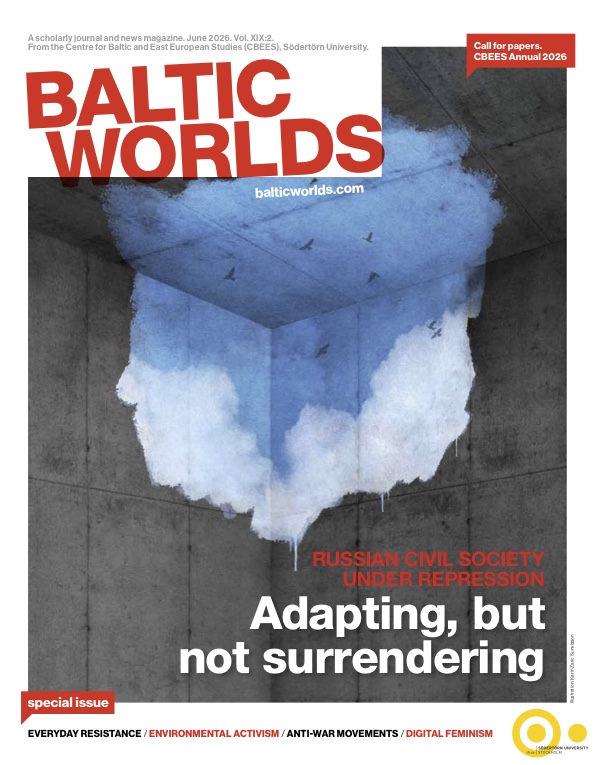 Issue 2026, 2: Download.
 Baltic Worlds covers; the Baltic Sea Region, Eastern Europe, Russia, CentralAsia, Caucasus and the Balkan area.