This essay traces the development of Latvian nationalism from its emergence in the 19th century to the present, particularly examining how the relationship between the individual and the nation has been interpreted. By relying on the ideas of Johann Gottlieb Fichte and his idealization of authentic cultures, this essay examines his influences on the invention of authentic Latvian culture (and people) in the 19th century, as well as the afterlives of Fichte’s ideas during the Ulmanis regime, the independence struggle in the 1980s, and finally, in the contemporary, liberal era. The essay argues that the unfavorable comparison to their idealized, “authentic” selves has contributed to a discourse in which people are expected to engage in a personal and inherently intimate relationship with their nation. I argue that these principles produce an anti-populist nationalism that distinguishes Latvian nationalism from its European counterparts.
Essay by
Gustav Lundberg
December 18, 2025
Dr. Karlis Leyasmeyer arrived to the United States in 1949 as a displaced person from Latvia. While unknown to most Americans, he quickly embarked on a coast-to-coast speaking tour, organized by newly formed evangelical groups like Youth for Christ and InterVarsity Christian Fellowship. In these talks he glorified Christ and harshly criticized Soviet communism. We explore how Leyasmeyer went from relative unknown, to featured speaker in short order, but also how he situated himself in multiple spaces in his new country: as both a Latvian refugee among other Latvians, and as an evangelical Christian among American evangelicals. At times, Leyasmeyer thrived in these environments, but he would also find himself at the intersection of these groups. This research examines Leyasmeyer’s early career, his many achievements, but also how he developed an intellectual and theological outlook that was distinct from his Latvian contemporaries, as well as from the larger movements of American evangelicals.
By
Joseph M. Ellis et al
December 18, 2025
The article discusses the portrayal of hippies in The Pink Elephant (Rozā zilonis, 1976), a story by the Latvian SSR writer and physician, Miervaldis Birze (1921–2000). The author’s attitude towards this counterculture is mostly critical, even patronizing; however, it is through the portrayal of the hippies, Broņislavs and Baiba, that the author indulges in a conversation about young adulthood, revives the story, and even trifles with the questionable or inadmissible aspects of life. The Pink Elephant, when read through the lens of renewed interest about Soviet hippies, reveals their living conditions, attitude towards power, their parents, and themselves. As opposed to their Western counterparts, the impoverished Soviet hippies (who had experienced the system of blats and the shadow economy) did not condemn consumerism; in fact, they sought out material goods, especially those originating from the other side of the ocean.
Essay by
Anna Auzāne Paula Auzāne
December 9, 2024
This article highlights some of Spekke’s activities during his proxy as head of the Latvian legation in Italy during the Soviet period, and immediately after re-independence when he was dividing his time between Italy and the United States.
By
Rosario Napolitano
September 18, 2024
This is a presentation of three original public opinion surveys covering the Baltic states, that were recently released in the public domain. All three surveys have been designed specifically to tap the political culture of Estonia, Latvia and Lithuania, including the Russian-speaking poulation groups and other domestic ethnic minorities.
By
Joakim Ekman
August 7, 2024
Radical right parties (RRPs) have been extensively studied throughout the past two decades. One neglected aspect is the youth organizations (YOs) of RRPs and their transnational networks. This article analyzes the transnational links between the YOs of RRPs in Estonia and Latvia. The article contributes to the literature by arguing for four findings relating to the transnational links between the YOs of RRPs, which provide a window into the future of the parties being analyzed.
By
Pēteris F Timofejevs and Louis John Wierenga
August 23, 2023
This Special Issue include eight articles that endeavor to analyze more deeply different aspects of the influence of transnational “soft power” aimed at coopting youth in authoritarian and hybrid regimes through radical and nationalist youth organizations, patriotic education, and youth wings of ruling parties. By means of such activities, governments try to distract the youth from countercultural movements and opposition politics as well as to educate an obedient and loyal generation. The purpose is to “vaccinate” such generations with illiberal or authoritarian values in order to eliminate potential threats to regimes’ stability.
Essay by
Oleg Antonov and Olena Podolian
August 23, 2023
Bakom och bortom järnridån. De sovjetiska åren och frigörelsen i Baltikum och Ukraina [Behind the Iron Curtain and Beyond. The Soviet Years and the Emancipation in the Baltics and Ukraine]. Li Bennich Björkman. Stockholm: Appell förlag. 465 pages
By
Kristian Gerner
June 20, 2023
Many who grew up speaking Russian in independent Latvia do not associate themselves with Russia or what one could call the Russian world, nor the values and aggressions carried out in Ukraine in the Russian language. A recent survey shows that the Russian speaking residents aged 18 to 34 years were more likely to condemn the Russian invasion of Ukraine. Yet, many Russian speakers in Latvia are experiencing an emotional crisis over Russia’s invasion of Ukraine. The war has securitized already divisive issues in the country, such as historical memory and access to media in one’s preferred language.
Essay by
Emma Rönngren
January 18, 2023
This article will present the story of Jānis (Žanis) Lipke, a Latvian man living an ordinary life who became a national hero by saving fifty-five Jews from the brutality of the Nazi regime.
By
Michela Romano
October 7, 2020

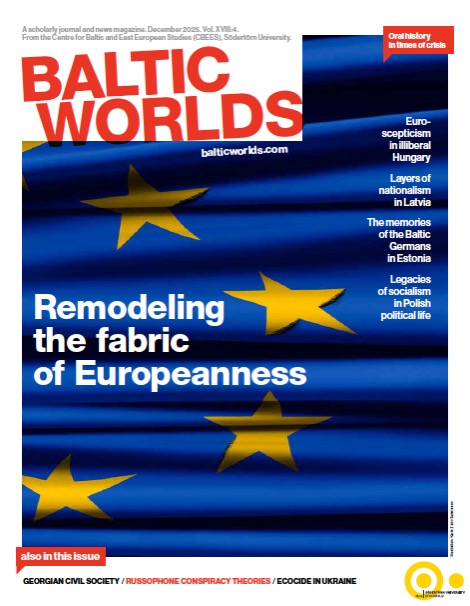 Issue 2025, 4:
  Baltic Worlds covers; the Baltic Sea Region, Eastern Europe, Russia, CentralAsia, Caucasus and the Balkan area.