Rather than moving towards arguments or ideological standpoints, the politics in Ukraine has moved farther towards selling emotions, stories and images. This time it was the politics of mediatised emotion on steroids. Is this simply a new politics that can be used in a populist and non-populist ways, or for progressive as much as reactionary causes? It may look like it is a neutral tool but I would still argue that this kind of politics substitutes political mobilisation with political immersion by submerging the audience into a story, an emotional environment, an experience.
By
Roman Horbyk
May 2, 2019
Ukraina och informationskriget – journalistik mellan ideal och självcensur [Ukraine and the information war – journalism between ideal and self-censorship] Gunnar Nygren and Jöran Hök (ed.), Myndigheten för samhällsskydd och beredskap. (2016), 279 pages.
By
Per Ekman
March 26, 2019
In less than 15 years, activist journalists have enjoyed a vertiginous career in Ukraine, from a persecuted and marginal minority to one of the most influential social groups and key actors in the political field. This was certainly facilitated by the technological shift that made media work more cost-efficient and less resource-demanding. But the transformation could also only happen because the culture had a long tradition of journalists taking a stand against authorities, and the idealized figures of an honest publicist, a passionately engaged writer, and a resistance fighter were familiar and readily accepted by the public.
By
Roman Horbyk
March 7, 2019
Independent media in Belarus is experiencing continued difficulties due to President Alexandr Lukashenko’s repressive policies. To avoid censorship, a number of independent media outlets, such as the most popular news site Charter 97, have chosen to work from abroad. Although this might give them maneuvering space to go on reporting, it also means that many Belarusian citizens do not have access to a sufficient amount of opposition news.
By
Marina Henrikson
September 6, 2018
The paper is a study of the Ukrainian popular culture based on the material of the Ukrainian TV comedy shows which emerged after 1991. They are: Maski Show, Gentlemen Show, Verka Serduchka, Fajna Ukrajna, Vital’ka, and Evening Kvartal. These TV shows have not been investigated by Western, nor Ukrainian scholars. The Ukrainian TV comedy shows are examined in the context of Bakhtin’s theory of carnival and of the ideas of the Australian Slavic scholar M. Pavlyshyn who has elaborated the concepts anticolonialsim and postcolonialism in relation to contemporary Ukrainian culture.
By
Viktoriya Sukovata
June 19, 2017
Disinformation tools are not something unique or new and have been used long time ago. But now we are living in times when information became a weapon. Annexation of Crimea, war in Donbas and in Syria have shown a significant role of information.
By
Maksym Kyiak
December 21, 2016
This article explores the limits of gendered surveillance in Azerbaijan – that is, how and to what extent female activists and women journalists are monitored and affected by the surveillative apparatuses of the state, both online and offline.
By
Ilkin Mehrabov
May 12, 2015
By analyzing the usage of the word “market” (rynok) in the Russian press since 1990, the author shows how the keyword takes on new meanings, reflecting and relates to the different social and political roles of the press outlets in an evolving, modernizing environment.
By
Katja Lehtisaari
October 20, 2014
The Russian media system today is a hybrid composed of the main public sphere — that is, state-owned mainstream media — and a parallel public sphere or counter-sphere, consisting of mainstream media relatively disloyal to the Kremlin, and social media. The present study is based on an analysis of one hundred journalist’s blogs maintained on the LiveJournal platform in during the 2012 presidential election in Russia.
By
Elena Johansson
October 19, 2014
BECAUSE OF THE direct Russian intervention, the territorial integrity and independence of the Ukrainian state is at stake. But as long as business and politics are as intimately intertwined as they are today, any serious reform in Ukraine in line with the ideological foundation of the protest movement will be a an exceptionally challenging task.
By
Hanna Söderbaum
April 28, 2014

 Issue 2026, 1:
 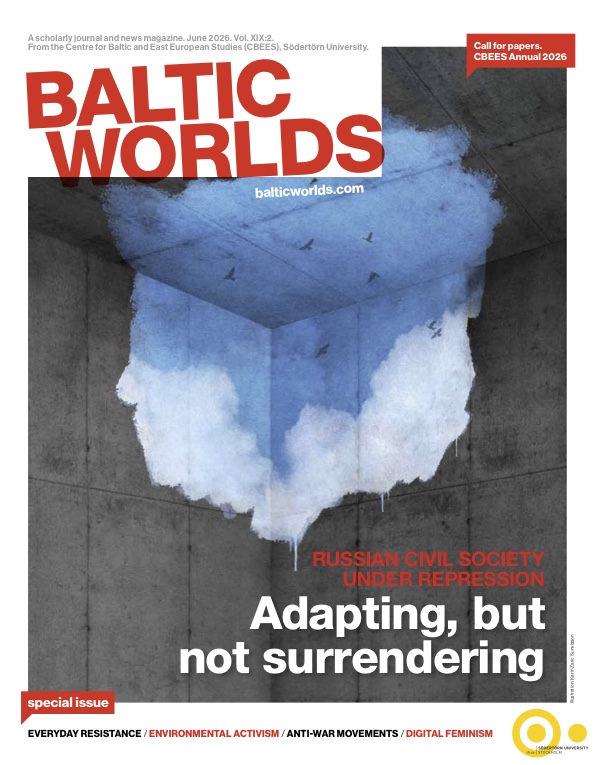 Issue 2026, 2:
  Baltic Worlds covers; the Baltic Sea Region, Eastern Europe, Russia, CentralAsia, Caucasus and the Balkan area.