The projection of imperial power through overtly religious pageantry, symbols and narratives has been a key element of Russia’s identity politics under Putin, informing the Kremlin’s aggressive international policies, but also shaping the domestic perceptions of Russia’s global role.
In a conversation with Irina Sandomirskaja, Valentina Izmirlieva explores the utility of the Russian Orthodox Church in this process, and the significant transformations within the Orthodox sphere that facilitate the radical militarization of Russian society. She also discusses the role and future of multidisciplinary area studies as such, and in particular Slavic Studies.
By
Irina Sandomirskaja
September 18, 2024
Is radical Ukrainian nationalism disappearing? However marginal but playing a decisive role in the resistance against
Russian aggression, along with the rest of Ukrainian society, this political movement has suffered terrible losses that raise questions about its ability to maintain itself in the post-war political arena. This forward-looking essay examines the multiple challenges posed by this issue, arguing that the Far-right in Ukraine could perhaps find in the war an undeniable opportunity for a renaissance
Essay by
Adrien Nonjon
June 20, 2023
This paper examines women’s contribution to war and the perceptions of that contribution by comparing experiences of women in the Red Army during the Second World War and in the Ukrainian Armed Forces in the conflict in the Donbas region. Here it is argued that in both cases structural gender discrimination was ingrained in the military, which accepted women’s contribution to war in times of need, but treated that contribution as subsidiary, thereby distorting men’s and women’s experiences of warfare and facilitating the instrumentalized militarization of women.
Essay by
Olesya Khromeychuk
March 8, 2018
Christer Lokind: DC-3:an. Kalla krigets hemlighet [The DC-3: the secret of the Cold War]. Stockholm: Medströms bokförlag, 2014.
By
Thomas Lundén
May 13, 2015
The geopolitical situation shaped life on the islands of Gotland, Rügen, and Saaremaa. They became garrison islands and the presence of the military transformed daily life. After the Cold War, the military left the islands.
Essay by
Beate Feldmann
February 12, 2010

 Issue 2026, 1:
 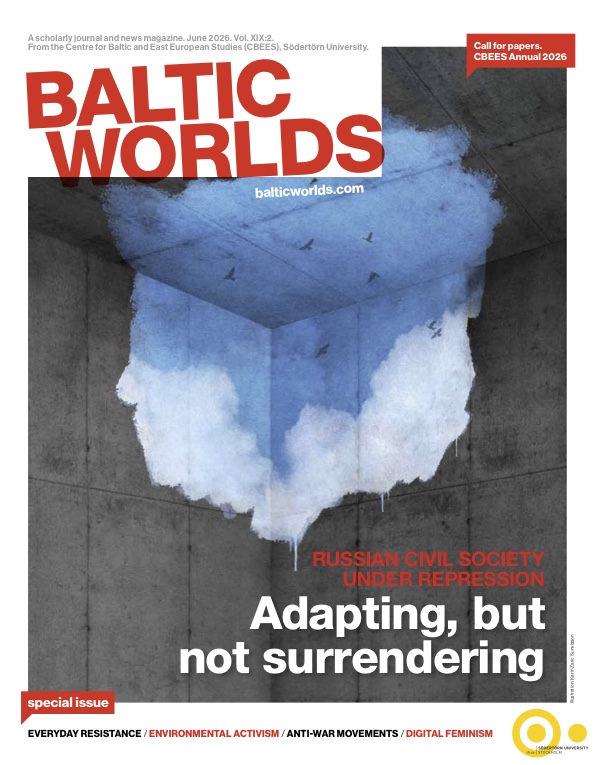 Issue 2026, 2:
  Baltic Worlds covers; the Baltic Sea Region, Eastern Europe, Russia, CentralAsia, Caucasus and the Balkan area.