Jessica Gorter. “I’m interested in how memory is inherently subjective, shaped by time, emotion, and experience”
Filming from under a history in erasure: Jessica Gorter’s documentary films about Russia’s memory and counter-memory.

A scholarly journal from the Centre for Baltic and East European Studies (CBEES) Södertörn University, Stockholm.
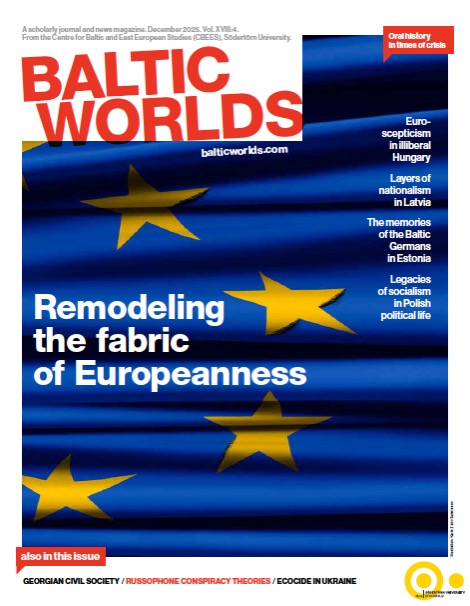 Issue 2025, 4: Download.
Filming from under a history in erasure: Jessica Gorter’s documentary films about Russia’s memory and counter-memory.
Hadley Z. Renkin on Hungarian sexual politics, geotemporal belonging, and the impending reemergence of fascism.
Yurii Latysh, PhD (Candidate of Historical Sciences), visiting Professor of State University of Londrina (Brazil), deputy editor-in-chief of the journal Historical Expertise (Istoriceskaja Ekspertiza), in a discussion with Denys Kiryukhin on how the Russo-Ukrainian war has affected the politics of memory in Eastern Europe.
RUTA is an association formed by epistemic communities and solidarity networks in response to Russia’s full-scale invasion of Ukraine. RUTA promotes and supports Central, South-Eastern, and Eastern European, Baltic, Caucasus, Central and Northern Asia Studies in the global conversation. Tereza Hendl is one of the founding members. In conversation with Elisa Satjukow she discusses the need to reclaim the debate, and emphasizes the decolonial forces set in motion to protect academia in the region from Russia’s violence and epistemological domination.
The repression in Belarus is targeting academia. Olga Shparaga is one of the co-founders of the European College of Liberal Arts in Minsk (ECLAB), and former lecturer at the European Humanities University (EHU), that was forcibly closed 2004 and moved into exile in Vilnius. In a conversation with Friedrich Cain, she describes how the Belarusian exile Academia, although persecuted even abroad, still works to educate Belarusian students and support teachers inside Belarus as well as in exile through various networks and strategies.
Serhii Plokhy, professor in Ukrainian history at Harvard University and director of the Harvard Ukrainian Research Institute, in a conversation on the history of Ukraine, knowledge production, decolonization, the role of the Church and the ongoing war, with Professor Barbara Törnquist-Plewa.
In a conversation with Irina Sandomirskaja, Luba Jurgenson explores how the epoch-making event of Russia’s war in Ukraine has led to changes in the research field Slavic Studies, particularly memory studies and the studies of camp literature. They discuss how ideas of repetition and the return of history have a new resonance, and how increasing concerns are impacting a historical consciousness that demands epistemic justice.
Olli-Pekka Martikainen is the Secretery General of the Association of Finnish Music Schools, an umbrella organization that includes 97 schools. He has a doctorate in music and he previously worked as the vice dean of the Sibelius Academy, University of the Arts Helsinki. Apart from leadership in higher music education Martikainen has worked as an orchestral and chamber musician and as a teacher at the Sibelius Academy. Martikainen holds the first artistic Doctoral degree in the field of percussion music in Finland. Ann Werner asked him questions about higher music education in the Baltic region with her own research on nation and gender in higher music education as background.
The projection of imperial power through overtly religious pageantry, symbols and narratives has been a key element of Russia’s identity politics under Putin, informing the Kremlin’s aggressive international policies, but also shaping the domestic perceptions of Russia’s global role. In a conversation with Irina Sandomirskaja, Valentina Izmirlieva explores the utility of the Russian Orthodox Church in this process, and the significant transformations within the Orthodox sphere that facilitate the radical militarization of Russian society. She also discusses the role and future of multidisciplinary area studies as such, and in particular Slavic Studies.
The following interview was conducted during the Pyrogeography course — the study of fires — at Wageningen University, the Netherlands. We talked with the Ukrainian scientist about forest fires in war and the challenge of conducting research in the field.
 Baltic Worlds covers; the Baltic Sea Region, Eastern Europe, Russia, CentralAsia, Caucasus and the Balkan area.