Abstract [en] In the classical Western aesthetic tradition, from Aristotle onwards, ’nature’ and ’art’ are conceptualised in relation to each […]
By
Florence Fröhlig
December 16, 2025
Abstract [en] This thesis examines the persistent political fragmentation of post-war Bosnia and Herzegovina, focusing on the role of the […]
By
Florence Fröhlig
December 16, 2025
Abstract [en] This dissertation takes as its focus the question of credibility in sustainable marketing: why it is both necessary […]
By
Florence Fröhlig
December 16, 2025
Abstract [en] This thesis unpacks the empirical puzzle that banks suspected of involvement in money laundering may nevertheless be deemed […]
By
Florence Fröhlig
December 16, 2025
Abstract [en] This thesis argues that the Baltic Sea region was shaped intellectually, politically and geographically during the period 1914–1945. […]
By
Florence Fröhlig
December 16, 2025
Abstract [en] We, the Expelled is a study of historical experiences communicated by the Polish Jews who came to Sweden as […]
By
Florence Fröhlig
December 16, 2025
Abstract [en] Since its inception in the late 1980s, the Turkish black metal scene has gone through significant changes. Whereas […]
By
Florence Fröhlig
December 16, 2025
Abstract [en] Over the course of the past century, European agriculture has transitioned from small-scale, manual farming to more mechanised, […]
By
Florence Fröhlig
December 16, 2025
That music may connect well with violence contradicts common understandings of music being a force of good which brings people together. While acknowledging that music can harmonize social relations, this special issue highlights the idea that music can equally justify war and ignite conflicts. Exploring music from such a matter-of-fact viewpoint shifts scholarly attention to the relationship between music, politics, and societal dynamics. This special issue does so in the context of Russia’s war on Ukraine.
By
Anna Schwenck, Aleksej Tikhonov, and David-Emil Wickström
October 23, 2025
Alesia Rudnik is a political scientist based in Sweden, originally from Belarus. Her research has been published in journals such as Europe-Asia Studies, Communist and Post-Communist Studies, Media, War & Conflict and Internet Policy Review. She is also a regular contributor to Baltic Worlds (see for example the co-authored article with Malin Rönnblom in BW, vol. 17, no. 4, 2024). She currently serves as the Director of the Center for New Ideas, an independent Belarusian think tank operating in exile. She previously led a Belarusian diaspora organization in Sweden and was awarded “European of the Year 2022” in Sweden for her civic engagement.
Rudnik’s academic work focuses on the relationship between people and technology in the context of political protests under authoritarian regimes. On September 12, 2025, she defended her doctoral dissertation in political science at Karlstad University, titled Machinery of Dissent: People and Technology in Political Protests in Autocracies. In conversation with Baltic Worlds, Dr. Rudnik reflects on research in Sweden concerning Belarus, the 2020 Belarusian protests, and the role of digital platforms in mobilizing protest movements within authoritarian contexts.
By
Joakim Ekman
October 6, 2025

 Issue 2026, 1:
 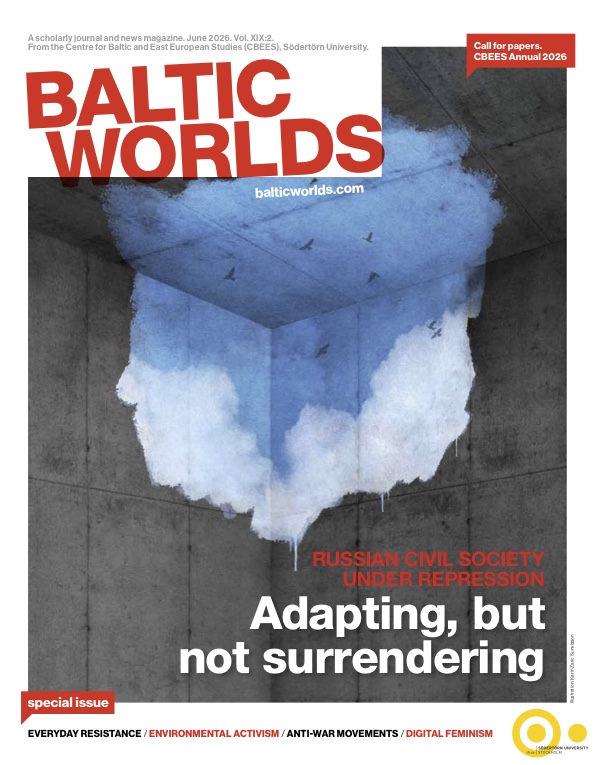 Issue 2026, 2:
  Baltic Worlds covers; the Baltic Sea Region, Eastern Europe, Russia, CentralAsia, Caucasus and the Balkan area.