THE INTERTWINING OF INFORMATION WARFARE AND PEACE
Conference name: Secure Horizons: Ukraine’s Peace & Infosecurity Confluence Date and location: Symposium arranged February 6, 2024, at Södertörn University/hybrid […]

A scholarly journal from the Centre for Baltic and East European Studies (CBEES) Södertörn University, Stockholm.
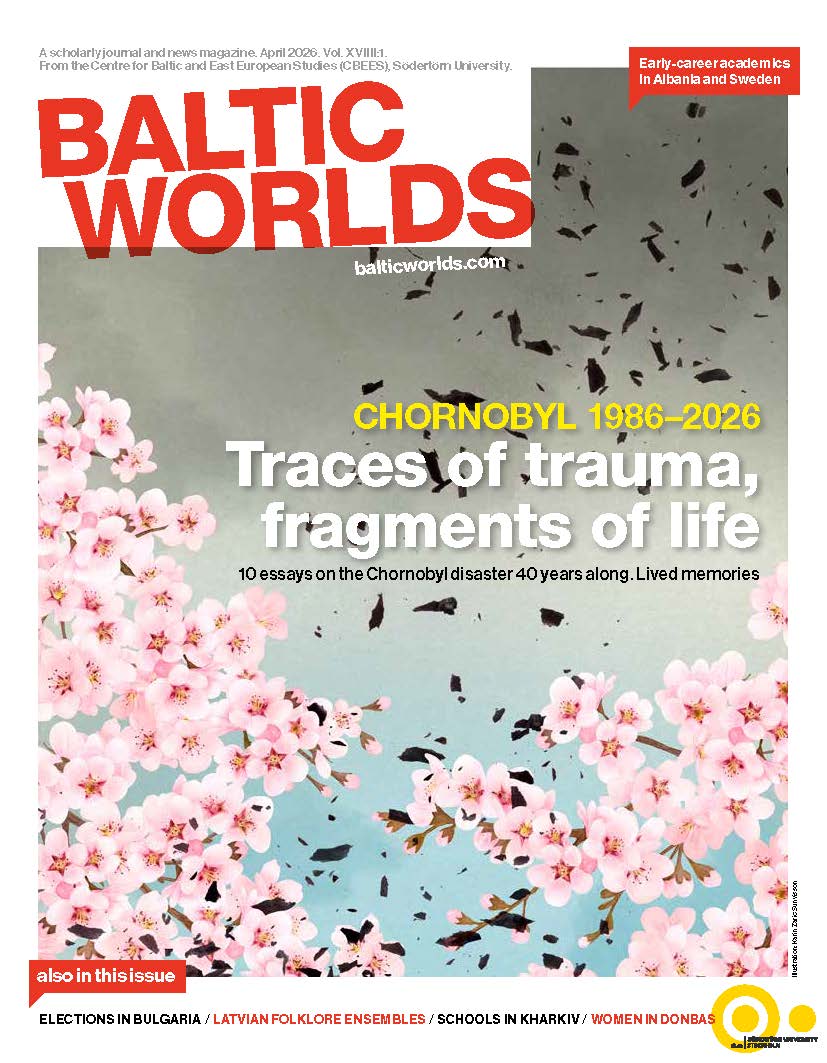 Issue 2026, 1: Download.
Alexandra Biktimirova is a student at the HSE University in Moscow and a feminist activist. Research interests center on the intersections of feminism and Islam in the Volga-Ural region in Russia, as well as globally. Coordinated the exhibition Feminist Translocalities in Kazan in 2020. Research interests are gender, muslim women, and relationships between discourses of power and marginality.
Victoria Kravtsova is a Feminist researcher, NGO-worker and activist. Born in Smolensk, Russia. Initiated Feminist Translocalities – a queer feminist network between the former USSR, Germany, and sometimes other locales, as wel l as a platform for supporting projects – publications, exhibitions, seminars, podcasts etc. Research interests include the intersections of feminist, antiracist and decolonial struggles in the countries of the former USSR.
Conference name: Secure Horizons: Ukraine’s Peace & Infosecurity Confluence Date and location: Symposium arranged February 6, 2024, at Södertörn University/hybrid […]
There are many things Vladimir Putin can be faulted for, but lacking a geopolitical vision is not one. A “new world system” is to come, he declared in a programmatic speech at the Valdai Club in Moscow in October 2023. The world will be divided up between “civilization-states” with an age-old identity, “large spaces, communities identifying as such”, for example Russia, China and India. Based on equality and diversity, this new world system will replace the “soulless universalism of a new globalization” that the West has been trying to impose through “dictatorship and violence”. Then “a multipolar world will be established”, a “synergy of civilization-states”, leading to “lasting peace” that will benefit all, he proclaimed in his speech. This was not the first time Putin has promoted this vision of multipolarity. Nor is it only his vision.
Serhii Plokhy, professor in Ukrainian history at Harvard University and director of the Harvard Ukrainian Research Institute, in a conversation on the history of Ukraine, knowledge production, decolonization, the role of the Church and the ongoing war, with Professor Barbara Törnquist-Plewa.
The article examines the deliberate process of depoliticizing contemporary art in Russia. The repressive laws introduced also target art, especially certain themes, and there is heightened censorship: furthermore, law enforcement exerts direct pressure on individual art institutions and artists. Simultaneously, the state is implementing large-scale programs to support (state-approved) contemporary art: constructing new museums, organizing street art competitions, and supporting the art market. At times, the authorities employ a form of “agenda hijacking,” adopting globally relevant themes in the art world, such as decolonization. For the average citizen, an illusion of a vibrant contemporary art scene is created. Meanwhile, over the two years of the full-scale invasion of Ukraine, the ideological component of art, built on propaganda or stylistic canons, has not become central.
The revolt that lasted 63 days was a desperate attempt to push back the German enemy before the Red Army crossed the Vistula River. Once it was quashed, the Poles counted their losses in hundreds of thousands: It is estimated that roughly 15 000 Polish soldiers who followed orders from the government-in-exile in London perished, hundreds of whom had already fought during the April 1943 uprising of the Warsaw ghetto. 150 000—170 000 civilians lost their lives, 65 000 of them in organized massacres. A contemporary Swedish reaction to the Warsaw uprising was published in September 1944 in Warszawa! [Warsaw!]. The editor of the anti-Nazi newspaper Trots allt! [In spite of everything!] and left-wing politician Ture Nerman wrote: "In the history of this time and age, Warsaw stands as one of the most heroic in humanity’s struggle for freedom."
The thematic bookstalls, on the eve of International Holocaust Remembrance Day in the Italian city of Turin, January 2025, show a range of covers, some only rather vaguely connected with the traumatic past in the context that they are displayed in. The Storyteller of Auschwitz is just one of many in the same vein, blending real events with fictionalized narratives. The Italian version sold at Milan airport as an on-the-plane read has a title that literally translates as “a girl who wrote love stories in Auschwitz”, and the cover shows the image of a malnourished child in bedraggled clothes with the eerie Birkenau gate contour as background. This leads to reflections on the many layers of Holocaust portrayal, 80 years after the end of WWII, and its implications.
In a conversation with Irina Sandomirskaja, Luba Jurgenson explores how the epoch-making event of Russia’s war in Ukraine has led to changes in the research field Slavic Studies, particularly memory studies and the studies of camp literature. They discuss how ideas of repetition and the return of history have a new resonance, and how increasing concerns are impacting a historical consciousness that demands epistemic justice.
The societies in Bosnia and Herzegovina (BiH) and Kosovo utilize dark (war) tourism to preserve and visualize memories of the 1990s conflicts and war crimes against civilians. Both countriesnhave developed numerous sites, mapped them, and integrated them into excursions and tourist programs. In BiH, dark tourism reflects collective trauma and a need to share experiences with others. Kosovan Albanians focus on reflecting upon the war and its consequences while constructing narratives about national history. A shared issue in both BiH and Kosovo is the dominance of a single perspective on the events of the 1990s, with Bosniaks and Kosovan Albanians promoting their versions of history while excluding the perspectives of other ethnic groups.
This paper focuses on the notions of “time” and “temporality” of nuclear waste, as well as the different time horizons implied by practitioners of nuclear waste storage. In doing so, the paper develops understandings of a key problem defining nuclear waste storage in C21: namely, how to communicate information and memory over the 100,000 years that highly radioactive nuclear matter remains a threat to organic life. This question is notable not least because it involves the proposition of communicating with “deep time” future scenarios in which contemporary representational systems are ineffectual, and even the existence of the “human” is in doubt.
CBEES Summerschool 2025, August 18-23 is now open for application. Apply before March 21.