In the course of just a few months Georgia went from having one of the best working environments for civil society actors to one in which heads of the most prominent organizations are facing charges of treason. The civic space is rapidly shrinking as a result of strong and unprecedented orchestrated attacks on independent organizations and media through the weaponizing of legislation and a fierce propaganda machine set out to silence, stigmatize and practically leave no space for civil society actors.
To illuminate how civil society actors are experiencing, interpreting, and adapting to this new climate of repression, we conducted four in-depth interviews with organizations active in different regions of Georgia. To this end, our paper aims to illuminate both the risks and the resourcefulness of Georgian civil society.
By
Sofie Bedford and Irine Guruli
December 18, 2025
Referendums have been extensively analyzed from multiple perspectives and different studies have discussed their various features and types and how different actors use them. However, little attention has been paid to investigating the reasons why political elites (i.e., European presidents) initiate referendums. Thus, this article explores the intentions and aims by analyzing 18 referendums called by European presidents from 2000 to 2020. Secondary sources, such as media reporting, official documents, and scientific works, have been analyzed using a
comparative case study approach. The results indicate that presidents usually have strategic objectives when they call referendums, and that the initiation of a referendum is influenced by the anticipated short- or long-term effects that could result from the referendum.
By
Paul Tap
June 20, 2023
"I was terrified and scared but more than ever before I felt that I am a Belarusian and I could not stay home. I can’t say that I felt exactly like a soldier preparing to die while protecting the Homeland, but a similar feeling overwhelmed me then."
These are the words of one of the female protestors who took part in a street demonstration in Minsk on February 27, 2022. According to different estimates, between 1,000 and several thousand Belarusians came out to protest against the start of the war in Ukraine and against the referendum on constitutional change in Belarus.
Essay by
Alesia Rudnik
January 18, 2023
While in the past there has generally been an atmosphere of resigned acceptance after the election, this time countless Belarusians went out on the streets to contest the results. The dynamics of the protest clearly illustrate its main goal is not to ensure Svitlana Tsikhanauskaya becomes the head of state, but rather to guarantee Lukashenka does not stay in this position. One factor that played a particularly important role was the way that President Lukashenka was handling the COVID-19 crisis. Nonetheless, it was Tsikhanauskaya’s campaign that made people actually vote – because it gave them hope they could influence political affairs.
By
Sofie Bedford
September 7, 2020
The Nordic Belarusian History Dialogue took place in Lund, Sweden, in January 2020. The gathering brought together colleagues from Tromsø on the northern coast of Norway to Polesia in southern Belarus with the aim of engaging Nordic and Belarusian historians in dialogue.
By
Per A. Rudling & Erkki Tuomioja
July 6, 2020
Student protest as a form of mobilization from below, excluding categorically political organizations like opposition parties and NGOs, has changed the perception in Albanian society about protesting and decision-making. Public opinion regarding the protest in December of 2018 has had the same value as the student movement in 1990—1991 when the system changed, and Albania became a democratic country, and the students are once again bringing hope to Albania!
By
Gilda Hoxha
March 6, 2019
On April 2, Armenia held its first parliamentary election with the newly adopted constitution, transforming the country from a presidential to a parliamentary republic. In short the change transfers the substantial executive power from the presidential office to the prime minister and the parliament. The elections have widely been regarded as an important test of the democracy in Armenia.
By
Vahagn Avedian
April 7, 2017
Baltic Worlds invites you to support CEU with its long-held reputation as a center of innovation, academic excellence and scientific inquiry.
By
Ninna Mörner
April 3, 2017
At the moment, there are virtually no signs or signals from the Government of Azerbaijan pointing toward democratic reforms. All international criticism is brushed away as propaganda and the government actively promotes ideas to undermine an international political order where it is regarded as a deviant country lacking respect for the rights of its own citizens.
By
Faradj Koliev
January 7, 2016
The political landscape in the parliament has changed quite drastically due to party mergers and the appearance of three new parties which made it over the threshold. And although SDPK increased their share of the votes, they’re still far from being able to form a single party government.
By
Henrik Ohlsson
October 15, 2015

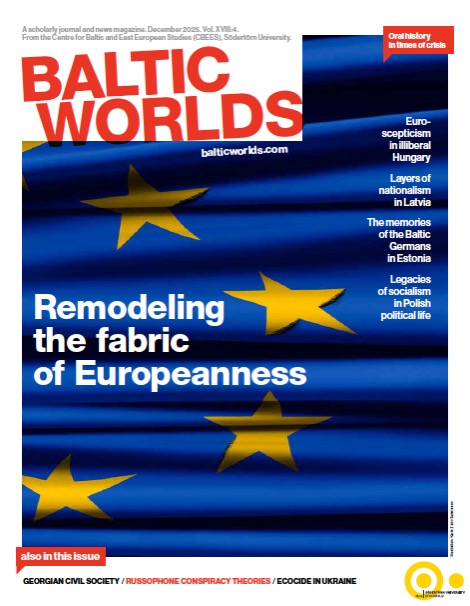 Issue 2025, 4:
  Baltic Worlds covers; the Baltic Sea Region, Eastern Europe, Russia, CentralAsia, Caucasus and the Balkan area.