In this issue (2020:1), there are several examples of scholars investigating contemporary feminist mass-struggles from this point of view, asking whether these are examples of or have the potential for forming a feminist populist movement that can effectively counteract neoliberal and authoritarian regimes.
By
Jenny Gunnarsson Payne
May 24, 2020
Agnieszka Mrozik analyzes the portrayals of women communists in the Stalinist period in Poland, produced in the framework of nationalist history during the illiberal turn. She argues that biographies of women dignitaries served the broader political function of delivering a cautionary tale against “excessive” liberation of women, so that female communists were often presented as beasts and demons rather than political agents.
Essay by
Agnieszka Mrozik
March 8, 2018
This paper discusses the current “herstorical turn” in professional and popular historiography and memory of WWII in Poland: a growing interest in women and the distinctiveness of their wartime experiences. Focusing on one dominant strand of this “herstorical turn” – nationalist herstory – the article reflects on the ways in which women’s history has become one of the platforms a broader illiberal political shift that is currently ongoing in Central Europe.
By
Weronika Grzebalska
March 8, 2018
In 2016, commemorations of the 60th anniversary of the 1956 Hungarian Revolution brought new conflicts in memory politics. This article analyzes the reasons for women’s absence from the historiography of the 1956 Revolution and discusses how the polypore state is using the populist turn to introduce hegemonic narratives and to include women in the narrative of “national feminism”.
By
Andrea Petö
March 8, 2018
Agnieszka Graff and Elżbieta Korolczuk in an interview about the phenomenon of anti-genderism: a topic they written together on and both try to understand as it is spreading in Poland but also widely elsewhere
By
Eva Karlberg
March 7, 2018
The main takeaway from the outcome of Bulgaria’s parliamentary elections in March 2017 is that stability has replaced relative instability. Nevertheless, the last elections have ushered in the possibility of democratic backsliding and increasing authoritarian rule in Bulgaria. In this sense Bulgaria fits within a regional trend. It should also be underlined that the far right managed to do what the ever-quarrelling urban middle class and mainly conservative milieu could not: namely unite and secure enough of a vote to become Borisov's junior partner in government.
By
Tom Junes
November 22, 2017
Mass mobilization against the ban on abortion is just another example of a new wave of grassroots mobilization in citizens protesting against the changes introduced by the conservative populist Law and Justice in Poland. Polish society becomes extremely polarized but also much more engaged and politically active.
By
Elzbieta Korolczuk
April 5, 2016
The authors examine neo-Nazis’ increased interest in issues involving the environment and nature, and scrutinize their reasoning about commodification and globalization.
By
Madeleine Hurd & Steffen Werther
October 29, 2013

 Issue 2026, 1:
 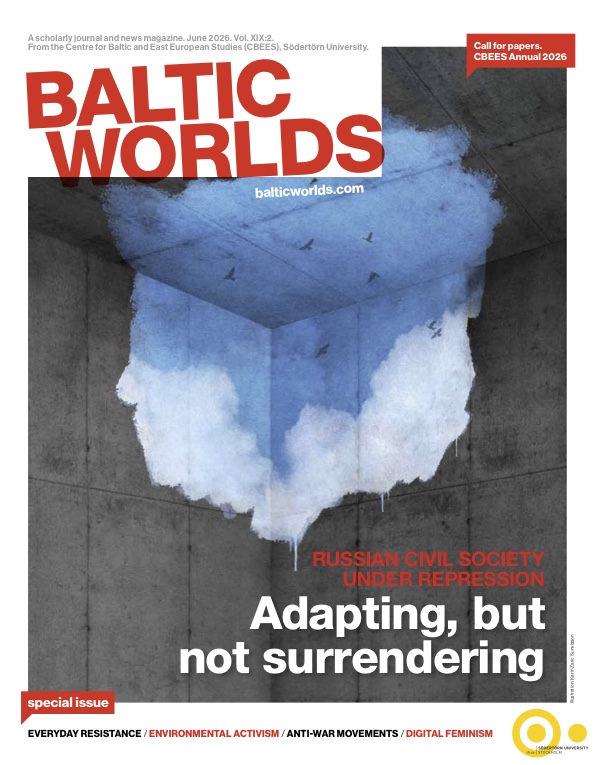 Issue 2026, 2:
  Baltic Worlds covers; the Baltic Sea Region, Eastern Europe, Russia, CentralAsia, Caucasus and the Balkan area.