The Gulag memory. The sites and places of commemoration
Gulag Memories. The re-discovery and com-memoration of Russia’s repressive past, Zuzanna Bogumil New York & Oxford: Berghahn Books 2018. 302 pages.

A scholarly journal from the Centre for Baltic and East European Studies (CBEES) Södertörn University, Stockholm.
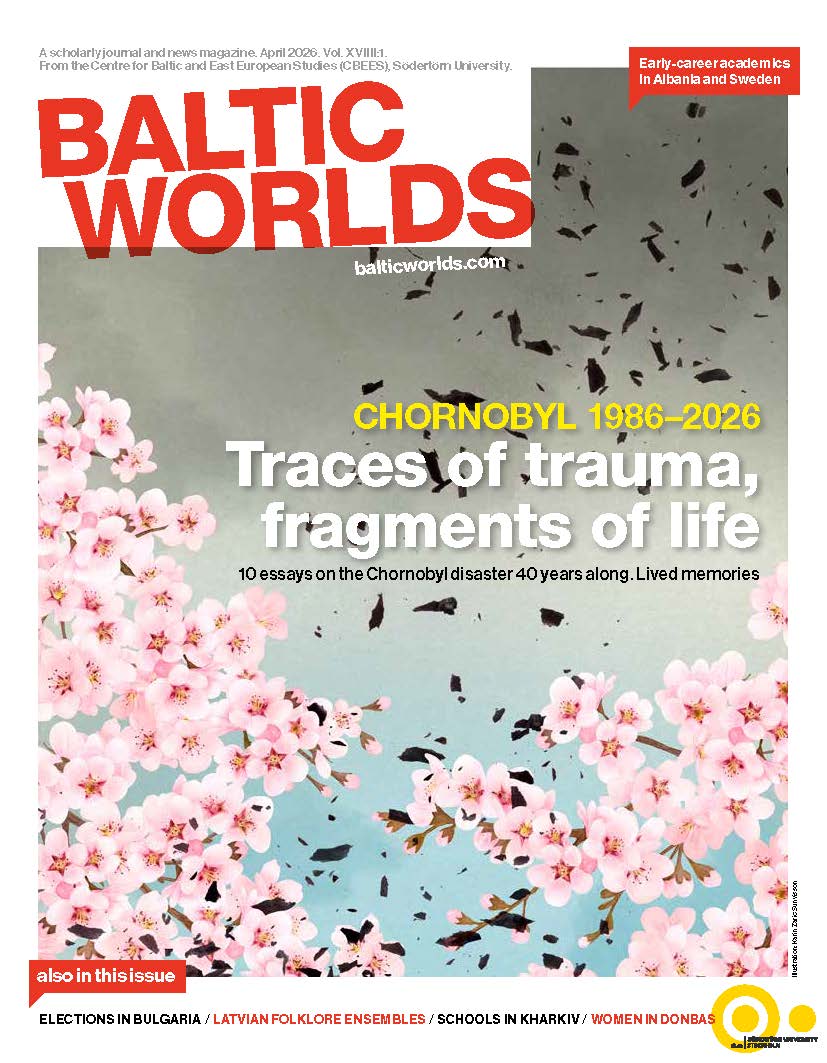 Issue 2026, 1: Download.
29 articles tagged with memory studies were found.
Gulag Memories. The re-discovery and com-memoration of Russia’s repressive past, Zuzanna Bogumil New York & Oxford: Berghahn Books 2018. 302 pages.
The Length of the Day (2017), Volodymyr Rafeenko, Dovhi Chasy, Lviv: Vydav-nytstvo Staroho Leva, 2017, 336 pages. The Boarding School (2017), Serhii Zhadan, Internat, Chernivtsi: Meredian Czernowitz, 2017, 272 pages.
This paper analyzes Soviet and Russian spy films with respect to maintaining and transmitting memories of the Great Patriotic War (1941–1945) in popular culture. The new Russian post-Soviet cinema (after the 2000s) about the “war spies” is considered not only with regard to its entertainment and ideological functions, but also with regard to its function as a “post-memory” of the traumatic experiences of the war and the Nazi occupation. The new Russian cinema about espionage and spies reinterprets the issues of dependent people, Stalinist repressions, and traumatic memories that were absent in Soviet cinema.
The conference Nuclear Legacies: Community, Memory, Waste, and Nature took place from September 14 to 16, 2017, at Södertörn University. It gathered about forty scholars engaged in nuclear issues, coming from twelve different countries and representing many different disciplines.
Agnieszka Mrozik analyzes the portrayals of women communists in the Stalinist period in Poland, produced in the framework of nationalist history during the illiberal turn. She argues that biographies of women dignitaries served the broader political function of delivering a cautionary tale against “excessive” liberation of women, so that female communists were often presented as beasts and demons rather than political agents.
In 2016, commemorations of the 60th anniversary of the 1956 Hungarian Revolution brought new conflicts in memory politics. This article analyzes the reasons for women’s absence from the historiography of the 1956 Revolution and discusses how the polypore state is using the populist turn to introduce hegemonic narratives and to include women in the narrative of “national feminism”.
There are parallels in discussions about monuments in Ukraine and the USA. The reminder of the Soviet past (or in the American context, of the Confederacy) is an abject that is difficult to assimilate. On the one hand, the abject is our unwillingness to see the past and accept it; on the other hand, for those who associate themselves with this past, this is the threat of castration because through the negation of a given past a certain group is cast out from the space of representation. That is why it is questionable whether a monument can be inclusive at all. Which memory does the monument recall? Which past is castrated when a new monument is built? Which groups are fighting for recognition and representation? Which groups lose this right? These questions confront researchers and memory workers and are discussed in this essay.
Juxtaposing the postcolonial in-betweenness of critical discourse with Bakhtin’s idea of hybridized, collusive and hidden dialogicality, the postcolonial memoir can be read as the self’s mapping of a paradigm shift in contemporary times. The postcolonial memoirs become a site of contested, unsettling and endless renegotiations. I shall read South Asian-American diasporic writer Meena Alexander’s 1993 Fault Lines: A Memoir and the revised 2003 version as dialogic texts. Alexander’s memoirs engage, contest and alter each other to disrupt the possibility of singular meanings and absolute truth. Instead, the texts offer a conflicting and incommensurate idea of the past and a fractured yet intensely interconnected vision of the present.
This paper deals with the dilemmas scholars can run into when they encounter the conflict between political activists and what can be proven by evidence. The dispute with historians revolves around what the anthropologist Michel-Rolph Trouillot terms “Silencing the past”. This is certainly true in the case of the Roma and genocide. What complicates the case is that a long-standing memory is part of a still ongoing political activist campaign to build a recognized memory for all of Europe’s Roma.
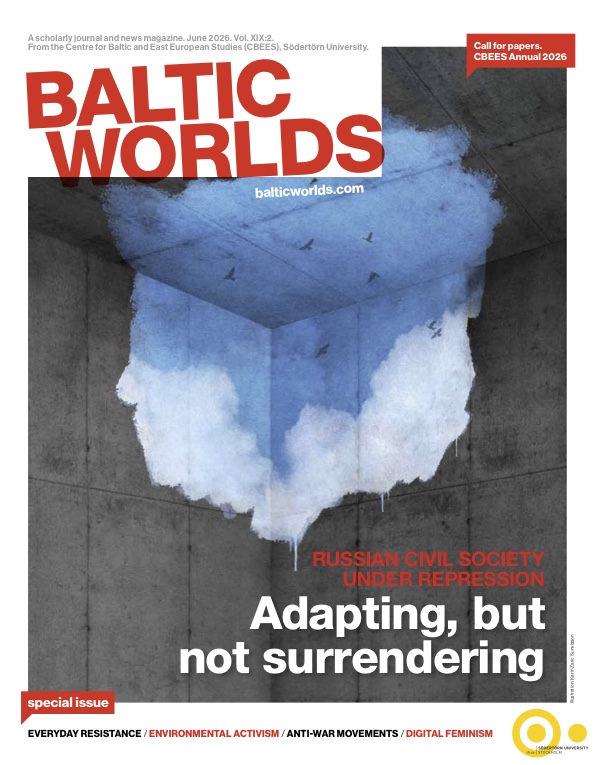 Issue 2026, 2: Download.
 Baltic Worlds covers; the Baltic Sea Region, Eastern Europe, Russia, CentralAsia, Caucasus and the Balkan area.