A positive effect of placing the Championships in Ukraine is that a more intense debate on the democratic deficit in Ukraine has emerged. On the other hand, this can also lead to a situation where the regime in Ukraine benefit from the Championships.
By
Kutte Jönsson
May 31, 2012
For various reasons, Ukraine’s relationship to the Holocaust and the Jews has been overshadowed by the similar, but more striking […]
By
Ingmar Oldberg
August 1, 2011
The current situation in Ukraine and the country’s economic and political development during President Viktor Ianukovych’s first year in office were discussed at the fifth Europe–Ukraine Forum, held in Kyiv February 23rd to 25th.
By
Peter Johnsson
March 26, 2011
Ukraine clearly became a democratic country after the Orange Revolution because all subsequent elections, the parliamentary elections in 2007 and even the presidential elections of 2010, raised no doubts or concerns from the international community, representing a new reality for Ukraine.
However, in a mere matter of months, the perception of Ukraine by the international democratic took a turn for the worse after the last presidential election.
By
Peter Johnsson
March 10, 2011
Last month Baltic Worlds' reporter visited two conferences being held in Poland with the aim of discussing the one and half year of EU’s Eastern Partnership Policy (EaP) and trying to generate new proposals for the future work of the EU towards Armenia, Georgia, Azerbaijan, Ukraine, Moldova, and Belarus. The main aim of the EaP is to promote democracy and economic integration with the Union of the six countries involved in the program, which is not an easy task.
By
Peter Johnsson
December 17, 2010
The highly preliminary electoral results of the regional elections in Ukraine indicate that the rapidly changing framework has had a highly diverse effect on the political arena, emboldening some, and discouraging others.
By
Geir Flikke
November 18, 2010
The ArtPole festival has become one of the most well known festivals in Ukraine over the course of its five-year history. In the past the festival exclusively featured traditional Ukrainian folk music as it developed and flourished during the last decade; now the focus is on what may be called the new urban folk music.
By
Hanna Söderbaum
September 21, 2010
+ Lennart Samuelson (ed.) Bönder och bolsjeviker: Den ryska landsbygdens historia 1902—1939 [Peasants and Bolsheviks: The History of the Russian Countryside 1902—1939] The Economic Research Institute, Stockholm School of Economics (EFI) 2007. 271 pages.
By
Johan Eellend
February 19, 2010

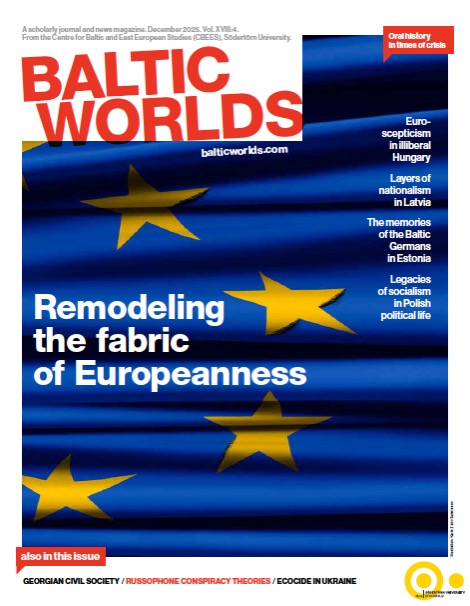 Issue 2025, 4:
  Baltic Worlds covers; the Baltic Sea Region, Eastern Europe, Russia, CentralAsia, Caucasus and the Balkan area.