Essays are selected scholarly articles published without prior peer-review process.
There are parallels in discussions about monuments in Ukraine and the USA. The reminder of the Soviet past (or in the American context, of the Confederacy) is an abject that is difficult to assimilate. On the one hand, the abject is our unwillingness to see the past and accept it; on the other hand, for those who associate themselves with this past, this is the threat of castration because through the negation of a given past a certain group is cast out from the space of representation. That is why it is questionable whether a monument can be inclusive at all. Which memory does the monument recall? Which past is castrated when a new monument is built? Which groups are fighting for recognition and representation? Which groups lose this right? These questions confront researchers and memory workers and are discussed in this essay.
Essay by
Yuliya Yurchuk
November 10, 2017
That gender cannot be reduced to an ahistorical fact is a widely researched insight of multidisciplinary gender studies. In theory as well as in political practice gender is thus generally understood as a post-essentialist, reflexive, and contingent concept. Against this backdrop the essay asks for the German context in what way and with which intentions, neo-authoritarian discourses and movements explicitly not only reject, attack and defame gender as concept, but also reclaim it. I will argue that under the cipher ‘anti-genderism’, a discourse has been formed that can first be described as a neo-fundamentalist discourse and that is secondly explicitly used to construct racist, neo-authoritarian us/them-dichotomies. The so called anti-gender forces become thus identifiable as the element of a dispositif, which is at the core and subject to further clarification of anti-democratic nature.
Essay by
Sabine Hark
November 7, 2017
This study focuses on three aspects of the geography of Pomerania: The definition of the area, in terms of bordering and containment, its governance, particularly in relation to the third aspect, its demography, in terms of which religious and ethnic groups were allowed in or expelled from the area. In the long history of Pomerania, groups in the area also changed religion or ethnicity.
Essay by
Thomas Lundén
June 19, 2017
New legislation at the end of the 1960s contained clearer procedural rules for marrying and divorcing and material regulations on support payments for children after divorce. Family values and domestic comfort increasingly occupied people’s minds from the 1960s onwards. This decade can be regarded as the point when, for the first time, public demands were made on men to be present in the family and more involved and engaged in their role as fathers.
Essay by
Helene Carlbäck
June 13, 2017
Following the 1934 establishment of socialist realism as the main “method” to be applied in all spheres of Soviet artistic production, more particular discourses evolved addressing the issue of how the concept was to be interpreted and defined in the various fields of culture. Literary translation was no exception. This paper explores the significance of the discourse on socialist realism for Soviet translation practices and translation theory during late Stalinism.
Essay by
Susanna Witt
January 30, 2017
Arkadii Gaidar (1904–1941) is one of the most popular Soviet children’s writers and an undisputed part of the Soviet literary canon. The Pioneer organization used him as a symbol to mold young Soviet citizens, the characters from his books entered Soviet folklore, and generations of Soviet children have been brought up on his books. Nonetheless, his path from military commander to a classic of Soviet literature was far from ordinary. This paper reviews Gaidar’s work, focusing especially on the analysis of his short story The Blue Cup as the most representative of his oeuvre and of the political and literary context of the 1930s.
Essay by
Aleksei Semenenko
January 30, 2017
Georgian capital and several buildings that were important parts of the cultural heritage have been demolished in recent years. Repairing is both cross-cultural and culturally relative; it has similarities across the world and differences based on tradition and affordances. In this sense, the specificity of repair is not that it happens but rather that it highlights the values attached and its aesthetics and moral implications.
Essay by
Francisco Martínez
October 25, 2016
Even though the EU’s conditionality per se did not make Lithuanian people more tolerant, it may have created the conditions for winning hearts and minds in the long run. Despite the fact that the majority of LGBT persons continue to hide their sexual or gender identity (in 2012, 81% did so at school and 55% at work), the problems they face are no longer invisible, and even backlash-like developments contribute to sparking a debate. On June 18, 2016 a march for LGBT (lesbian, gay, bisexual and transgender) rights, known as the Baltic Pride parade, took place in Lithuania’s capital, Vilnius.
Essay by
Ausra Padskocimaite
October 25, 2016
The unsuccessful “translation” of “gender equality” into Russian reveals numerous difficulties and indicates that the realization of the transnational feminist agenda could meet with serious obstacles not only in the countries of the “Third World”, but also in some former “Second World” countries.
Essay by
Yulia Gradskova
May 12, 2015
The article considers the centrifugal trajectories of the postsocialist world in the direction of the secondary Europe and the global South as seen through the prism of gender relations and at the intersection of the postsocialist and the postcolonial. The author focuses on the importance and specificity of geopolitical positioning in postsocialist gendered discourses using Central Asia and the Caucasus as graphic examples.
Essay by
Madina Tlostanova
May 12, 2015

 Issue 2026, 1:
 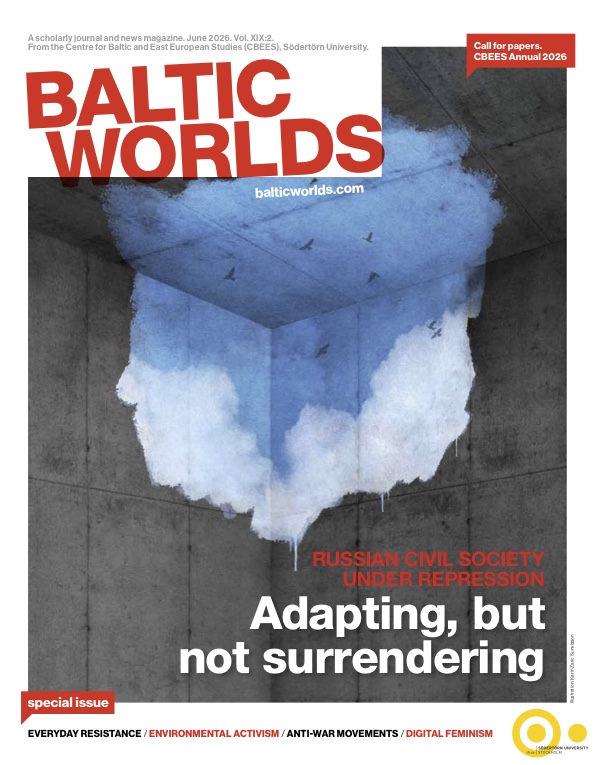 Issue 2026, 2:
  Baltic Worlds covers; the Baltic Sea Region, Eastern Europe, Russia, CentralAsia, Caucasus and the Balkan area.