Essays are selected scholarly articles published without prior peer-review process.
In the year 1872, Chief G’psgolox from the Kitlope Eagle clan of the Xenaaksiala/Haisla people (in Kitlope Valley, British Columbia, Canada) decided to have a totem pole carved and erected. In 1928 the pole was cut down on behalf of a Swedish consul to be shipped to Stockholm the following year.
Essay by
Anders Björklund
June 18, 2018
It was very common to force people to work for the Congo Free State, and the point of building the railway was to make transportations easier and to get rid of the time-consuming caravans. It is probably one of these men, forced to work until he died, that Moberg collected the skull from. There is no explanation for why he collected skulls in the first place, but he studied medicine for his exam when returning to Sweden.
Essay by
Johan Hegardt
June 18, 2018
Like the lives of the saints, Brinton consciously crafted his own vita, iconography, and legend by inserting himself within the genealogy of his collection. From the portrait icon to the pious patron, the portraits of Christian Brinton tell us something of not only the actor, but also the narrative of Russian art that the collector constructed.
Essay by
Mechella Yezernitskaya
June 18, 2018
Just as the Soviets could trade “Rembrandts for tractors,” Aschberg could trade icons for social capital, while his donations also served the purpose of establishing links between himself in Paris and his business, cultural, and political contacts in Stockholm and ensuring the longevity of Swedish contacts with its great neighbor to the east, Russia.
Essay by
Carl Marklund
June 18, 2018
It is here claimed that it is practically impossible to determine whether the collector and connoisseur in question (namely Igor Immanuilovich Grabar, 1879—1960) was, indeed, saving his objects from scattering and destruction — or contributing to their further enslavement by exploiting them in a capacity that was radically alien, if not inimical, to their nature.
Essay by
Irina Sandomirskaja
June 18, 2018
The Basilys had both the means and opportunities to collect and exhibit Imperial elite art and books. In doing so, it is argued here that they wished to present an alternative narrative of Russia’s past to the Soviet political, economic, and modernist artistic program that they witnessed unfolding in Soviet Russia.
Essay by
Edward Kasinec
June 18, 2018
Lithuanian architecture of the past 25 years is a mirror of social decomposition is here argued. It is suggested that is should serve as a space for engagement with outcomes of this decomposition instead of glossing over it. Further that architecture and architects might contribute to the dissensus in all spheres of life existing today, or might cultivate fantasies about the social unity and spirituality of their art-craft.
Essay by
Arnoldas Stramskas
June 18, 2018
This paper examines women’s contribution to war and the perceptions of that contribution by comparing experiences of women in the Red Army during the Second World War and in the Ukrainian Armed Forces in the conflict in the Donbas region. Here it is argued that in both cases structural gender discrimination was ingrained in the military, which accepted women’s contribution to war in times of need, but treated that contribution as subsidiary, thereby distorting men’s and women’s experiences of warfare and facilitating the instrumentalized militarization of women.
Essay by
Olesya Khromeychuk
March 8, 2018
Agnieszka Mrozik analyzes the portrayals of women communists in the Stalinist period in Poland, produced in the framework of nationalist history during the illiberal turn. She argues that biographies of women dignitaries served the broader political function of delivering a cautionary tale against “excessive” liberation of women, so that female communists were often presented as beasts and demons rather than political agents.
Essay by
Agnieszka Mrozik
March 8, 2018
This paper is devoted to the semantics of the visual images of the Chinese-Eastern Railroad (KVGD)1 and the “Oriental Other” in the Russian public consciousness of the late 19th and early 20th centuries. Here it is that the construction of the KVGD was intended to be a symbol of the technological progress and spiritual strength of the Russian Empire in the Russian mass consciousness.
Essay by
Viktoriya Sukovata
March 8, 2018

 Issue 2026, 1:
 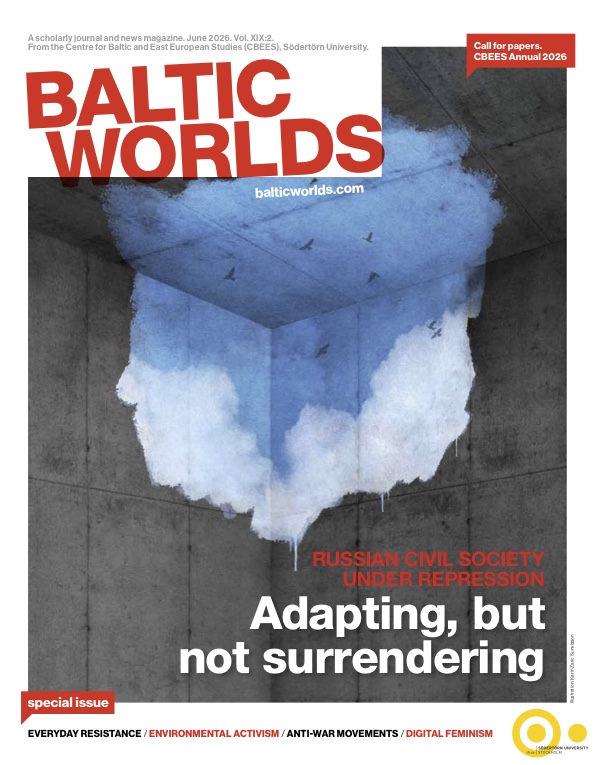 Issue 2026, 2:
  Baltic Worlds covers; the Baltic Sea Region, Eastern Europe, Russia, CentralAsia, Caucasus and the Balkan area.