In the shadow of Rumkowski
The deportation of children, the elderly, and the sick transformed Łódź from a traditional ghetto to an industrial slave city and established the motto for which Rumkowski would become known: work is our only way out.

A scholarly journal from the Centre for Baltic and East European Studies (CBEES) Södertörn University, Stockholm.
 Issue 2026, 1: Download.
Essays are selected scholarly articles published without prior peer-review process.
The deportation of children, the elderly, and the sick transformed Łódź from a traditional ghetto to an industrial slave city and established the motto for which Rumkowski would become known: work is our only way out.
Interviews from three communities in a Russian region illustrate that there are many new opportunities for potential women entrepreneurs, while there are also many at times unpredictable obstacles to overcome.
About Estonia’s endeavors to become part of the staid but stable Scandinavia – an effort based on the belief that the country actually has a special affinity with Scandinavia. One sign of this, Pärtel Piirimäe points out, is the use of the word jõul (cognate to English “Yule”). The Estonians, like the Swedes, Norwegians, Danes, and Finns, thus live in Yule Land.
Maria Janion is Poland’s undisputed intellectual authority – but she is relatively unknown abroad. Maria Janion is a professor emeritus of literature. Her studies of Romanticism led Janion to see the specificity in Poland’s cultural development. As a public intellectual, Janion has always intervened in the political discourse. In recent years, she has put her authority to use to support the feminist movement and the reawakened new Left.
The Polish professor in literature, Maria Janion, writes on Polish identity, and its interpretation and reinterpretation, its crisis and the process of shaping a new Polish imagery. There is a ongoing dialog between the past and the present and a constant struggle between the free Poland and the posthumous life of Romanticisim.
Dag Hammarskjöld died on the night of September 17, 1961 after a still unexplained crash landing in the border area between the former Belgian Congo and Northern Rhodesia, when he was on his way to negotiate during the Congo Crisis. The author argues that Dag Hammarskjöld as a cosmopolitan is the trailblazer of a way of thinking that is still totally absent despite economic globalization: respect for those who are different.
In literature, the opposition between Russian Christians and Muslims was established early on in the folk epics, in the “historical songs” told by the bards in the oral tradition. Several of them deal with the capturing of the khanate of Kazan, the northernmost Tatar realm. From the “Tatars” conquered by Ivan the Terrible in Kazan and depicted in Russian folk songs to Tolstoy’s thistle called “the Tatar” (tatarin) there is a winding line of literary works.
On March 11, 1990, Lithuania declared its independence. The Soviet Union reacted by threatening economic sanctions. Lithuania needed support. Its hopes were directed at the West, and particularly at France. How did France react? What was its foreign policy regarding the “Baltic question”, that is, the demands of the Baltic States for the restoration of their sovereignty, which they had lost in their forced annexation by the Soviet Union in 1940?
The new organization “NSZZ Solidarity” had to be registered by a court in order to act. This registration process was the subject of lively debate at the CPSU Politburo meeting on October 29. The minutes of this Politburo meeting are included in one of the most extraordinary collections of documents from the Soviet era that have yet been made public by the Russian State Archives. It covers the period between the outbreak of strikes in 1980 and the imposition of martial law on December 13, 1981, a period known as the “Polish Crisis”. As a whole, the material shows that it was a rather clear message that the Soviet leadership conveyed to their Polish Party comrades.
Peter Weiss' descriptions of the agony and torture associated with the genocide against the Jews, of the survivors’ experiences of violence, death and war, contribute substantially to breaching the taboo of the Shoah, and hence to coming to terms with the past. By invoking the dead through memory, making them speak and thus overcome death in his works, the author confronts his guilt complex and mortal fear.
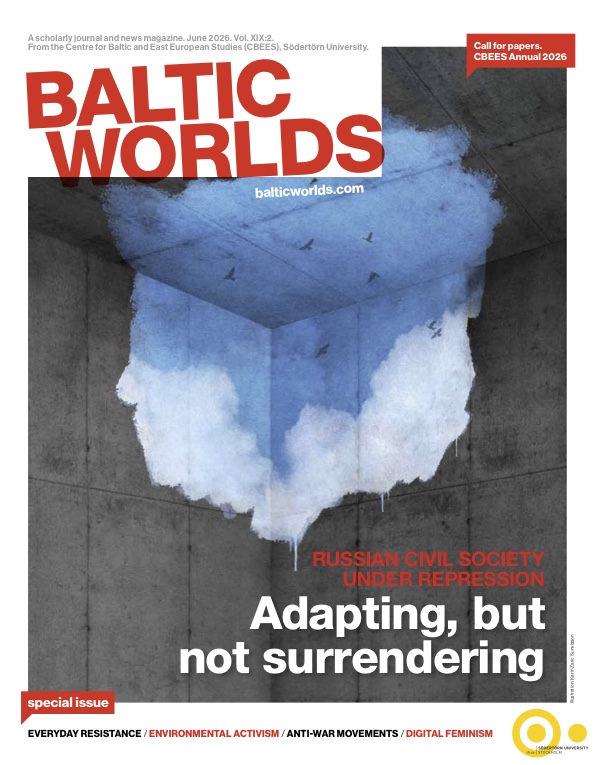 Issue 2026, 2: Download.
 Baltic Worlds covers; the Baltic Sea Region, Eastern Europe, Russia, CentralAsia, Caucasus and the Balkan area.