platonov’s chevengur. the ambivalent space
The author suggests that Platonov’s Chevengur is an attempt to describe the relationships between utopia and ideology, as seen through the eyes of a participant observer.

A scholarly journal from the Centre for Baltic and East European Studies (CBEES) Södertörn University, Stockholm.
 Issue 2026, 1: Download.
Essays are selected scholarly articles published without prior peer-review process.
The author suggests that Platonov’s Chevengur is an attempt to describe the relationships between utopia and ideology, as seen through the eyes of a participant observer.
Is it possible to imagine a disused nuclear power plant as a monument or memory site, a trace in the landscape that tells of days gone by? Have our notions of what constitutes history and cultural heritage expanded to the degree that we can also include a physical setting whose meaning is so controversial, especially considering the current political relevance of nuclear power technology?
If one wants to understand the arguments for institutional and ideological change propagated today, a closer study of the developments during the “long 19th century” is crucial, simply because this particular period in the history of higher learning continues to play a central role in the ongoing discussions on the future of the European university — Wilhelm Freiherr von Humboldt certainly casts a very long shadow.
Professor Archie Brown argues that Gorbachev was not selected as General Secretary because he was a reformer. He did at the time he became party leader believe both that the system was reformable and that it must be reformed. But he did not, however, reveal the full extent of his existing reformism on the eve of perestroika.
A close reading of Ginzburg’s diaries shows how a fight against a shrinking living space is conducted on two levels: the purely physical fight for survival during the famine in Leningrad and the intellectual fight in a cultural environment increasingly dictated.
The development of a system for producing Russian fashion clothing, along with the discussion surrounding this venture into fashion, is described here. The GUM department store established a studio and hired designers. The quality and wealth of ideas was often poor, but demand grew steadily.
A close reading of Zinoviev and his view of the dissolution of the Soviet Union as a tragedy. Zinoviev helps us to understand how it feels to have your world dismantled and how that experience forms many of the attitudes that lie behind Putin’s policies.
Factors such as widespread ennui and resignation should also be seen as part of the explanation for the dissolution of the Soviet Union. The increasing tristesse, combined with a diminishing fear of reprisals, contributed to the collapse of the system, it is here claimed.
On the changes in suicide rates in Eastern Europe after the transformations of 1990. Here, a large number of individual studies are summarized, and the results are compared with previous research on transitional societies undergoing rapid change.
In the Soviet Union, maps of reality as it should be were published, and with no information about sensitive data. The manipulation of maps did not, however, disappear with the fall of Communism.
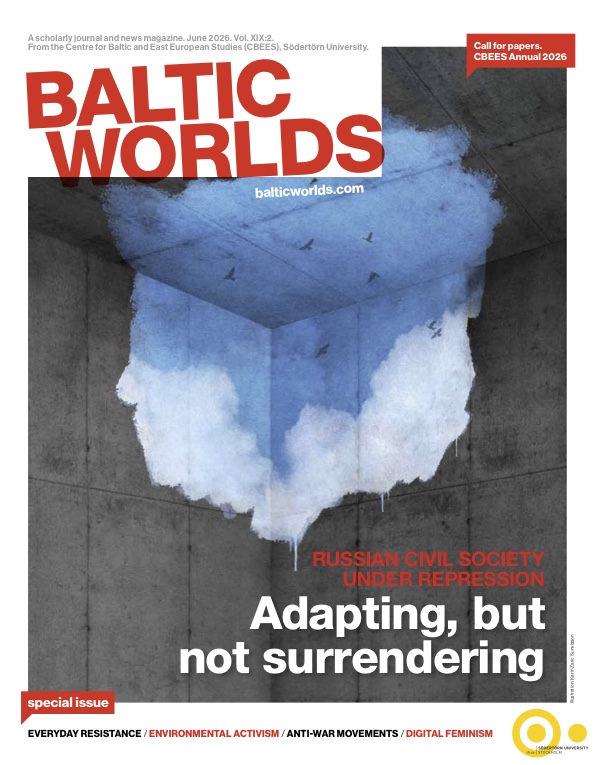 Issue 2026, 2: Download.
 Baltic Worlds covers; the Baltic Sea Region, Eastern Europe, Russia, CentralAsia, Caucasus and the Balkan area.