Features offer in-depth accounts of issues related to the region without prior peer-review process.
Even though, with the dissolution of Austria-Hungary, Galicia ceased to exist, the idea of Galicia has a kind of ghostly presence in contemporary politics. The area was incorporated in 1919—1923 in the resurrected Polish state, only to be divided twenty years later between Germany and the Soviet Union as a result of the Molotov-Ribbentrop pact. This cleaving in two endured through the “shift” of Poland westwards after the Second World War. East Galicia became part of Soviet Ukraine and thereafter of independent Ukraine.
By
Anders Hammarlund
October 3, 2011
For various reasons, Ukraine’s relationship to the Holocaust and the Jews has been overshadowed by the similar, but more striking […]
By
Ingmar Oldberg
August 1, 2011
The new virtual Gulag museum in Paris appears in many languages and transcends national boundaries.
By
Florence Fröhlig
June 30, 2011
What began in Poland, with the publication of Jan Tomasz Gross’s provocative essays, the most recent historical studies, and the research project initiated by the Polish Center for Holocaust Research, is a new phase in the public debate about the Polish nation’s relationship to the Holocaust. What is totally new is that historians and researchers in Poland are now leading the way and providing the most difficult answers to the most difficult questions.
By
Peter Johnsson
June 30, 2011
The film "For Cod’s Sake" shows the bizarre EU management of this now rare gold in an impressive way. While the Polish fisherman on his rickety cutter takes a few hundred kilograms of cod out of the sea illegally, Rickard Sollander, a Swede, is allowed to take 1.5 tons from the water each week with his extremely modern trawler. His huge net invariably catches eight tons. According to EU rules, he must throw nearly seven tons back into the sea, all dead. “You turn your back and try to think about something else”, he says sadly.
By
Thomas Borchert
June 30, 2011
After a fall in GDP of 25 percent and two and a half years of hard budget slashing, Latvia’s economy is growing again. In this moment of hope, the country is suddenly thrown into political turmoil. Corruption has grown out of hand, and the Latvian president has decided that enough is enough.
By
Arne Bengtsson
June 30, 2011
While negotiations and controversies about the future of Linnahall in Talinn continue, people, not only traceurs but also beer-drinking youths and lovers, are mounting an opposition to the visions of investors and planners of remaking the space into an attractive enclave for the affluent.
By
Beate Feldmann
June 30, 2011
Is Russia part of Europe? Russians answer this question in different ways. For many of them, Russia is not Europe but Eurasia, which is an alternate unit of civilization. I do not share this opinion, writes Adam Michnik here.
By
Adam Michnik
May 13, 2011
Drakulić claims that top-down governance, which - she argues - started the war, is also the path to reconciliation in the region: Without the whipping up of nationalist emotions, purposefully and with the political will to do so, it would not be possible to start wars. It is only logical, then, that addressing people’s emotions is equally important as a way out of nationalism.
By
Slavenka Drakulic
May 13, 2011
Ragnvald Blix was both a cartoonist and author. Blix declared his manifesto: “To be a good cartoonist, you have to be cold as ice in the face of all ideas and all persons. Sympathies and antipathies do not exist. First and foremost, you must have no respect for authority, tradition, or anything else in Heaven or on Earth, or even for anything in Hell.” Blix continued ridiculing fascism, Nazism, and communism in his satirical cartoons.
By
Rikke Petersson
May 2, 2011

 Issue 2026, 1:
 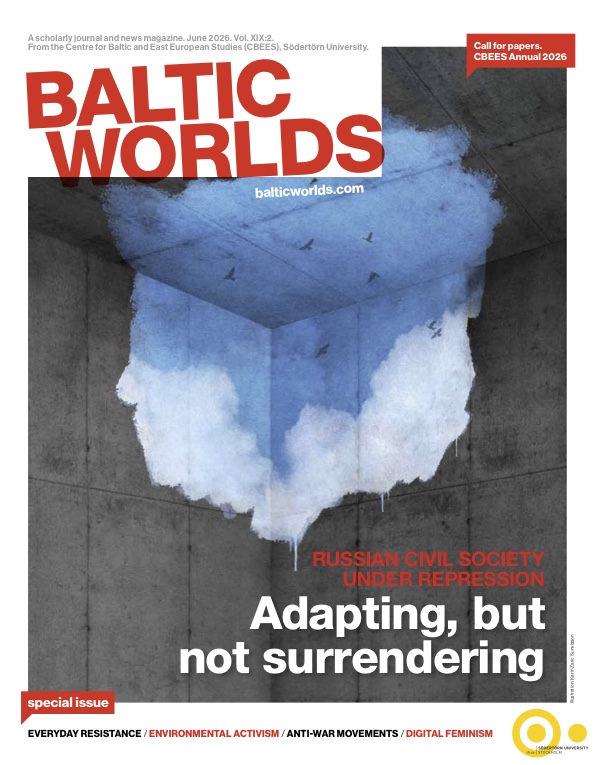 Issue 2026, 2:
  Baltic Worlds covers; the Baltic Sea Region, Eastern Europe, Russia, CentralAsia, Caucasus and the Balkan area.