Minsk. Kurapaty. Khatyn.
Kurapaty and Khatyn: two places along the same road, the number three highway from Minsk to Vitebsk. Two places that are about history. But also about how history is used.

A scholarly journal from the Centre for Baltic and East European Studies (CBEES) Södertörn University, Stockholm.
 Issue 2026, 1: Download.
Features offer in-depth accounts of issues related to the region without prior peer-review process.
Kurapaty and Khatyn: two places along the same road, the number three highway from Minsk to Vitebsk. Two places that are about history. But also about how history is used.
Professor of mathematics, Ulf Persson, visits the legandary Steklov Institute, the flagship of pure mathematics in the Soviet Union. Russian mathematicians have long inspired awe among their Western colleagues. A second-rate Soviet mathematician was usually considered first-rate by Western standards.
Region-building around the Baltic Rim is not simply proceeding along a continuous path: it has entered a new phase. The region’s agenda has become increasingly outwardly oriented, argues the author.
A specter is haunting the Baltic States. It appears in different forms and with different names: Air Baltic, Mažeikių Nafta, Lattelecom, Ventspils Nafta, Latvenergo, Estonian Air. With their independence in 1991, the Baltic nations inherited enormous state enterprises, built to serve large parts of the Soviet Union, and thus too big for small republics like Lithuania, Latvia, and Estonia.
There was a time, only a few decades ago, when Northern Europe was the object of intensified strategic attention. Today, by comparison, the Baltic area seems a fairly tranquil place. Is it in fact too tranquil? That is worrisome for the once-again independent three republics on the eastern shores of the Baltic Sea.
In Michael Madsen’s film Into Eternity, the safe storage of nuclear waste has gone awry: distant descendants of ours from a civilization unknown to us have penetrated the defenses of Onkalo, the final repository of nuclear waste on Finland’s west coast.
The Decision-in-Principle (DiP) in 2002 to build a fifth nuclear power plant made Finland the center of attention when the nuclear power industry began to see its chances. Finland is the first country to have made a decision on final storage of nuclear waste. Finland is also the only Nordic country in which energy consumption is rising.
The ArtPole festival has become one of the most well known festivals in Ukraine over the course of its five-year history. In the past the festival exclusively featured traditional Ukrainian folk music as it developed and flourished during the last decade; now the focus is on what may be called the new urban folk music.
The eleven-day Baltic Sea Festival in Stockholm is supposed to build bridges and tie cultural bounds.
Today, Pomerania is divided between Germany and Poland, but the German and Polish populations have few factors in common that might serve to unify them. Nevertheless, in some respects the region is gradually becoming more interwoven. To study the development of these cross-border flows, a series of interviews is being conducted as part of a on-going research project
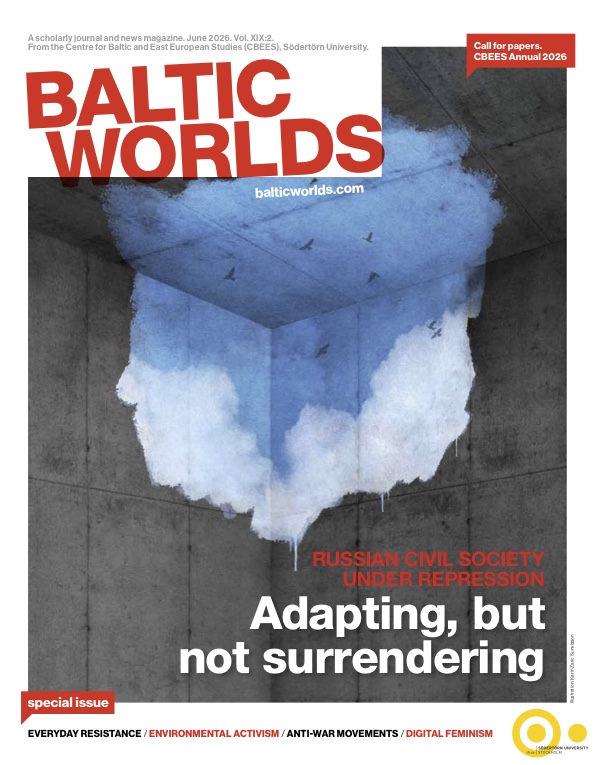 Issue 2026, 2: Download.
 Baltic Worlds covers; the Baltic Sea Region, Eastern Europe, Russia, CentralAsia, Caucasus and the Balkan area.