Peer-reviewed articles have all been through a peer-review process. We practice double-blind peer-review. All material is reviewed by two independent specialists at least at post-doc level. A prerequisite for publishing scientific articles in Baltic Worlds is that the article has not already been published in English elsewhere. If an article is simultaneously being considered by another publication, this should be indicated when submitting.
The practice of mandatory recourse to linguistic experts’ opinions in cases pertaining to racial, ethnic, and other types of hatred and hostility, has caused the vast development of different approaches to the analysis of the texts. During last ten years, numerous methods for identifying “verbal extremism” have been recommended. It has been suggested that the evolution of Russian legal linguistics has not yet resulted in a “common theoretical basis for linguistic investigation in court that is shared by all experts”. The current status of the proposed approach to studying texts in order to identify “hostility and hate” demonstrates both the difficulty of establishing a general theoretical basis for forensic linguistics as a whole and the contradictions that arise in applying the numerous methodologies that exist in Russian science for studying “extremist” texts.
By
Dmitry V. Dubrovskiy
October 25, 2016
This paper presents the constitution of the “political” in two cases of political squatting in Hungary after 1989: the Centrum squatter group’s occupations in 2004–2006, and the homeless advocacy group The City is for All’s occupations in 2013–2014.
By
Agnes Gagyi
June 23, 2016
This paper explores the scope, causes, flourishing, and decline of squatting in Lithuanian society during the period of 1990-2002. Drawing on 16 in-depth interviews conducted with squatters in Vilnius, newspaper articles and legal documents, this paper shows that squatters made contributions to the city with their cultural capital, creating local subcultures and making the urban space more attractive.
By
Jolanta Aidukaite
June 23, 2016
The case of late Soviet and early post-Soviet squatting helps to elucidate how squatting is structured in regard to public-private relations and what the political component of squatting can be in a society not based on private property. The self-help occupying of vacant flats was not restricted to subcultures.
By
Tatiana Golova
June 23, 2016
Two Polish cities, Warsaw and Poznań, are studied in the article to examine how external structures are handled and used by squatters in these two settings. The aim is to analyze opportunity structures that condition the emergence and development of squatting and how squatters respond to and utilize these opportunities.
By
Dominika V. Polanska and Grzegorz Piotrowski
June 23, 2016
The predominantly unfavorable and restrictive socio-spatial conditions of squatting in Prague, have been shaped by the socialist past and post-socialist transformation. Temporarily facilitated by the fluid and liberalized nature of the early post-1989 era, the emergence of the first squats in Prague was inspired by the international squatters’ movement, and alienated from the enthusiastic acceptance of capitalism by Czech society.
By
Michaela Pixova and Arnost Novak
June 23, 2016
This article examines the construction of Narva and local spatial identity formation from the perspective of Russian-speaking Estonians in Narva, as elucidated in their own discourses and perceptions.
By
David J. Trimbach
June 23, 2016
This article explores how several key museums discuss the Holocaust in the wider context of Estonian history, including Estonia’s traumatic past under Soviet occupation. It is argued that the Estonian narrative of victimhood still dominates collective memory as displayed in museums, and Jewish suffering in the Holocaust takes a much less prominent place despite an increase in Holocaust awareness among the Estonian political elite since the country’s “return to the West”.
By
Paul Oliver Stocker
June 16, 2016
Abstract: The purpose of this article is to test an explanation for the atypical nature of the development of demesne lordship in western Estonia1 in early modern times. My proposed hypothesis concerning the development of early modern demesne lordship in the Baltic Sea region takes as its starting point the impact on private land ownership in Europe caused by governments’ extension of their political powers and increasing conflicts. The twenty-first-century discourse about raison d’état has here been broadened with additional arguments about the role of the early modern military state in the development of demesne lordship in the Baltic Sea region, following the reasoning behind Braudel’s and Wallerstein’s center–periphery models.
By
Magnus Berencreutz
May 30, 2016
The paper examines the relationship between the degree of the integration of financial regulation and the level of economic development. The main finding is that factors such as population and economy size have negative effects on financial regulation integration, while quality of governance, the size of the non-banking financial market sector and regulatory quality have a positive impact.
By
Maria Chernova and Alexander Abramov and Alexander Radygin
November 19, 2015

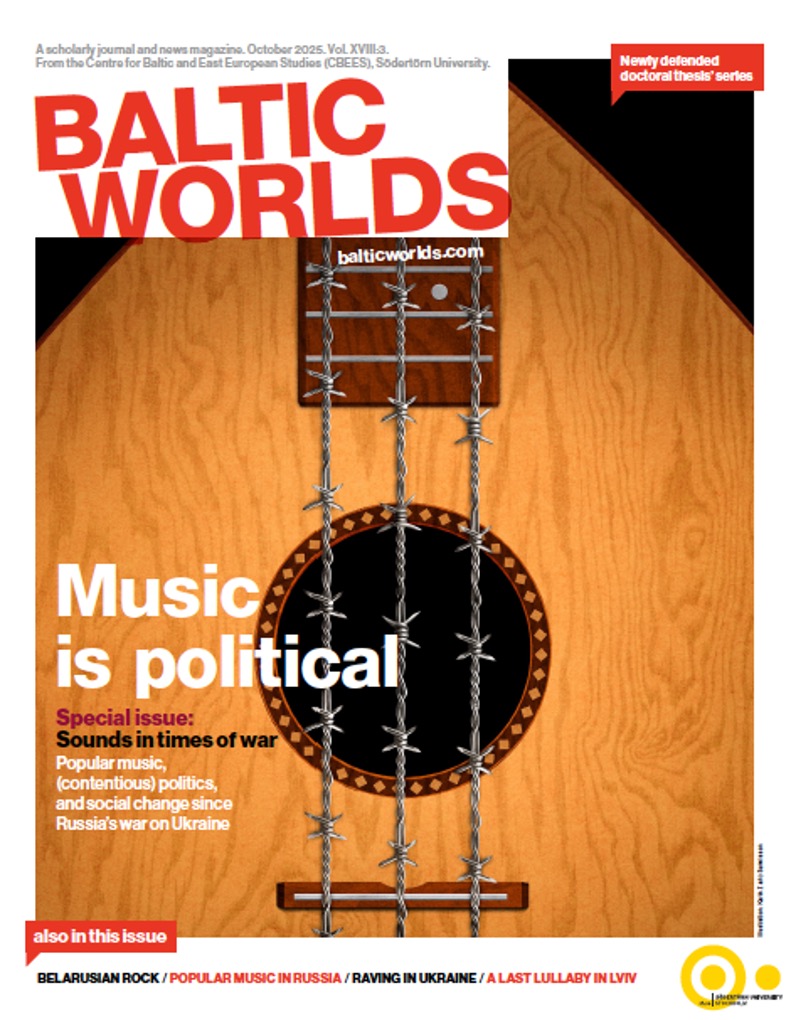 Issue 2025, 3:
  Baltic Worlds covers; the Baltic Sea Region, Eastern Europe, Russia, CentralAsia, Caucasus and the Balkan area.