Peer-reviewed articles have all been through a peer-review process. We practice double-blind peer-review. All material is reviewed by two independent specialists at least at post-doc level. A prerequisite for publishing scientific articles in Baltic Worlds is that the article has not already been published in English elsewhere. If an article is simultaneously being considered by another publication, this should be indicated when submitting.
Although there have been great changes in the lives and livelihoods of people in the Baltic Sea archipelago during the last century, the lives of local inhabitants are still strongly linked to the local nature, culture, and history. Customary use of local ecosystems provides resources for the household, but it is also an important carrier of local identity, culture, and way of life. Fishing, hunting, and harvesting of berries, mushrooms, etc., function as cultural and intergenerational glue for the local community context even today. This paper reflects upon the cultural and social importance of the small scale and informal economy in the Swedish Baltic Sea archipelago for sustainability living local communities, some of the present challenges to its continuation, and the potentials for positive change. It is based on participatory research on customary use of biodiversity and local and traditional knowledge in the Kalix Archipelago in the northern Bothnian Bay and in the Sankt Anna Archipelago in the Baltic Sea proper.
By
Håkan Tunón, Marie Kvarnström, Joakim Boström and Anna-Karin Utbult Almkvist
June 17, 2019
This article focuses on the blackmailing of the Jews during the Nazi occupation of Lviv, Galicia. Despite a considerable amount of attention from historians to the Shoah in Lviv, this issue is still one of the few unstudied problems. Based on the carefully collected source materials, the author reconstructs the main features of this phenomenon, its evolution, its local specifics, and the main types of blackmailers and the methods of their activities.
By
Taras Martynenko
March 7, 2019
In less than 15 years, activist journalists have enjoyed a vertiginous career in Ukraine, from a persecuted and marginal minority to one of the most influential social groups and key actors in the political field. This was certainly facilitated by the technological shift that made media work more cost-efficient and less resource-demanding. But the transformation could also only happen because the culture had a long tradition of journalists taking a stand against authorities, and the idealized figures of an honest publicist, a passionately engaged writer, and a resistance fighter were familiar and readily accepted by the public.
By
Roman Horbyk
March 7, 2019
In Romani Studies, the second half of the 19th century witnessed a great migration of the Roms from the two Rumanian provinces of Wallachia and Moldavia as a result of the abolition of slavery (also called “Emancipation”, which ushered in the massive liberation of the Romani slaves in 1856 at the initiative of the Prime Minister Mihail Kogălniceanu). However, this period is still poorly explored, particularly from a linguistic and ethnologic point of view.
By
Julieta Rotaru
September 6, 2018
The Roma migrations, which are becoming more topical today, have prompted policies giving attention to issues of Roma inclusion first in the East, but then also in the West. Inclusion policies have, by and large, failed to improve the situation of Roma communities. In order to achieve a better understanding of these issues, we argue that attention should be paid to Roma as distinct ethnic communities, but that are still integral parts of their respective civic nations
By
Elena Marushiakova and Vesselin Popov
September 6, 2018
This article discusses Yugoslavia’s ethnic and Romani policies and the activities for maintaining common cultural practices among Romani writers and activists after the dissolution of the federation as a political entity, and it examines literary activities and narratives related to Yugoslav topics and the way in which they sustain and demonstrate Romani (post-)Yugoslav belonging. The article argues that a sense of Yugoslav belonging and cooperation has been maintained among Romani writers and activists with explicitly positive references to the legacies of Yugoslavia. These tendencies contrast with the official post-Yugoslav political discourse among the rest of the ethnic and national communities’ leaderships, which have been to a great extent built on criticizing Yugoslav policies and ideologies.
By
Sofiya Zahova
September 6, 2018
The focus of this work is on the position of Roma girls/women who have a different set of privileges as well as rights and often experience multiple forms of discrimination in relation to a number of categories of difference. Specifically, the life trajectories of three Roma women living in poverty and experiencing different levels of discrimination are presented and examined. Highlighting the multiple positioning that constitutes their everyday life, these life trajectories show that gender, ethnicity, socio-economic status and other categories of difference are not distinct and isolated realms of experience and that the impact of their intersections needs to be foregrounded. In sum, these brief excerpts undeniably show how discrimination has consistently denied these Roma women personal development, self-esteem, decent living conditions, livelihood opportunities and institutional services.
By
Lynette Šikić-Mićanović
September 6, 2018
This paper deals with the moment in 1948–1949, when the representative organization of the Romanian Roma unsuccessfully tried to obtain for them from the communist authorities the status of a national minority. For the Romanian Communist Party, the Roma represented a population that had to be brought into its sphere of influence. Discussions on the establishment of the People’s Union of the Roma lasted for several months but eventually led to the rejection of the request of the Roma leaders. The institutions involved in these discussions created documents, some of which are kept in the archives and allow us to study this moment in time.
By
Viorel Achim
September 6, 2018
Members of the Artists Colony were participants in the transformation processes, regardless of the functions they performed in such processes, the intensity of contacts with workers at the Gdańsk Shipyard, or the subject of their artistic works. Artists from the Colony identified the area of the former shipyard as a space of their own experience, memory, and history.
By
Agneiszka Kozik
June 18, 2018
In the analysis of how self-organized groups work, act, and cooperate in young democracies like Albania, it is shown that different financial, human, technical, and political factors determine to what degree the self-organized groups are dependent on the political opportunity system in order to achieve their goals.
By
Gilda Hoxha
June 18, 2018

 Issue 2026, 1:
 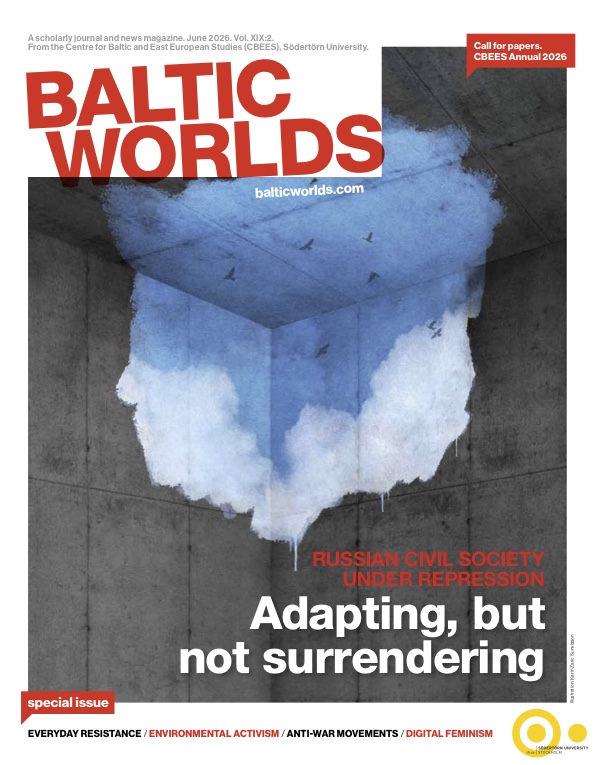 Issue 2026, 2:
  Baltic Worlds covers; the Baltic Sea Region, Eastern Europe, Russia, CentralAsia, Caucasus and the Balkan area.