This essay reflects on the issues of the past, memory practices, decolonisation, and reconciliation, as discussed during the 2024 CBEES Summer School. The author applies these reflections to think of her own research on LGBTQ+ Ukrainians’ wartime embodied relationalities, and how the discussed issues might manifest for her studied group. She further reflects on importance of positionality in discussions on postwar memory.
Essay by
Eugenia Seleznova
October 7, 2024
This essay explores the intersection of personal reflection and Ukraine’s collective journey towards reconciliation amid the ongoing war with Russia. Set against the peaceful backdrop of a CBEES Summer School, the author delves into the challenges of memory construction, highlighting Ukraine’s historical complexities and the importance of inclusive memorialization in shaping a unified postwar identity. The essay draws comparisons with Eastern Europe’s post-communist memory work, emphasizing reconciliation and social cohesion.
Essay by
Eva Ievgeniia Babenko
October 2, 2024
The CBEES Summer School 2024 “The Return of History: Memory, War and the End of the "Post” is a specialized course that delves into in-depth studies of central theories of cultural memory.
By
Ninna Mörner
September 10, 2024
CBEES Annual Report 2020: Constructions and Instrumentalization of the Past. A Comparative Study on Memory Management in the Region, Eds. Ninna Mörner et al., (Södertörn University: Stockholm, 2021). 186 pages
By
Per-Arne Bodin
January 24, 2022
The roundtable at CBEES 27 March, provided the space for an academic debate in which scholars and experts could present the findings of their research and share their views on the current events in Ukraine with a broader audience.
By
Julia Malitska, Olena Podolian & Yuliya Yurchuk
April 28, 2015
The critical review of cosmopolitanism as a historical, philosophical, and moral concept was afforded a special place on the agenda, but presentations oriented towards practical policy applications of cosmopolitan ideas were also represented, at the conference arranged by CBEES at Södertörn University November 24—26 "Cosmopolitanism in a Wider Context: Conceptualizing Past and Present".
By
Markus Huss
April 12, 2012
“Market Reform and Socio-Economic Change in Russia” was the subject of an ambitious full-day seminar held October 6, focusing on the period since the fall of the Soviet Union.
By
Per Jönsson
January 16, 2012
Privatizations in states with no actual market economy obviously become legislative matters. For instance, matters related to property rights may need to be re-regulated. The role of EU law in privatization was brought up at the conference. The law does not regulate privatizations, but contains a great deal on liberalization, which in turn affects privatization. Matters related to the alignment of legislation have made law more interesting for all of us who usually categorize legislation among the restrictions.
By
Björn Rombach
October 3, 2011
“Why is there no happiness in the East?” was the, according to many, provocative title of a conference put on by CBEES and Södertörn University September 8–10 of this year.
The organizers of the conference, Teresa Kulawik, Renata Ingbrant and Youlia Gradskova, wanted to bring together feminist scholars for a discussion about conditions facing feminism in the East and in the West after the Berlin Wall, as well as the role of the EU and politics in the development of feminism.
By
Ninna Mörner
September 28, 2011
Baltic Worlds Roundtable illuminates the tremendous changes that Russian social and economic life has undergone due to the introduction of market economy after the fall of state socialism. The Rondtable takes place October 6, 2011.
By
Ninna Mörner
August 8, 2011

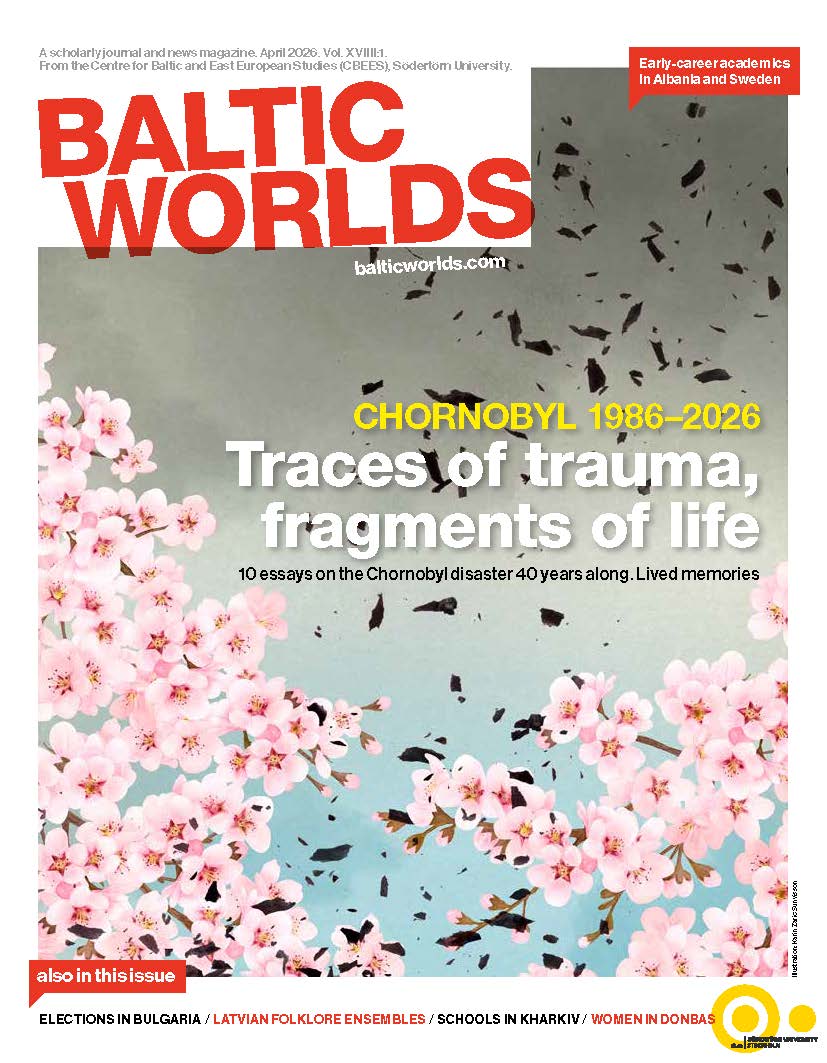 Issue 2026, 1:
 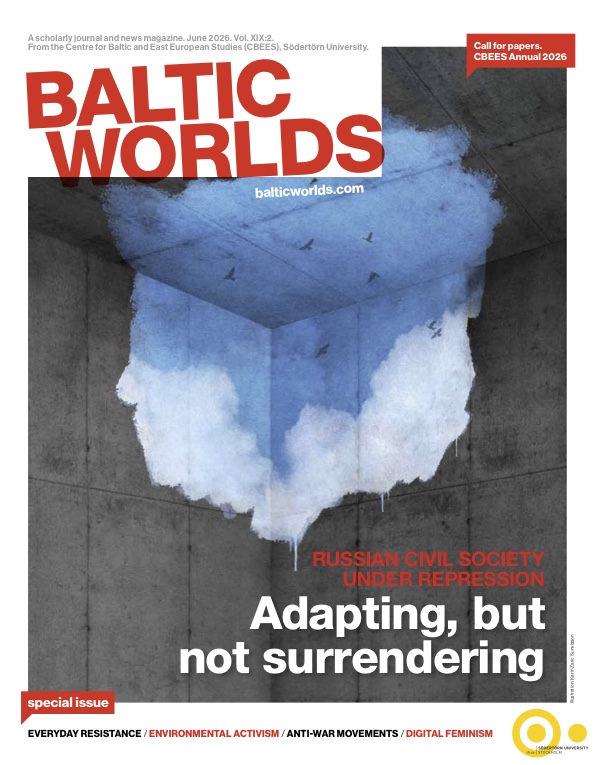 Issue 2026, 2:
  Baltic Worlds covers; the Baltic Sea Region, Eastern Europe, Russia, CentralAsia, Caucasus and the Balkan area.