Douglas Mattsson (140) To Praise Disgrace. Islamic Semiotic Resources in Turkish Black Metal
Abstract [en] Since its inception in the late 1980s, the Turkish black metal scene has gone through significant changes. Whereas […]

A scholarly journal from the Centre for Baltic and East European Studies (CBEES) Södertörn University, Stockholm.
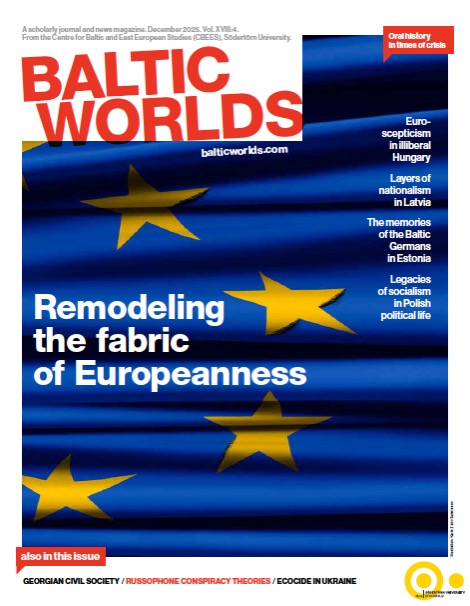 Issue 2025, 4: Download.
Abstract [en] Since its inception in the late 1980s, the Turkish black metal scene has gone through significant changes. Whereas […]
Abstract [en] Over the course of the past century, European agriculture has transitioned from small-scale, manual farming to more mechanised, […]
That music may connect well with violence contradicts common understandings of music being a force of good which brings people together. While acknowledging that music can harmonize social relations, this special issue highlights the idea that music can equally justify war and ignite conflicts. Exploring music from such a matter-of-fact viewpoint shifts scholarly attention to the relationship between music, politics, and societal dynamics. This special issue does so in the context of Russia’s war on Ukraine.
Alesia Rudnik is a political scientist based in Sweden, originally from Belarus. Her research has been published in journals such as Europe-Asia Studies, Communist and Post-Communist Studies, Media, War & Conflict and Internet Policy Review. She is also a regular contributor to Baltic Worlds (see for example the co-authored article with Malin Rönnblom in BW, vol. 17, no. 4, 2024). She currently serves as the Director of the Center for New Ideas, an independent Belarusian think tank operating in exile. She previously led a Belarusian diaspora organization in Sweden and was awarded “European of the Year 2022” in Sweden for her civic engagement. Rudnik’s academic work focuses on the relationship between people and technology in the context of political protests under authoritarian regimes. On September 12, 2025, she defended her doctoral dissertation in political science at Karlstad University, titled Machinery of Dissent: People and Technology in Political Protests in Autocracies. In conversation with Baltic Worlds, Dr. Rudnik reflects on research in Sweden concerning Belarus, the 2020 Belarusian protests, and the role of digital platforms in mobilizing protest movements within authoritarian contexts.
Network of Concerned Historians Annual Report 2025, contains news about the domain where history and human rights intersect, in particular about the censorship of history and the persecution of historians.
Sadly, Markus Huss, member of the Scholarly Advisory Board and former Chair of the board, is no longer with us. Markus Huss was a muchappreciated scholar, beloved friend and colleague and is deeply missed.
This special theme focuses on a regional context, whose academic history has so far been viewed primarily from a “Western” perspective. We argue, however, that the universities in the area that was supposed to be “integrated” after 1989 under the banner of Europeanisation have a history of their own. This history is shaped not only by different layers of imperial and national history, but above all by the shared experience of decades of socialist rule with its own ideas about the function of the university under socialism. The authors of this special theme present case studies from different universities in the socialist countries of Central, Eastern, and Southeast Europe and their successor states. It aims to critically assess concepts and practices of “university” within the scientific systems of these (post-)socialist countries on the one hand, and the reciprocal effects that have occurred in the exchange with political or economic discourses on the other.
CBEES Summerschool 2025, August 18-23 is now open for application. Apply before March 21.
With deep sadness, we have learnt of the sudden death of our colleague and friend Markus Huss. 2009, we all […]
The section is an invitation to think further on the possibilities of implementing decolonial theory in the memory field of the countries that were dominated by the Soviet Union.
 Baltic Worlds covers; the Baltic Sea Region, Eastern Europe, Russia, CentralAsia, Caucasus and the Balkan area.