Advertise in printed Baltic Worlds
Your advertisement in Baltic Worlds reaches a specialised, academic target group. Baltic Worlds contributes to the dissemination of knowledge about […]

A scholarly journal from the Centre for Baltic and East European Studies (CBEES) Södertörn University, Stockholm.
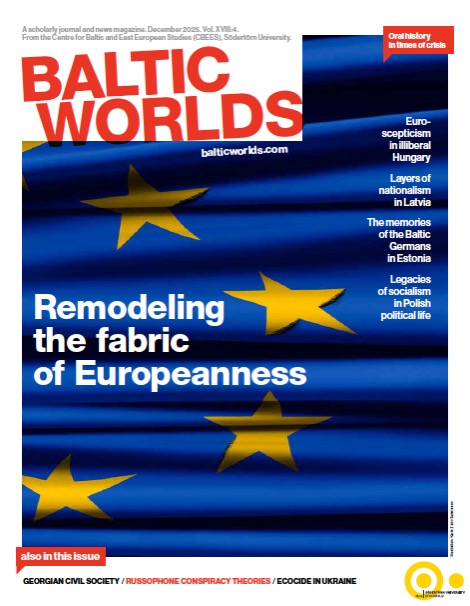 Issue 2025, 4: Download.
Your advertisement in Baltic Worlds reaches a specialised, academic target group. Baltic Worlds contributes to the dissemination of knowledge about […]
An interview with Russian human rights activist Elena Vasilyeva, founder of the group “Load 200 from Ukraine to Russia.” that gathers information about soldiers killed in military operation zones abroad and then transported home. The article contains statements that reflect the views of the author and the interviewed, not necessary the view of Baltic Worlds'.
During the May 25 presidential election, the leaders of Svoboda and the Right sector had only 1, 7 percent of support. This is, according to Lyudmyla Pavlyuk, professor in journalism in Ukraine, an argument that the Russian official propaganda about Ukraine’s “fascism” is a way to legitimize Russian policies of occupation and aggression.
The ambiguity of the 1920s Ukrainianization is well known among its scholars. A curious fact is that was becoming less intense and effective where the initial positions of the Ukrainian were weaker. Donbas was specifically one such region. If Ukraine is a borderland, Donbas is a borderland multiplied by itself, notes the author and further claims that "Donbas will retain its hybridity no matter the outcome of the current unrest. Still, the volatile situation brings not only risks but also yet another chance for belated modernisation."
BECAUSE OF THE direct Russian intervention, the territorial integrity and independence of the Ukrainian state is at stake. But as long as business and politics are as intimately intertwined as they are today, any serious reform in Ukraine in line with the ideological foundation of the protest movement will be a an exceptionally challenging task.
It is difficult to identify why Maidan took a violent, military turn. Among the main possible reasons we might first note the inability of three opposition leaders (namely Vitaliy Klychko, Arseniy Yatsenyuk, and Oleh Tyahnybok) to settle on just one Maidan leader, and the absence of any visible, concrete accession to the demands of the protesters by the authorities.
"Euromaidan is an anti-amnesia action of a postcolonial nation aimed against a restored post-Soviet space", posts Lyudmyla Pavlyuk, professor in journalism in Ukraine.
A message on situation in Ukraine from Ukrainian writer Yuri Andrukhovych. (translated by Vitaly Chernetsky, via Andrij Bondar)
Maidan 2.0. Letter from the Ukrainian PEN Club, Kyiv January 22 2014.
Maidan 2.0. Letter from Kyiv the 10th of December 2013.
 Baltic Worlds covers; the Baltic Sea Region, Eastern Europe, Russia, CentralAsia, Caucasus and the Balkan area.