During the May 25 presidential election, the leaders of Svoboda and the Right sector had only 1, 7 percent of support. This is, according to Lyudmyla Pavlyuk, professor in journalism in Ukraine, an argument that the Russian official propaganda about Ukraine’s “fascism” is a way to legitimize Russian policies of occupation and aggression.
By
Lyudmyla Pavlyuk
June 5, 2014
The ambiguity of the 1920s Ukrainianization is well known among its scholars. A curious fact is that was becoming less intense and effective where the initial positions of the Ukrainian were weaker. Donbas was specifically one such region.
If Ukraine is a borderland, Donbas is a borderland multiplied by itself, notes the author and further claims that "Donbas will retain its hybridity no matter the outcome of the current unrest. Still, the volatile situation brings not only risks but also yet another chance for belated modernisation."
By
Roman Horbyk
May 19, 2014
BECAUSE OF THE direct Russian intervention, the territorial integrity and independence of the Ukrainian state is at stake. But as long as business and politics are as intimately intertwined as they are today, any serious reform in Ukraine in line with the ideological foundation of the protest movement will be a an exceptionally challenging task.
By
Hanna Söderbaum
April 28, 2014
It is difficult to identify why Maidan took a violent, military turn. Among the main possible reasons we might first note the inability of three opposition leaders (namely Vitaliy Klychko, Arseniy Yatsenyuk, and Oleh Tyahnybok) to settle on just one Maidan leader, and the absence of any visible, concrete accession to the demands of the protesters by the authorities.
By
Alla Marchenko Sergiy Kurbatov
April 28, 2014
"Euromaidan is an anti-amnesia action of a postcolonial nation aimed against a restored post-Soviet space", posts Lyudmyla Pavlyuk, professor in journalism in Ukraine.
By
Lyudmyla Pavlyuk
January 24, 2014
A message on situation in Ukraine from Ukrainian writer Yuri Andrukhovych.
(translated by Vitaly Chernetsky, via Andrij Bondar)
By
Yuri Andrukhovych
January 24, 2014
Maidan 2.0. Letter from the Ukrainian PEN Club, Kyiv January 22 2014.
By
Mykola Riabchuk
January 23, 2014
Maidan 2.0. Letter from Kyiv the 10th of December 2013.
By
Mykola Riabchuk
January 23, 2014
“Weber talks of a Tischgemeinschaft, where you can eat and drink and pray. At the table people, or rather the male population, got to know each other, have faith in one another. Coming together, sharing bread and views, wine and troubles, without risk of being beaten, but with the prospect of enhancing one’s knowledge and wellbeing — what is this, if not tolerance? It wouldn’t be totally wrong to see an Eranos conference as a Weberian Tischgemeinschaft.".
By
Anders Björnsson
August 8, 2013
Comment on Pussy Riot: Reflections on Receptions Again, Samutsevich’s testimony evokes a similarity between the Pussy Riot case and women […]
By
Nadezda Petrusenko
December 20, 2012

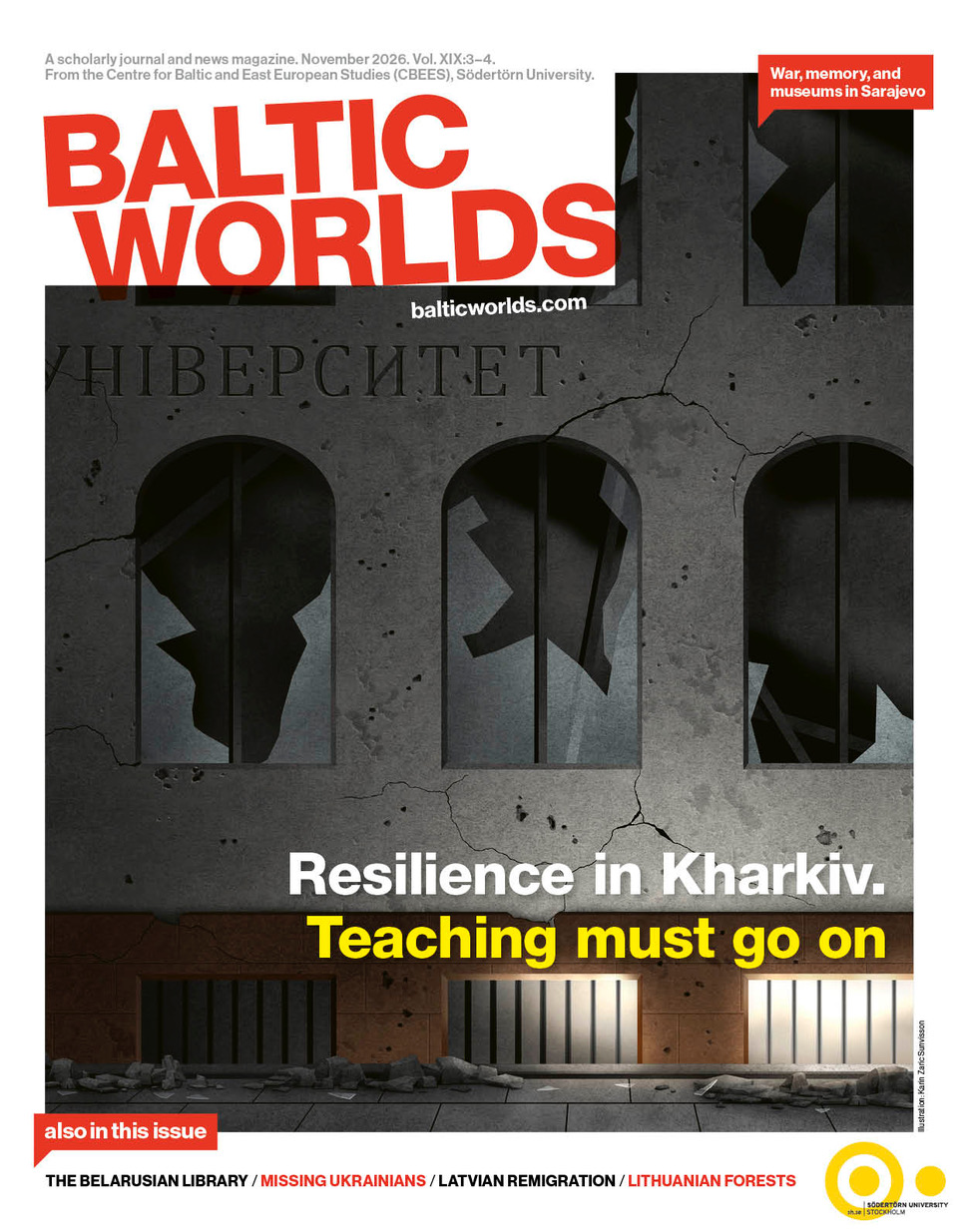 Issue 2026, 3-4:
 Baltic Worlds covers; the Baltic Sea Region, Eastern Europe, Russia, CentralAsia, Caucasus and the Balkan area.